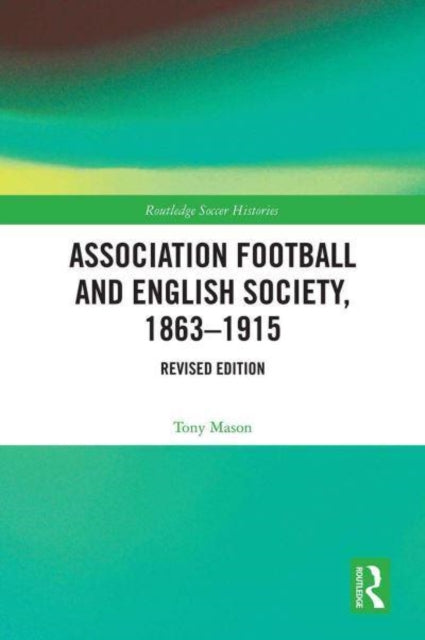
Tony Mason
Association Football and English Society, 1863-1915 (revised edition)
Association Football and English Society, 1863-1915 (revised edition)
💎 Earn 689 Points (£6.89) on this item.
We can order this item for you. Delivery usually takes about 4 to 6 weeks.
This item is not held in our immediate stock. We will order it for you after checkout.
Estimated delivery: About 4 to 6 weeks
YOU SAVE £8.18
- Condition: Brand new
- UK Delivery times: Usually arrives within 2 - 3 working days
- UK Shipping: Fee starts at £2.39. Subject to product weight & dimension
Bulk ordering. Want 15 or more copies? Get a personalised quote and bigger discounts. Learn more about bulk orders.
Couldn't load pickup availability
- More about Association Football and English Society, 1863-1915 (revised edition)
In the late 19th and early 20th centuries, association football rapidly developed in Britain, reflecting and reshaping society. This updated edition, by Tony Mason, emphasizes the amateur-professional divide, social class, and mass spectatorship, making it a valuable resource for understanding the global phenomenon of football.
Format: Hardback
Length: 236 pages
Publication date: 16 March 2023
Publisher: Taylor & Francis Ltd
Association football, as it rapidly developed in the late-nineteenth and early-twentieth centuries, not only reflected British society but also played a significant role in shaping it. In this newly released edition of Tony Mason's seminal account of the game's rise, the focus is on key issues such as the amateur-professional divide, social class, and mass spectatorship. These aspects are considered fundamental in understanding the current global phenomenon of association football. To complement this classic text, Dilwyn Porter has provided a brand new introduction, adding fresh insights and perspectives to enhance our understanding of the game's evolution.
The late-nineteenth and early-twentieth centuries witnessed the rapid development of association football, a sport that not only reflected but also shaped British society. This transformation was driven by various factors, including the rise of industrialization, urbanization, and the expansion of the middle class. The game's popularity grew exponentially, attracting millions of spectators to football stadiums across the country.
One of the defining characteristics of association football during this period was the amateur-professional divide. While the game had always been played by individuals from different social backgrounds, the professionalization of the sport began to take shape in the late 19th century. This divide created a schism between those who played the game for leisure and those who pursued it as a career. The professional players were often paid higher salaries, had more training opportunities, and were subject to stricter regulations and rules.
The amateur-professional divide had significant implications for the game and society as a whole. On the one hand, it allowed for the development of a skilled and dedicated professional player base, which contributed to the improvement of the game's quality and competitiveness. On the other hand, it created tensions and divisions within the football community, with some players and fans arguing that the professionalization of the sport was undermining the spirit of the game and devaluing the amateur players' contributions.
Another important aspect of association football during this period was social class. Football had always been a sport that was closely associated with working-class communities, and the game's popularity continued to grow among these groups. However, as the professionalization of the sport progressed, it became increasingly accessible to upper-class individuals as well. This led to the development of a new class of football fans, who were often wealthier and more educated than their working-class counterparts.
The social class of football fans had a significant impact on the game and society as a whole. For example, the development of a new class of football fans who were wealthier and more educated led to the expansion of the football industry and the creation of new commercial opportunities. This, in turn, led to the growth of football clubs, with new stadiums and facilities being built and new teams and leagues being formed.
Furthermore, the social class of football fans also had implications for the game's rules and regulations. As the upper-class fans became more influential, they began to demand more sophisticated and complex rules, which were often implemented to appeal to their tastes and preferences. This led to the development of new styles of play, such as the "tiki-taka" style of play that was popularized by Spanish teams in the early 2000s.
Mass spectatorship was another significant aspect of association football during the late-nineteenth and early-twentieth centuries. The game's popularity grew exponentially, attracting millions of spectators to football stadiums across the country. This led to the development of new forms of entertainment and leisure, such as football-themed pubs and clubs, and the emergence of football as a cultural phenomenon.
Mass spectatorship had a profound impact on the game and society as a whole. For example, it helped to create a sense of community and identity among football fans, who shared a common interest in the sport. It also helped to promote social and economic development, as football stadiums and other football-related infrastructure were often used as a catalyst for urban regeneration and economic growth.
However, mass spectatorship also had its downsides. For example, it led to the development of hooliganism and violence, as some football fans became increasingly aggressive and violent towards opposing teams and fans. This led to the introduction of new security measures and regulations to protect the safety of football fans and players.
In conclusion, association football, as it developed rapidly in the late-nineteenth and early-twentieth centuries, reflected British society and helped to reshape it. The amateur-professional divide, social class, and mass spectatorship were all fundamental to our understanding of what is now a global phenomenon. Dilwyn Porter's new introduction adds fresh insights and perspectives to complement this classic text, enhancing our understanding of the game's evolution and its impact on society.
Weight: 650g
Dimension: 234 x 156 (mm)
ISBN-13: 9781032073842
UK and International shipping information
UK and International shipping information
UK Delivery and returns information:
- Delivery within 2 - 3 days when ordering in the UK.
- Shipping fee for UK customers from £2.39. Fully tracked shipping service available.
- Returns policy: Return within 30 days of receipt for full refund.
International deliveries:
Shulph Ink now ships to Australia, Belgium, Canada, France, Germany, Ireland, Italy, India, Luxembourg Saudi Arabia, Singapore, Spain, Netherlands, New Zealand, United Arab Emirates, United States of America.
- Delivery times: within 5 - 10 days for international orders.
- Shipping fee: charges vary for overseas orders. Only tracked services are available for most international orders. Some countries have untracked shipping options.
- Customs charges: If ordering to addresses outside the United Kingdom, you may or may not incur additional customs and duties fees during local delivery.