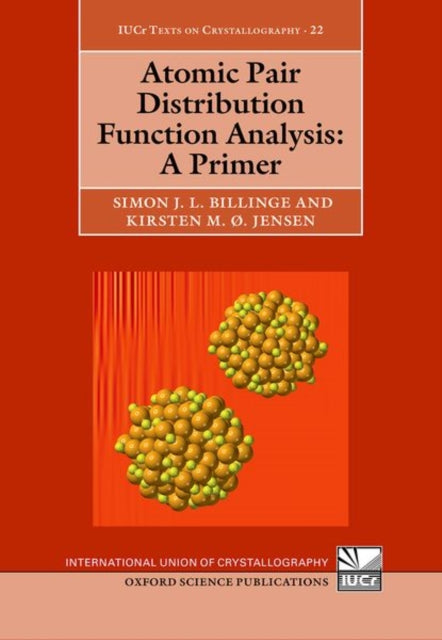
Prof SimonBillinge,Assoc. Prof KirstenJensen
Atomic Pair Distribution Function Analysis: A Primer
Atomic Pair Distribution Function Analysis: A Primer
💎 Earn 344 Points (£3.44) on this item.
YOU SAVE £4.09
- Condition: Brand new
- UK Delivery times: Usually arrives within 2 - 3 working days
- UK Shipping: Fee starts at £2.39. Subject to product weight & dimension
Bulk ordering. Want 15 or more copies? Get a personalised quote and bigger discounts. Learn more about bulk orders.
Couldn't load pickup availability
- More about Atomic Pair Distribution Function Analysis: A Primer
The atomic pair distribution function (PDF) analysis of powder diffraction data has revolutionized its ability to yield important structural information beyond the average crystal structure of a material. It is now useful for studying the structure of nanocrystals, clusters, molecules in solution or otherwise disordered in space, nanoporous materials, and intercalated into them. This book addresses the gap in knowledge when trying to use PDF to extract structural information by modeling and guides the reader through a series of real-life worked examples to increase their independence and confidence in applying PDF methods. It is intended for graduate students and other research scientists who are new to PDF and want to use the methods.
Format: Unspecified
Length: 272 pages
Publication date: 23 November 2023
Publisher: Oxford University Press
Since the early 1990s, the atomic pair distribution function (PDF) analysis of powder diffraction data has undergone a remarkable transformation in its capability to provide valuable structural information beyond the typical crystal structure of a material. With the advent of advanced sources, computing, and algorithms, it has become an invaluable tool for studying the structure of nanocrystals, clusters, molecules in solution or otherwise disordered in space, nanoporous materials, and materials intercalated into them. Moreover, it enables the exploration of local distortions and defects in crystals. The ability to study structural changes occurring during synthesis and in operating devices in a time-resolved manner makes PDF a powerful tool for mapping heterogeneous systems. While the experimental setup is relatively straightforward, there can be a knowledge gap when attempting to extract structural information using PDF by modeling.
To address this gap, this book offers a comprehensive guide through a series of real-life worked examples that gradually increase in complexity. It is designed to empower graduate students and other research scientists who are new to PDF and wish to utilize its methods but are unsure about the next steps to get started.
The book begins by introducing the fundamental principles of PDF and its applications in materials science. It then delves into the theoretical background, computational methods, and data analysis techniques employed in PDF analysis. The authors provide detailed explanations of the various PDF models and their parameters, allowing the reader to understand the underlying principles and apply them to their research.
Throughout the book, numerous real-life examples are presented, ranging from simple systems to complex materials. Each example is accompanied by step-by-step instructions, theoretical explanations, and computational simulations to facilitate a deeper understanding of the PDF methods. The examples cover a wide range of applications, including solid-state chemistry, nanotechnology, materials science, and biophysics.
In addition to the theoretical aspects, the book emphasizes the importance of experimental techniques and data quality in PDF analysis. It provides guidance on experimental setup, data collection, and data processing, ensuring that the reader can obtain high-quality PDF data that can be effectively analyzed.
Furthermore, the book addresses the challenges and limitations of PDF analysis and provides strategies for overcoming them. It discusses the importance of choosing the appropriate PDF model, optimizing parameter settings, and dealing with experimental artifacts. The authors also provide tips and tricks for improving the accuracy and reliability of PDF results.
By the end of this book, readers will have gained a comprehensive understanding of PDF methods and their applications in materials science. They will be equipped with the knowledge and skills necessary to apply PDF to their own research and answer scientific questions related to the structure and properties of materials.
Whether you are a graduate student, research scientist, or industry professional, this book is an essential resource for anyone interested in advancing their knowledge in PDF analysis. It will serve as a valuable guide and reference for years to come.
Weight: 682g
Dimension: 177 x 253 x 22 (mm)
ISBN-13: 9780198885801
This item can be found in:
UK and International shipping information
UK and International shipping information
UK Delivery and returns information:
- Delivery within 2 - 3 days when ordering in the UK.
- Shipping fee for UK customers from £2.39. Fully tracked shipping service available.
- Returns policy: Return within 30 days of receipt for full refund.
International deliveries:
Shulph Ink now ships to Australia, Belgium, Canada, France, Germany, Ireland, Italy, India, Luxembourg Saudi Arabia, Singapore, Spain, Netherlands, New Zealand, United Arab Emirates, United States of America.
- Delivery times: within 5 - 10 days for international orders.
- Shipping fee: charges vary for overseas orders. Only tracked services are available for most international orders. Some countries have untracked shipping options.
- Customs charges: If ordering to addresses outside the United Kingdom, you may or may not incur additional customs and duties fees during local delivery.