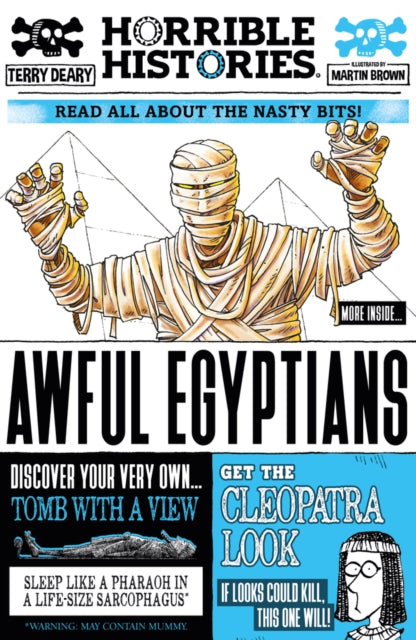
Terry Deary,Martin Brown
Awful Egyptians
Awful Egyptians
💎 Earn 24 Points (£0.24) on this item.
YOU SAVE £2.05
- Condition: Brand new
- UK Delivery times: Usually arrives within 2 - 3 working days
- UK Shipping: Fee starts at £3.89. Subject to product weight & dimension
Bulk ordering. Want 15 or more copies? Get a personalised quote and bigger discounts. Learn more about bulk orders.
Couldn't load pickup availability
- More about Awful Egyptians
The book "Horrible Histories: All the Awful Egyptians" is a fun and informative read for fans of the classic Horrible Histories style, covering topics such as why the Egyptian people worshipped a dung beetle, which pharaoh married her grandfather, and what the Shepherd of the Royal Backside had to do.
\n Format: Paperback / softback
\n Length: 192 pages
\n Publication date: 03 June 2021
\n Publisher: Scholastic
\n
The Egyptians were a fascinating civilization with a rich history and culture. However, they were also known for some of their strange and bizarre practices. Here are some of the most horrible facts about the Egyptians:
The Egyptians worshipped a dung beetle: The Egyptians believed that the dung beetle was a symbol of creation and fertility. They would worship the beetle and offer it food and sacrifices.
The pharaoh married her grandfather: One of the most famous pharaohs in Egyptian history, Hatshepsut, married her grandfather, Thutmose III. This was a controversial marriage, as it was considered incestuous.
The Shepherd of the Royal Backside: The Shepherd of the Royal Backside was a position in ancient Egypt that was responsible for the care and maintenance of the pharaoh's backside. The position was highly respected and was filled by a skilled barber who would use a variety of tools to groom the pharaoh's backside.
The Egyptians had a strange belief in the afterlife: The Egyptians believed in a complex system of the afterlife, where the soul would travel through the underworld and be judged by the gods. If the soul was found to be pure, it would be rewarded with eternal life. However, if the soul was found to be impure, it would be punished with eternal death.
The Egyptians practiced mummification: Mummification was a process used by the Egyptians to preserve the bodies of their dead. The process involved removing the internal organs and wrapping the body in linen bandages.
The Egyptians had a strange belief in the afterlife: The Egyptians believed in a complex system of the afterlife, where the soul would travel through the underworld and be judged by the gods. If the soul was found to be pure, it would be rewarded with eternal life. However, if the soul was found to be impure, it would be punished with eternal death.
The Egyptians practiced mummification: Mummification was a process used by the Egyptians to preserve the bodies of their dead. The process involved removing the internal organs and wrapping the body in linen bandages.
The Egyptians had a strange belief in the afterlife: The Egyptians believed in a complex system of the afterlife, where the soul would travel through the underworld and be judged by the gods. If the soul was found to be pure, it would be rewarded with eternal life. However, if the soul was found to be impure, it would be punished with eternal death.
The Egyptians were known for their impressive architecture: The Egyptians were known for their impressive architecture, including the pyramids, temples, and tombs. The pyramids were particularly impressive, as they were built using a large number of stone blocks and took thousands of workers to construct.
The Egyptians were also known for their art and literature: The Egyptians were known for their art and literature, which included paintings, sculptures, and literature. Some of the most famous works of Egyptian art include the painting of the pharaoh Ramses II and the sculpture of the god Osiris.
The Egyptians were also known for their technology: The Egyptians were known for their technology, including the invention of the papyrus and the use of the hieroglyphic writing system.
The Egyptians were also known for their trade: The Egyptians were known for their trade, which included the trade of goods such as gold, spices, and textiles. The Egyptians were also known for their trade with other civilizations, such as the Greeks and the Romans.
The Egyptians were also known for their military: The Egyptians were known for their military, which included the use of chariots, swords, and spears. The Egyptians were also known for their military conquests, which included the conquest of the Nubian kingdom and the conquest of the kingdom of Mitanni.
The Egyptians were also known for their religion: The Egyptians were known for their religion, which included the worship of a large number of gods and goddesses. Some of the most famous gods and goddesses of the Egyptians include Osiris, Isis, Horus, and Seth.
The Egyptians were also known for their festivals: The Egyptians were known for their festivals, which included the festival of the Nile, which was celebrated to celebrate the flooding of the Nile River. The festival of the Nile was also celebrated to celebrate the birth of the sun god, Ra.
The Egyptians were also known for their medicine: The Egyptians were known for their medicine, which included the use of herbs, plants, and animals. The Egyptians were also known for their use of acupuncture and massage.
The Egyptians were also known for their fashion: The Egyptians were known for their fashion, which included the use of elaborate costumes and jewelry. The Egyptians were also known for their use of makeup and perfume.
The Egyptians were also known for their food: The Egyptians were known for their food, which included the use of bread, meat, vegetables, and fruits. The Egyptians were also known for their use of beer and wine.
The Egyptians were also known for their music: The Egyptians were known for their music, which included the use of instruments such as the harp, lyre, and flute. The Egyptians were also known for their use of singing and dancing.
The Egyptians were also known for their sports: The Egyptians were known for their sports, which included the use of chariot racing, wrestling, and boxing. The Egyptians were also known for their use of swimming and diving.
The Egyptians were also known for their language: The Egyptians were known for their language, which included the use of hieroglyphic writing and the use of the Coptic language.
The Egyptians were also known for their culture: The Egyptians were known for their culture, which included the use of a large number of customs and traditions. Some of the most famous customs and traditions of the Egyptians include the use of the ankh, the use of the pyramid, and the use of the scarab beetle.
The Egyptians were a fascinating civilization with a rich history and culture. However, they were also known for some of their strange and bizarre practices. These facts provide a glimpse into the unique and complex culture of the Egyptians and their contributions to the world.
\n Weight: 138g\n
Dimension: 129 x 198 x 27 (mm)\n
ISBN-13: 9780702311277\n \n
UK and International shipping information
UK and International shipping information
We deliver throughout the United Kingdom and to 128 countries and territories worldwide, including the United States, Australia, Canada, Germany, Spain and France.