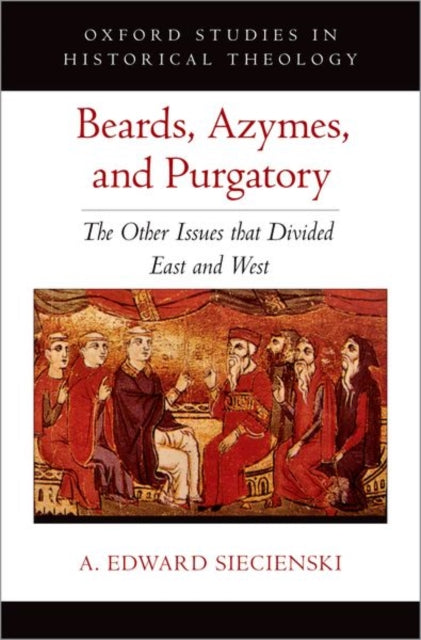
A. EdwardSiecienski
Beards, Azymes, and Purgatory: The Other Issues that Divided East and West
Beards, Azymes, and Purgatory: The Other Issues that Divided East and West
💎 Earn 597 Points (£5.97) on this item.
We can order this item for you. Delivery usually takes about 4 to 6 weeks.
This item is not held in our immediate stock. We will order it for you after checkout.
Estimated delivery: About 4 to 6 weeks
- Condition: Brand new
- UK Delivery times: Usually arrives within 2 - 3 working days
- UK Shipping: Fee starts at £2.39. Subject to product weight & dimension
Bulk ordering. Want 15 or more copies? Get a personalised quote and bigger discounts. Learn more about bulk orders.
Couldn't load pickup availability
- More about Beards, Azymes, and Purgatory: The Other Issues that Divided East and West
The Catholic and Orthodox churches have been divided for nearly a thousand years due to theological differences, including the Nicene Creed and the authority of the Pope. However, other issues such as the beardlessness of the Latin clergy, the Western use of unleavened bread in the Eucharist, and the doctrine of Purgatory also played a significant role in the schism. These issues were frequently cited as reasons for the dispute between East and West, even before the more significant arguments about the wording of the Nicene Creed. To understand the schism, it is important to grasp both the reasons it remains and the reasons it began.
Format: Hardback
Length: 432 pages
Publication date: 20 January 2023
Publisher: Oxford University Press Inc
The Catholic and Orthodox churches have been divided for nearly a thousand years, with profound theological differences that have shaped their distinct identities. These differences range from fundamental questions of faith, such as the Nicene Creed and the authority of the Pope, to seemingly minor issues such as the beardlessness of the Latin clergy, the Western use of unleavened bread in the Eucharist, and the doctrine of Purgatory. While these issues are often cited as the primary reasons for the schism, it is important to recognize that they were not necessarily the sole factors that led to the division.
In his book "Beards, Azymes, and Purgatory," A. Edward Siecienski argues that these seemingly minor issues played a significant role in the schism between East and West. Siecienski highlights how these issues were frequently cited as the reasons for the dispute between the two churches, even though they may not seem immediately relevant to the core beliefs of Christianity.
For centuries, these issues were among the most frequently debated topics between the Eastern and Western branches of the church. The beardlessness of the Latin clergy, for example, was cited as a reason for breaking communion with the Latin Church prior to all the subsequent arguments about the wording of the Nicene Creed. The Western use of unleavened bread in the Eucharist was also seen as a threat to the Eastern tradition, which emphasized the use of leavened bread as a symbol of Christ's body.
Despite these differences, the Catholic and Orthodox churches have maintained a dialogue and a degree of cooperation over the years. There have been attempts to bridge the gap, including the historic meeting between Pope John Paul II and Ecumenical Patriarch Bartholomew I in 1994, which was seen as a significant step towards reconciliation. However, the schism remains a complex and enduring issue that continues to divide the Christian world.
To understand the schism between East and West, it is essential to grasp both the reasons it remains and the reasons it began. Siecienski argues that the schism was not simply a result of theological differences but also of political and cultural factors. The rise. The political and cultural context of the Middle Ages played a significant role in shaping the divisions between the Eastern and Western churches. The Eastern Empire, which was ruled by the Byzantine Empire, was characterized by a strong emphasis on tradition and hierarchy. The Western Empire, on the other hand, was characterized by a more decentralized political structure and a greater emphasis on individualism and personal freedom.
Theological differences also played a role in the schism. The Eastern Church, which was influenced by Greek philosophy and culture, emphasized the importance of the intellect. The Western Church, which was influenced by Roman philosophy and culture, emphasized the importance of reason and logic. These differences led to a clash of ideologies and a breakdown in communication between the two branches of the church.
In addition to these theological and political factors, the schism was also influenced by cultural differences. The Eastern Church, for example, was characterized by a more hierarchical structure, with a clear distinction between the clergy and the laity. The Western Church, on the other hand, was more democratic, with a greater emphasis on the participation of the laity in the church's decision-making process.
Despite these differences, the Catholic and Orthodox churches have maintained a degree of cooperation and dialogue over the years. There have been efforts to bridge the gap, including the establishment of the World Council of Churches, which seeks to promote unity and cooperation among Christian denominations. However, the schism remains a complex and enduring issue that requires careful consideration and dialogue.
In conclusion, the Catholic and Orthodox churches have been divided for nearly a thousand years, with profound theological differences that have shaped their distinct identities. While these issues are often cited as the primary reasons for the schism, it is important to recognize that they were not necessarily the sole factors that led to the division. The beardlessness of the Latin clergy, the Western use of unleavened bread in the Eucharist, and the doctrine of Purgatory also played significant roles in the schism between East and West. To understand the schism between East and West, it is essential to grasp both the reasons it remains and the reasons it began. The political and cultural context of the Middle Ages played a significant role in shaping the divisions between the Eastern and Western churches, as well as theological differences. Cultural differences also played a role in the schism, with the Eastern Church characterized by a more hierarchical structure and the Western Church characterized by a more democratic structure. Despite these differences, the Catholic and Orthodox churches have maintained a degree of cooperation and dialogue over the years, with efforts to bridge the gap, including the establishment of the World Council of Churches. However, the schism remains a complex and enduring issue that requires careful consideration and dialogue.
Dimension: 235 x 156 (mm)
ISBN-13: 9780190065065
UK and International shipping information
UK and International shipping information
UK Delivery and returns information:
- Delivery within 2 - 3 days when ordering in the UK.
- Shipping fee for UK customers from £2.39. Fully tracked shipping service available.
- Returns policy: Return within 30 days of receipt for full refund.
International deliveries:
Shulph Ink now ships to Australia, Belgium, Canada, France, Germany, Ireland, Italy, India, Luxembourg Saudi Arabia, Singapore, Spain, Netherlands, New Zealand, United Arab Emirates, United States of America.
- Delivery times: within 5 - 10 days for international orders.
- Shipping fee: charges vary for overseas orders. Only tracked services are available for most international orders. Some countries have untracked shipping options.
- Customs charges: If ordering to addresses outside the United Kingdom, you may or may not incur additional customs and duties fees during local delivery.