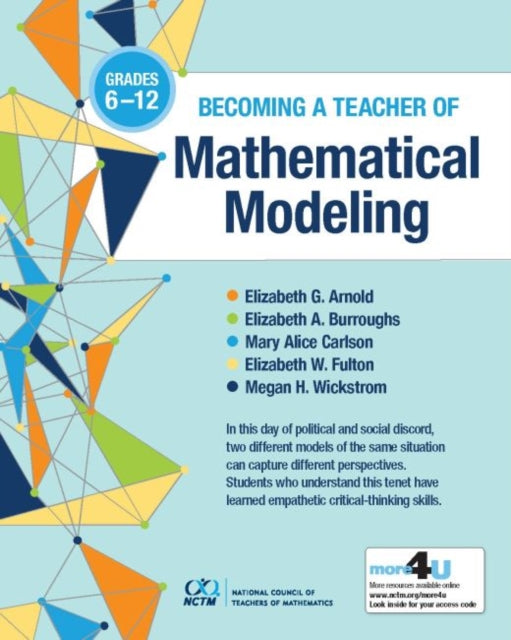
Elizabeth G. Arnold,Elizabeth A. Burroughs,Mary Alice Carlson,Elizabeth W. Fulton,Megan H. Wickstrom
Becoming a Teacher of Mathematical Modeling: Grades 6-12
Becoming a Teacher of Mathematical Modeling: Grades 6-12
💎 Earn 122 Points (£1.22) on this item.
We can order this item for you. Delivery usually takes about 4 to 6 weeks.
This item is not held in our immediate stock. We will order it for you after checkout.
Estimated delivery: About 4 to 6 weeks
YOU SAVE £1.46
- Condition: Brand new
- UK Delivery times: Usually arrives within 2 - 3 working days
- UK Shipping: Fee starts at £2.39. Subject to product weight & dimension
Bulk ordering. Want 15 or more copies? Get a personalised quote and bigger discounts. Learn more about bulk orders.
Couldn't load pickup availability
- More about Becoming a Teacher of Mathematical Modeling: Grades 6-12
This book explores the meaning of teaching modeling, the student practices and perspectives involved, how modeling can empower students, and classroom communities that support modeling. It also examines the complementary perspectives of mathematical and statistical models, the role of modeling in the secondary mathematics curriculum, and the role of technology in supporting modeling.
Format: Paperback / softback
Length: 136 pages
Publication date: 30 April 2022
Publisher: National Council of Teachers of Mathematics,U.S.
This book delves into the intricate realm of modeling, encompassing a comprehensive exploration of its significance in education. Part I of the book provides a broad overview of mathematical modeling, allowing readers to delve into the diverse student practices and perspectives associated with it. It also highlights the empowering effects of modeling and the supportive classroom communities that foster its growth. Part II takes readers on a transformative journey, guiding them toward becoming skilled teachers of modeling. Through vivid illustrations of modeling practices in experienced teachers' classrooms, the authors offer valuable strategies for integrating modeling into their own teaching practices. Part III delves into the complementary perspectives of mathematical and statistical models, examining their roles in the secondary mathematics curriculum. Additionally, it explores the role of technology in supporting modeling endeavors. Finally, the book concludes with insightful wisdom from other teachers who have successfully navigated the modeling journey, inviting readers to join this vibrant community.
Part I: Mathematical Modeling
In this introductory section, the authors provide a comprehensive overview of mathematical modeling, encompassing its various aspects and applications. They discuss the broad scope of mathematical modeling, which includes both qualitative and quantitative approaches, and its significance in various fields such as science, engineering, and mathematics. The authors also highlight the importance of mathematical modeling in developing students' problem-solving skills, critical thinking abilities, and ability to communicate complex ideas effectively.
The authors then delve into the student practices and perspectives involved in mathematical modeling. They explore how students engage with modeling tasks, the challenges they face, and the strategies they employ to solve problems. The book provides insights into the different ways students approach modeling, including analytical, intuitive, and collaborative approaches, and how these approaches can contribute to their learning outcomes.
Furthermore, the authors emphasize the role of classroom communities in supporting modeling practices. They discuss the importance of creating a supportive and inclusive environment where students feel comfortable expressing their ideas, collaborating with peers, and taking risks. The book provides practical strategies for building such classroom communities, including fostering open communication, promoting active learning, and providing opportunities for peer feedback and collaboration.
In conclusion, Part I of the book sets the stage for the subsequent chapters by providing a foundational understanding of mathematical modeling, the student practices and perspectives involved, and the importance of classroom communities in supporting modeling. It lays the groundwork for readers to explore the transformative power of modeling in education and its potential to empower students and enhance their learning experiences.
Part II: Becoming a Teacher of Modeling
In Part II, the authors take readers on a journey of becoming a teacher of modeling. They begin by illustrating the key features of modeling that are evident in the classrooms of experienced teachers who engage their students in modeling. The authors showcase the effective strategies these teachers employ to make modeling a central part of their teaching practices.
One of the key aspects of modeling is its ability to engage students actively and promote deeper learning. The authors discuss how modeling encourages students to think critically, analyze problems, and develop solutions. They highlight the importance of providing students with real-world contexts and authentic problems to solve, which helps them connect with the material and apply their knowledge in meaningful ways.
The authors also emphasize the importance of modeling as a collaborative process. They discuss how modeling promotes teamwork, communication, and collaboration among students. They provide practical strategies for fostering collaborative learning, including assigning group projects, promoting peer feedback, and using collaborative tools and technologies.
Furthermore, the authors explore the role of technology in supporting modeling practices. They discuss the use of digital tools, such as modeling software, simulations, and interactive visualizations, to enhance students' understanding of complex concepts and enable them to explore and analyze models in a more interactive and engaging way.
In conclusion, Part II of the book provides valuable insights and strategies for becoming a teacher of modeling. It illustrates the key features of modeling that are evident in successful classrooms and offers practical strategies for integrating modeling into teaching practices. By adopting these strategies, teachers can create engaging and effective learning environments that empower students to develop their mathematical modeling skills and apply them in real-world contexts.
Part III: Complementary Perspectives of Mathematical and Statistical Models
In Part III, the authors examine the complementary perspectives of mathematical and statistical models. They discuss the strengths and limitations of each model and their respective applications in different fields. The authors highlight the importance of understanding the underlying principles of both models and their interdependence in solving complex problems.
The authors also explore the role of modeling in the secondary mathematics curriculum. They discuss how modeling can be used to enhance students' understanding of mathematical concepts, improve their problem-solving skills, and promote deeper learning. They provide examples of how modeling can be integrated into various secondary mathematics topics, such as algebra, geometry, and statistics.
Furthermore, the authors examine the role of technology in supporting modeling practices. They discuss the use of digital tools, such as modeling software, simulations, and interactive visualizations, to enhance students' understanding of complex concepts and enable them to explore and analyze models in a more interactive and engaging way.
In conclusion, Part III of the book provides a comprehensive exploration of the complementary perspectives of mathematical and statistical models. It discusses the strengths and limitations of each model, their applications in different fields, and their role in the secondary mathematics curriculum. By integrating these perspectives into teaching practices, teachers can create learning environments that empower students to develop their mathematical modeling skills and apply them in real-world contexts.
Conclusion and Invitation to Join the Modeling Community
In conclusion, this book delves into the multifaceted world of modeling, providing a comprehensive exploration of its significance in education. Through its three parts, the book offers valuable insights and strategies for becoming a skilled teacher of modeling, integrating complementary perspectives of mathematical and statistical models, and supporting modeling practices through technology.
The authors invite readers to join the modeling community, where they can continue to explore the latest developments, share their experiences, and collaborate with other educators who are passionate about modeling. The modeling community is a vibrant and dynamic space where teachers can learn from each other, share best practices, and contribute to the ongoing development of modeling as an effective teaching tool.
By embracing the power of modeling, educators can empower students to think critically, solve complex problems, and develop a deeper understanding of the world around them. This book serves as a valuable resource for teachers, educators, and anyone interested in enhancing their teaching practices and promoting student learning.
Note: The content provided in this book is for informational purposes only and should not be considered as professional advice or guidance. It is always best to consult with experienced educators and experts in the field before implementing any teaching strategies or curriculum changes.
Weight: 349g
ISBN-13: 9781680540468
UK and International shipping information
UK and International shipping information
UK Delivery and returns information:
- Delivery within 2 - 3 days when ordering in the UK.
- Shipping fee for UK customers from £2.39. Fully tracked shipping service available.
- Returns policy: Return within 30 days of receipt for full refund.
International deliveries:
Shulph Ink now ships to Australia, Belgium, Canada, France, Germany, Ireland, Italy, India, Luxembourg Saudi Arabia, Singapore, Spain, Netherlands, New Zealand, United Arab Emirates, United States of America.
- Delivery times: within 5 - 10 days for international orders.
- Shipping fee: charges vary for overseas orders. Only tracked services are available for most international orders. Some countries have untracked shipping options.
- Customs charges: If ordering to addresses outside the United Kingdom, you may or may not incur additional customs and duties fees during local delivery.