Christina Ramos
Bedlam in the New World: A Mexican Madhouse in the Age of Enlightenment
Bedlam in the New World: A Mexican Madhouse in the Age of Enlightenment
💎 Earn 349 Points (£3.49) on this item.
We can order this item for you. Delivery usually takes about 4 to 6 weeks.
This item is not held in our immediate stock. We will order it for you after checkout.
Estimated delivery: About 4 to 6 weeks
YOU SAVE £9.08
- Condition: Brand new
- UK Delivery times: Usually arrives within 2 - 3 working days
- UK Shipping: Fee starts at £2.39. Subject to product weight & dimension
Bulk ordering. Want 15 or more copies? Get a personalised quote and bigger discounts. Learn more about bulk orders.
Couldn't load pickup availability
- More about Bedlam in the New World: A Mexican Madhouse in the Age of Enlightenment
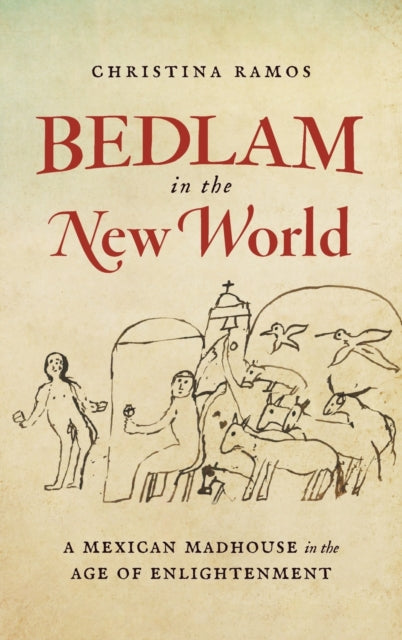
In the late eighteenth century, the Hospital de San Hipolito in Mexico City was the first hospital of the New World to specialize in the care and custody of the mentally disturbed. Christina Ramos reconstructs the history of this hospital, treating it as a microcosm and colonial laboratory of the Hispanic Enlightenment, where traditional Catholicism and rationalist models of madness mingled in surprising ways. She shows how the emerging ideals of order, utility, rationalism, and the public good reshaped the institutional and medical management of madness.
Format: Hardback
Length: 266 pages
Publication date: 15 March 2022
Publisher: The University of North Carolina Press
In the late eighteenth century, a group of individuals in Mexico City, including a rebellious Indian claiming noble ancestry and entitlement, a military lieutenant foreshadowing the coming of revolution, and a blasphemous Creole embroiderer in possession of a bundle of sketches brimming with pornography, were all deemed to be mad and forcefully admitted to the Hospital de San Hipolito. This hospital, the first of its kind in the New World to specialize in the care and custody of the mentally disturbed, played a significant role in the history of psychiatry. Christina Ramos reconstructs the history of this overlooked colonial hospital from its origins in 1567 to its transformation in the eighteenth century, when it began to admit a growing number of patients transferred from the Inquisition and secular criminal courts.
Drawing on the poignant voices of patients, doctors, friars, and inquisitors, Ramos treats San Hipolito as both a microcosm and a colonial laboratory of the Hispanic Enlightenment. She shows how the emerging ideals of order, utility, rationalism, and the public good came to reshape the institutional and medical management of madness. While the history of psychiatry's beginnings has often been told as seated in Europe, Ramos proposes an alternative history of madness's medicalization that centers colonial Mexico and places religious figures, including inquisitors, at the pioneering forefront.
The Hospital de San Hipolito was a place where traditional Catholicism and rationalist models of madness mingled in surprising ways. Patients, who were often marginalized and stigmatized by society, found solace and care within its walls. Doctors and friars worked tirelessly to provide medical treatment and spiritual guidance to their patients, often challenging the prevailing beliefs and practices of the time.
One of the most significant aspects of Ramos's work is her exploration of the role of religious figures in the medicalization of madness. Inquisitors, in particular, played a crucial role in shaping the understanding and treatment of mental illness. They were often seen as the guardians of moral and social order, and their authority was used to justify the coercive treatment of patients deemed to be mad. However, Ramos argues that inquisitors were also deeply interested in understanding the nature of madness and were willing to experiment with new treatments and therapies.
Through her analysis of the Hospital de San Hipolito, Ramos sheds light on the complex and multifaceted history of psychiatry and the role that colonialism played in its development. She challenges the notion that the medicalization of madness was solely a product of European Enlightenment and demonstrates how it was deeply influenced by the cultural and social contexts of colonial Mexico. This work is a valuable contribution to the field of psychiatry and history, and it provides a fresh perspective on the origins and development of mental illness in the New World.
Dimension: 235 x 155 (mm)
ISBN-13: 9781469666563
This item can be found in:
UK and International shipping information
UK and International shipping information
UK Delivery and returns information:
- Delivery within 2 - 3 days when ordering in the UK.
- Shipping fee for UK customers from £2.39. Fully tracked shipping service available.
- Returns policy: Return within 30 days of receipt for full refund.
International deliveries:
Shulph Ink now ships to Australia, Belgium, Canada, France, Germany, Ireland, Italy, India, Luxembourg Saudi Arabia, Singapore, Spain, Netherlands, New Zealand, United Arab Emirates, United States of America.
- Delivery times: within 5 - 10 days for international orders.
- Shipping fee: charges vary for overseas orders. Only tracked services are available for most international orders. Some countries have untracked shipping options.
- Customs charges: If ordering to addresses outside the United Kingdom, you may or may not incur additional customs and duties fees during local delivery.