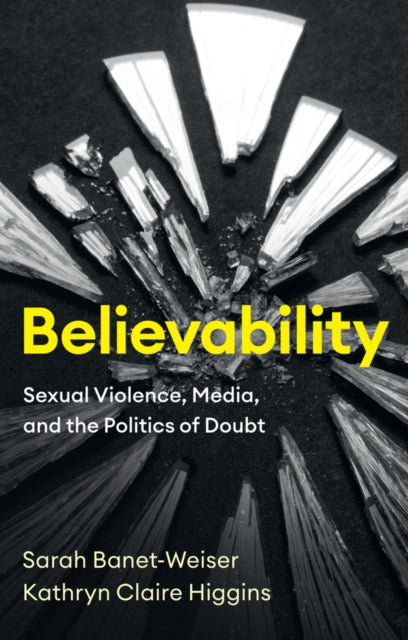
Sarah Banet-Weiser,Kathryn C. Higgins
Believability: Sexual Violence, Media, and the Politics of Doubt
Believability: Sexual Violence, Media, and the Politics of Doubt
💎 Earn 70 Points (£0.70) on this item.
YOU SAVE £1.84
- Condition: Brand new
- UK Delivery times: Usually arrives within 2 - 3 working days
- UK Shipping: Fee starts at £2.39. Subject to product weight & dimension
Bulk ordering. Want 15 or more copies? Get a personalised quote and bigger discounts. Learn more about bulk orders.
Couldn't load pickup availability
- More about Believability: Sexual Violence, Media, and the Politics of Doubt
The #MeToo movement has created more opportunities for women to speak up about sexual assault, but this has led to a paradox where "fake news" and "alternative facts" call into question the nature of truth. This book explores the experiences of women and people of color whose claims around issues of sexual violence are often held in doubt, proposing that a mediated "economy of believability" is the context in which public bids for truth are made, negotiated, and authorized.
Format: Paperback / softback
Length: 256 pages
Publication date: 13 April 2023
Publisher: Polity Press
The #MeToo movement has been a powerful force for women to speak out against sexual assault, providing them with a platform to share their experiences and seek justice. However, we are also living in a time where the concept of truth is being challenged by the rise of "fake news" and "alternative facts." This paradoxical situation is at the center of this thought-provoking book. The authors explore how the #MeToo movement intersects with the crisis of post-truth, examining the experiences of women and people of color whose claims of sexual violence are often doubted or dismissed. They investigate how the gendered and racialized logics of "believability" are established and contested within media culture, proposing that a mediated "economy of believability" shapes how public narratives around sexual violence are constructed, negotiated, and authorized in today's society.
The #MeToo movement has brought about significant changes in the way sexual assault is addressed and acknowledged. It has empowered women to speak out against their perpetrators and has led to a greater awareness of the prevalence of sexual violence in society. However, the rise of "fake news" and "alternative facts" has created a challenging environment for the pursuit of truth. These phenomena undermine the credibility of news outlets and can lead to misinformation and misunderstandings.
One of the key challenges posed by the convergence of #MeToo and post-truth is the definition and contestation of "believability." In media culture, there are often gendered and racialized logics that determine what is considered believable and what is not. Women and people of color who come forward with claims of sexual violence may face skepticism and disbelief due to these biases. The authors argue that a mediated "economy of believability" is at play in this context. This economy is shaped by the media, social media, and other institutions that shape public discourse.
In this economy, public bids for truth about sexual violence are made, negotiated, and authorized. Media outlets and social media platforms play a crucial role in this process, as they have the power to amplify and disseminate information. However, they also have the responsibility to verify the accuracy and reliability of the information they present. Unfortunately, there have been instances where media outlets have failed to uphold these standards, leading to the spread of false information and damaging the reputations of innocent individuals.
Social media platforms, in particular, have been criticized for their role in the spread of fake news and alternative facts. They have been accused of allowing misinformation to spread rapidly and of not taking sufficient measures to prevent it. This has led to a loss of trust in these platforms and has made it more difficult for people to rely on them for accurate information.
To address these challenges, it is important to promote media literacy and critical thinking. People need to be able to discern between credible sources of information and those that are unreliable. This can be achieved through education and awareness campaigns that teach people how to evaluate the credibility of news outlets and social media platforms.
Furthermore, media outlets and social media platforms need to be held accountable for their role in the spread of fake news and alternative facts. They should implement stricter guidelines and regulations to ensure that the information they present is accurate and reliable. This can include fact-checking procedures, penalties for spreading false information, and transparency about their algorithms and policies.
In conclusion, the convergence of #MeToo and post-truth presents a complex and challenging situation. While the #MeToo movement has provided women with a platform to speak out against sexual assault, the rise of "fake news" and "alternative facts" has undermined the pursuit of truth. It is important to address these challenges by promoting media literacy, critical thinking, and accountability in the media and social media platforms. By doing so, we can create a more informed and trustworthy public discourse that supports the rights and dignity of all individuals.
Weight: 324g
Dimension: 138 x 216 x 20 (mm)
ISBN-13: 9781509553822
UK and International shipping information
UK and International shipping information
UK Delivery and returns information:
- Delivery within 2 - 3 days when ordering in the UK.
- Shipping fee for UK customers from £2.39. Fully tracked shipping service available.
- Returns policy: Return within 30 days of receipt for full refund.
International deliveries:
Shulph Ink now ships to Australia, Belgium, Canada, France, Germany, Ireland, Italy, India, Luxembourg Saudi Arabia, Singapore, Spain, Netherlands, New Zealand, United Arab Emirates, United States of America.
- Delivery times: within 5 - 10 days for international orders.
- Shipping fee: charges vary for overseas orders. Only tracked services are available for most international orders. Some countries have untracked shipping options.
- Customs charges: If ordering to addresses outside the United Kingdom, you may or may not incur additional customs and duties fees during local delivery.