Akash Kapur
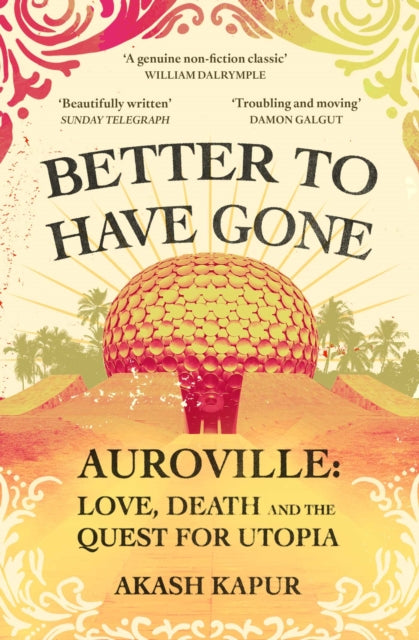
Better To Have Gone: Love, Death and the Quest for Utopia in Auroville
Better To Have Gone: Love, Death and the Quest for Utopia in Auroville
💎 Earn 35 Points (£0.35) on this item.
YOU SAVE £2.92
- Condition: Brand new
- UK Delivery times: Usually arrives within 2 - 3 working days
- UK Shipping: Fee starts at £2.39. Subject to product weight & dimension
Bulk ordering. Want 15 or more copies? Get a personalised quote and bigger discounts. Learn more about bulk orders.
Couldn't load pickup availability
- More about Better To Have Gone: Love, Death and the Quest for Utopia in Auroville
In Better to Have Gone, Akash Kapur explores the mysterious deaths of John Walker and Diane Maes, two lovers who founded Auroville, an international utopian community in South India. The book delves into the human cost of our quest for a more perfect world and portrays the daily life of one utopian community in vivid detail.
Format: Paperback / softback
Length: 368 pages
Publication date: 07 July 2022
Publisher: Simon & Schuster Ltd
Beautifully written and structured, deeply moving, and realized in wise, thoughtful, chiseled prose, it is that rarity: a genuine non-fiction classic.
William Dalrymple, author of the Booker Prize-winning The Promise, A troubling and moving account of lives gone wrong in the search for an eastern Utopia.
Damon Galgut, author of the Booker Prize-winning The Promise, A spellbinding story about love, faith, the search for utopia, and the often devastating cost of idealism.
Its the late 1960s, and two lovers converge on an arid patch of earth in South India. John Walker is the handsome scion of a powerful East Coast American family. Diane Maes is a beautiful hippie from Belgium. They have come to build a new world: Auroville, an international utopian community for thousands of people. Their faith is strong, the future bright.
So how do John and Diane end up dying two decades later, on the same day, on a cracked concrete floor in a thatch hut by a remote canyon? This is the mystery Akash Kapur sets out to solve in Better to Have Gone, and it carries deep personal resonance: Diane and John were the parents of Akashs wife, Auralice. Akash and Auralice grew up in Auroville; like the rest of their community, they never really understood those deaths.
In 2004, Akash and Auralice return to Auroville from New York, where they have been living with Johns family. As they re-establish themselves, along with their two sons, in the community, they must confront the ghosts of those distant deaths. Slowly, they come to understand how the tragic individual fates of John and Diane intersected with the collective history of their town.
Better to Have Gone is a book about the human cost of our age-old quest for a more perfect world. It probes the under-explored yet universal idea of utopia, and it portrays in vivid detail the lives of the people who lived in Auroville, a utopian community founded in 1968 in southern India.
The book is divided into three parts: "The Dream," "The Reality," and "The Legacy." In "The Dream," Kapur describes the founding of Auroville and the idealistic vision of its founders, including the late Sri Aurobindo, a spiritual leader who believed in the unity of all religions and the creation of a new world based on love and peace.
In "The Reality," Kapur explores the challenges that Auroville faced in its early years, including financial difficulties, political tensions, and the struggles of its residents to live up to the ideals of utopia. He also delves into the personal lives of the people who lived in Auroville, including the loves, losses, and betrayals that shaped their experiences.
In "The Legacy," Kapur examines the impact of Auroville on the world and the lives of its residents. He explores the legacy of utopia, the idea that a perfect society can be created on Earth, and the challenges that remain in achieving that goal. He also considers the personal and collective struggles of the people who lived in Auroville, and the ways in which they continue to strive for a better world.
One of the most striking aspects of Better to Have Gone is Kapur's ability to capture the essence of Auroville and the people who lived there. He paints a vivid portrait of the community, its buildings, its gardens, and its inhabitants, and he does so with a deep sense of empathy and understanding.
Kapur also delves into the complex and often conflicting emotions that the people of Auroville experienced as they tried to live up to the ideals of utopia. He explores the tensions between the idealistic vision of the founders and the practical realities of everyday life, and he shows how the people of Auroville struggled to balance their personal desires and their commitment to the community.
Another notable aspect of Better to Have Gone is Kapur's exploration of the idea of utopia and the challenges that it presents. He questions whether utopia is possible, and he explores the ways in which it has been interpreted and practiced throughout history. He also considers the personal and collective struggles of the people who live in utopian communities, and the ways in which they navigate the challenges of living in a society that is based on ideals rather than reality.
Overall, Better to Have Gone is a powerful and thought-provoking book that offers a unique perspective on the human cost of our age-old quest for a more perfect world. It is a must-read for anyone interested in utopia, history, or the human experience, and it will leave readers with a deeper understanding of the complexities and challenges of living in a society that is based on ideals rather than reality.
Dimension: 198 x 130 (mm)
ISBN-13: 9781398506770
UK and International shipping information
UK and International shipping information
UK Delivery and returns information:
- Delivery within 2 - 3 days when ordering in the UK.
- Shipping fee for UK customers from £2.39. Fully tracked shipping service available.
- Returns policy: Return within 30 days of receipt for full refund.
International deliveries:
Shulph Ink now ships to Australia, Belgium, Canada, France, Germany, Ireland, Italy, India, Luxembourg Saudi Arabia, Singapore, Spain, Netherlands, New Zealand, United Arab Emirates, United States of America.
- Delivery times: within 5 - 10 days for international orders.
- Shipping fee: charges vary for overseas orders. Only tracked services are available for most international orders. Some countries have untracked shipping options.
- Customs charges: If ordering to addresses outside the United Kingdom, you may or may not incur additional customs and duties fees during local delivery.