Shulph Ink
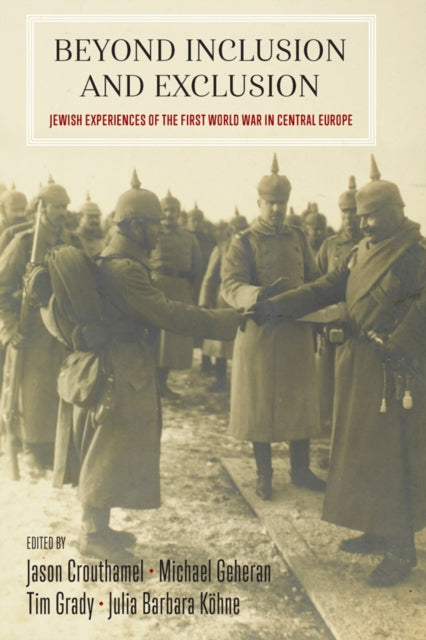
Beyond Inclusion and Exclusion: Jewish Experiences of the First World War in Central Europe
Beyond Inclusion and Exclusion: Jewish Experiences of the First World War in Central Europe
💎 Earn 136 Points (£1.36) on this item.
We can order this item for you. Delivery usually takes about 4 to 6 weeks.
This item is not held in our immediate stock. We will order it for you after checkout.
Estimated delivery: About 4 to 6 weeks
YOU SAVE £4.62
- Condition: Brand new
- UK Delivery times: Usually arrives within 2 - 3 working days
- UK Shipping: Fee starts at £2.39. Subject to product weight & dimension
Bulk ordering. Want 15 or more copies? Get a personalised quote and bigger discounts. Learn more about bulk orders.
Couldn't load pickup availability
- More about Beyond Inclusion and Exclusion: Jewish Experiences of the First World War in Central Europe
During the First World War, the Jewish population of Central Europe was diverse, with antisemitism and Jewish disillusionment dominating previous studies. This collection explores four interconnected themes: minorities and military service, Jewish-Gentile relations, cultural legacies of the war, and memory politics.
Format: Paperback / softback
Length: 418 pages
Publication date: 01 November 2021
Publisher: Berghahn Books
During the First World War, the Jewish population of Central Europe was a complex tapestry of political, social, and experiential diversity, defying easy categorization within a singular historical narrative. While antisemitism and Jewish disillusionment have often dominated previous studies of this period, this collection seeks to reclaim the rich and multifaceted nature of Central European Jewish life through the experiences of soldiers and civilians alike. Here, scholars from various disciplines delve into rare sources and employ innovative methodologies to explore four interconnected themes: the experiences of minorities in the military, Jewish-Gentile relations, the cultural legacies of the war, and the politics of memory.
The Jewish community in Central Europe during the First World War was a vibrant and diverse tapestry, composed of individuals from various backgrounds, cultures, and religious traditions. This diversity extended to their political and social experiences, as well as their wartime experiences.
Politically, the Jewish population in Central Europe was diverse, with many different political ideologies and affiliations. Some Jews supported the war effort, while others opposed it. Some Jews were members of political parties and organizations that were opposed to the war, while others were active in the military.
Socially, the Jewish population in Central Europe was diverse as well, with different social classes, occupations, and lifestyles. Some Jews were wealthy and influential, while others were poor and marginalized. Some Jews were educated and cultured, while others were less so.
Experientially, the Jewish population in Central Europe was diverse as well, with different wartime experiences. Some Jews served in the military, while others worked in civilian industries or volunteered for relief organizations. Some Jews were persecuted and discriminated against by their non-Jewish neighbors, while others were able to escape persecution and find safety.
Despite this diversity, the Jewish population in Central Europe was also subject to antisemitism and Jewish disillusionment. Antisemitism was a widespread phenomenon in Europe during the First World War, and many Jews were subjected to discrimination, persecution, and even genocide. Jewish disillusionment was also a common experience, as many Jews saw the war as a betrayal of their hopes and dreams for a better future.
This collection of essays seeks to reclaim the multifariousness of Central European Jewish life in the experiences of soldiers and civilians alike during the First World War. The essays explore a range of topics, including the experiences of minorities in the military, Jewish-Gentile relations, the cultural legacies of the war, and the politics of memory.
The first essay in the collection explores the experiences of Jewish soldiers in the First World War. The essay argues that Jewish soldiers were not a monolithic group, but rather a diverse and complex community with a range of experiences and perspectives. The essay explores the different ways in which Jewish soldiers served in the military, including in the infantry, the air force, and the navy. The essay also explores the different ways in which Jewish soldiers were treated by their non-Jewish colleagues and superiors, including discrimination, prejudice, and even violence.
The second essay in the collection explores the experiences of Jewish civilians in Central Europe during the First World War. The essay argues that Jewish civilians were not a monolithic group, but rather a diverse and complex community with a range of experiences and perspectives. The essay explores the different ways in which Jewish civilians were affected by the war, including displacement, persecution, and even genocide. The essay also explores the different ways in which Jewish civilians responded to the war, including resistance, collaboration, and escape.
The third essay in the collection explores the cultural legacies of the First World War in Central Europe. The essay argues that the war left a lasting impact on the cultural landscape of Central Europe, including the emergence of new forms of cultural expression and the destruction of old ones. The essay explores the different ways in which the war influenced the art, literature, music, and film of Central Europe, including the emergence of new genres and the use of war themes.
The fourth essay in the collection explores the politics of memory in Central Europe during the First World War. The essay argues that the war has been remembered and commemorated in a range of different ways, including through official monuments, museums, and memorials, as well as through popular culture and folklore. The essay explores the different ways in which the war has been interpreted and represented by different groups and individuals, including the Jewish community, the non-Jewish community, and the state.
In conclusion, the Jewish population of Central Europe during the First World War was a complex and diverse community with a range of political, social, and experiential diversity. Despite this diversity, the Jewish population was also subject to antisemitism and Jewish disillusionment. This collection of essays seeks to reclaim the multifariousness of Central European Jewish life in the experiences of soldiers and civilians alike during the First World War, exploring a range of topics including the experiences of minorities in the military, Jewish-Gentile relations, the cultural legacies of the war, and the politics of memory.
ISBN-13: 9781800732025
UK and International shipping information
UK and International shipping information
UK Delivery and returns information:
- Delivery within 2 - 3 days when ordering in the UK.
- Shipping fee for UK customers from £2.39. Fully tracked shipping service available.
- Returns policy: Return within 30 days of receipt for full refund.
International deliveries:
Shulph Ink now ships to Australia, Belgium, Canada, France, Germany, Ireland, Italy, India, Luxembourg Saudi Arabia, Singapore, Spain, Netherlands, New Zealand, United Arab Emirates, United States of America.
- Delivery times: within 5 - 10 days for international orders.
- Shipping fee: charges vary for overseas orders. Only tracked services are available for most international orders. Some countries have untracked shipping options.
- Customs charges: If ordering to addresses outside the United Kingdom, you may or may not incur additional customs and duties fees during local delivery.