AndrewKraebel
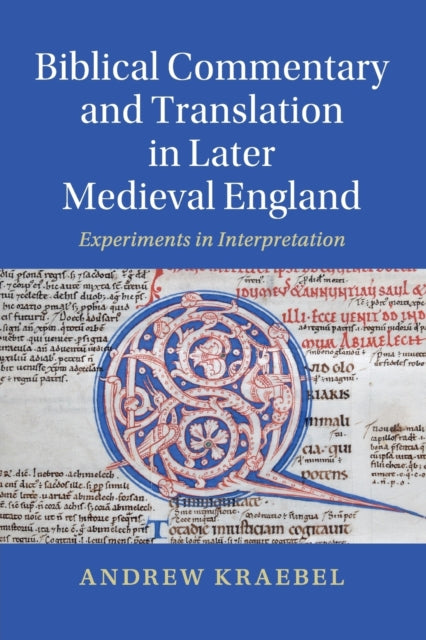
Biblical Commentary and Translation in Later Medieval England: Experiments in Interpretation
Biblical Commentary and Translation in Later Medieval England: Experiments in Interpretation
💎 Earn 118 Points (£1.18) on this item.
We can order this item for you. Delivery usually takes about 4 to 6 weeks.
This item is not held in our immediate stock. We will order it for you after checkout.
Estimated delivery: About 4 to 6 weeks
YOU SAVE £1.40
- Condition: Brand new
- UK Delivery times: Usually arrives within 2 - 3 working days
- UK Shipping: Fee starts at £2.39. Subject to product weight & dimension
Bulk ordering. Want 15 or more copies? Get a personalised quote and bigger discounts. Learn more about bulk orders.
Couldn't load pickup availability
- More about Biblical Commentary and Translation in Later Medieval England: Experiments in Interpretation
This study challenges the idea that medieval English Bible translations were a proto-Protestant rejection of scholastic modes of interpretation and argues that early translators were part of a larger scholastic interpretive tradition. It explores the culture of experimentation in biblical exegesis in fourteenth-century England, focusing on works by writers from John Wyclif to Richard Rolle and lesser-known authors, and provides new insight into the ingenuity of medieval interpreters willing to develop new literary-critical methods.
Format: Paperback / softback
Length: 323 pages
Publication date: 02 February 2023
Publisher: Cambridge University Press
This comprehensive study delves into the rich tapestry of experimentation that permeated biblical exegesis in fourteenth-century England, drawing extensively from unpublished manuscript sources. In a field ripe for reevaluation, Andrew Kraebel sets forth a compelling argument that challenges the prevailing notion, inherited from Reformation writers, that medieval English Bible translations represent a proto-Protestant rejection of scholastic modes of interpretation. Instead, he posits that early translators themselves were integral members of a broader scholastic interpretive tradition, and their goal was to disseminate this tradition to a wider audience. Translation emerged as one of the numerous avenues through which English exegetes explored the boundless possibilities of commentary. Spanning a wide range of works by writers such as the heretic John Wyclif, the hermit Richard Rolle, alongside numerous lesser-known authors like Henry Cossey and Nicholas Trevet, as well as numerous anonymous texts, this study offers fresh perspectives on the ingenuity of medieval interpreters who were willing to forge new literary-critical methods and embrace intellectual risks.
Introduction:
The study of biblical exegesis in the fourteenth century in England has long been a subject of fascination for scholars. During this period, the English language was undergoing significant transformations, and the Bible was being translated into English for the first time. This translation process was not without its challenges, as the translators sought to convey the meaning of the original Hebrew and Greek texts while also adapting them to the cultural and linguistic context of their time.
One of the key aspects of biblical exegesis in fourteenth-century England was the culture of experimentation that surrounded it. Scholars in this period were eager to explore new methods and approaches to interpreting the Bible, and they were not afraid to take intellectual risks. This culture of experimentation was driven by a number of factors, including the desire to expand the boundaries of knowledge and the growing influence of humanism and Renaissance thinking.
In this study, we will explore the culture of experimentation that surrounded biblical exegesis in fourteenth-century England. We will examine the works of key scholars in this period, including John Wyclif, Richard Rolle, Henry Cossey, and Nicholas Trevet, as well as a host of lesser-known authors. We will also consider the anonymous texts that were produced during this time, which offer valuable insights into the ways in which biblical exegesis was practiced in the fourteenth century.
The Scholastic Interpretive Tradition:
One of the key factors that drove the culture of experimentation in biblical exegesis in fourteenth-century England was the scholastic interpretive tradition. This tradition was rooted in the medieval period and was characterized by a focus on the study of the Bible in the context of the broader intellectual and cultural traditions of the time.
Scholastic interpreters believed that the Bible was not just a religious text but also a source of knowledge and wisdom. They sought to understand the Bible in its historical, cultural, and literary contexts, and they used a variety of methods to accomplish this goal. These methods included the use of allegory, metaphor, and typology, as well as the analysis of grammatical and rhetorical structures.
Scholastic interpreters also believed that the Bible was a living text that could be interpreted in different ways depending on the context and the reader. They were open to the possibility of multiple interpretations and were willing to engage in dialogue and debate with other scholars to explore the possibilities of interpretation.
The Role of Early Translators:
One of the most significant figures in the culture of experimentation in biblical exegesis in fourteenth-century England was the early translator. These translators were responsible for bringing the Bible into English for the first time, and they played a crucial role in shaping the way in which the Bible was interpreted in English.
Early translators were themselves part of the broader scholastic interpretive tradition, and they sought to make this tradition available to a broader audience. They worked to translate the Bible into English in a way that was accessible and understandable to a wide range of readers, including those who were not familiar with the scholarly traditions of the time.
However, early translators also experimented with new methods and approaches to interpreting the Bible. They were willing to take intellectual risks and were open to the possibility of multiple interpretations. This led to the development of new literary-critical methods and the exploration of new ways of understanding the Bible.
The Works of John Wyclif:
One of the most influential figures in the culture of experimentation in biblical exegesis in fourteenth-century England was John Wyclif. Wyclif was a heretic who was condemned by the Catholic Church in 1382 for his teachings on the Bible. However, his teachings on the Bible and his translations of the Bible had a significant impact on the way in which the Bible was interpreted in English.
Wyclif's teachings on the Bible were rooted in his belief that the Bible should be interpreted in a way that was consistent with the teachings of the early Christian church. He believed that the Bible was not just a source of religious knowledge but also a source of wisdom and knowledge about the natural world. Wyclif's translations of the Bible were also influenced by his belief that the Bible should be translated in a way that was accessible to a wide range of readers.
Wyclif's translations of the Bible were widely circulated in fourteenth-century England, and they had a significant impact on the way in which the Bible was interpreted in English. Wyclif's translations were known for their clarity and simplicity, and they were widely used in schools and universities. Wyclif's translations also helped to spread his teachings on the Bible, and his ideas were widely debated and discussed by scholars in the fourteenth century.
The Works of Richard Rolle:
Another influential figure in the culture of experimentation in biblical exegesis in fourteenth-century England was Richard Rolle. Rolle was a hermit who lived in the early fourteenth century and was known for his writings on the spiritual life. Rolle's writings on the spiritual life were influenced by his experiences as a hermit and his studies of the Bible.
Rolle's writings on the spiritual life were widely circulated in fourteenth-century England, and they had a significant impact on the way in which the Bible was interpreted in English. Rolle's writings on the spiritual life were known for their emphasis on the importance of meditation and prayer and their emphasis on the relationship between the spiritual and the physical world. Rolle's writings also helped to spread his ideas about the spiritual life, and his ideas were widely debated and discussed by scholars in the fourteenth century.
The Works of Henry Cossey:
Henry Cossey was a lesser-known author who was active in fourteenth-century England. Cossey was known for his writings on the spiritual life and his translations of the Bible. Cossey's writings on the spiritual life were influenced by his experiences as a monk and his studies of the Bible.
Cossey's translations of the Bible were widely circulated in fourteenth-century England, and they had a significant impact on the way in which the Bible was interpreted in English. Cossey's translations were known for their clarity and simplicity, and they were widely used in schools and universities. Cossey's translations also helped to spread his ideas about the spiritual life, and his ideas were widely debated and discussed by scholars in the fourteenth century.
The Works of Nicholas Trevet:
Nicholas Trevet was a lesser-known author who was active in fourteenth-century England. Trevet was known for his writings on the spiritual life and his translations of the Bible. Trevet's writings on the spiritual life were influenced by his experiences as a monk and his studies of the Bible.
Trevet's translations of the Bible were widely circulated in fourteenth-century England, and they had a significant impact on the way in which the Bible was interpreted in English. Trevet's translations were known for their clarity and simplicity, and they were widely used in schools and universities. Trevet's translations also helped to spread his ideas about the spiritual life, and his ideas were widely debated and discussed by scholars in the fourteenth century.
Anonymous Texts:
In addition to the works of key scholars in fourteenth-century England, there were also a host of anonymous texts that were produced during this time. These texts offer valuable insights into the ways in which biblical exegesis was practiced in the fourteenth century.
Anonymous texts were produced by a wide range of authors, including monks, hermits, and laypeople. These texts were often produced in response to specific questions or challenges that were facing the Christian community at the time. Anonymous texts were also often produced in response to the works of key scholars, and they offered alternative interpretations and perspectives on the Bible.
Anonymous texts were widely circulated in fourteenth-century England, and they had a significant impact on the way in which the Bible was interpreted in English. Anonymous texts were often used as a source of inspiration and guidance for spiritual practice, and they were widely used in schools and universities. Anonymous texts also helped to spread the ideas of key scholars, and they were widely debated and discussed by scholars in the fourteenth century.
Conclusion:
In conclusion, the culture of experimentation that surrounded biblical exegesis in fourteenth-century England was driven by a number of factors, including the desire to expand the boundaries of knowledge and the growing influence of humanism and Renaissance thinking. The works of key scholars in this period, including John Wyclif, Richard Rolle, Henry Cossey, and Nicholas Trevet, as well as a host of lesser-known authors, offer valuable insights into the ways in which biblical exegesis was practiced in the fourteenth century. Anonymous texts also offer valuable insights into the ways in which biblical exegesis was practiced in the fourteenth century. The culture of experimentation in biblical exegesis in fourteenth-century England was a rich and complex tapestry that was shaped by a variety of factors, including the scholastic interpretive tradition, the role of early translators, and the influence of anonymous texts. This culture of experimentation was a testament to the intellectual and creative spirit of the fourteenth century, and it continues to inspire scholars and religious practitioners today.
ISBN-13: 9781108708128
UK and International shipping information
UK and International shipping information
UK Delivery and returns information:
- Delivery within 2 - 3 days when ordering in the UK.
- Shipping fee for UK customers from £2.39. Fully tracked shipping service available.
- Returns policy: Return within 30 days of receipt for full refund.
International deliveries:
Shulph Ink now ships to Australia, Belgium, Canada, France, Germany, Ireland, Italy, India, Luxembourg Saudi Arabia, Singapore, Spain, Netherlands, New Zealand, United Arab Emirates, United States of America.
- Delivery times: within 5 - 10 days for international orders.
- Shipping fee: charges vary for overseas orders. Only tracked services are available for most international orders. Some countries have untracked shipping options.
- Customs charges: If ordering to addresses outside the United Kingdom, you may or may not incur additional customs and duties fees during local delivery.