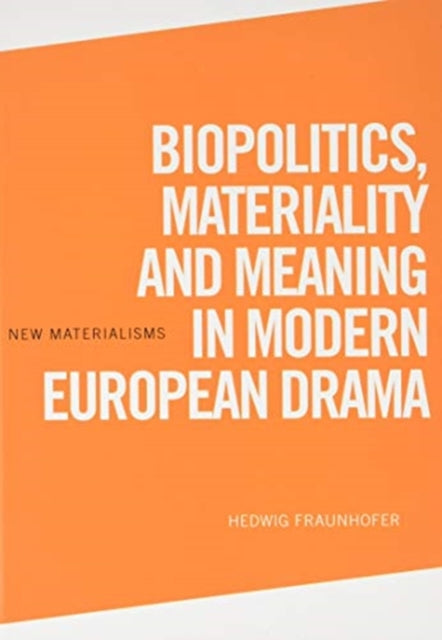
Hedwig Fraunhofer
Biopolitics, Materiality and Meaning in Modern European Drama
Biopolitics, Materiality and Meaning in Modern European Drama
💎 Earn 402 Points (£4.02) on this item.
YOU SAVE £24.46
- Condition: Brand new
- UK Delivery times: Usually arrives within 2 - 3 working days
- UK Shipping: Fee starts at £2.39. Subject to product weight & dimension
Bulk ordering. Want 15 or more copies? Get a personalised quote and bigger discounts. Learn more about bulk orders.
Couldn't load pickup availability
- More about Biopolitics, Materiality and Meaning in Modern European Drama
Hedwig Fraunhofer proposes a rewriting of modernity that challenges binary methodologies and reveals the performativity of theatre in its double sense. She highlights the biopolitical exclusions that mark modern western epistemology and leads up to modernity's totalitarian crisis point. Fraunhofer's work explores the collapse of public and private, human and more-than-human, materiality and meaning in modern theatre, creating a common life.
Format: Hardback
Length: 328 pages
Publication date: 31 December 2020
Publisher: Edinburgh University Press
Hedwig Fraunhofer challenges traditional modernization theories, proposing a more comprehensive understanding of modernity that transcends binary methodologies. She reworks the biopolitical exclusions that characterize modern Western epistemology, leading to the totalitarian crisis point of modernity. Fraunhofer highlights the performativity of theatre, both as a theatrical production and as the intra-activity of a dynamic system of multiple relations between human and more-than-human actors, energies, and affects. In modern theatre, the boundaries between public and private, human and more-than-human, materiality and meaning collapse into a common life.
Fraunhofer's approach cuts across nature and culture, mind and matter, epistemology and ontology, critique and affirmative writing, and dramatic and postdramatic theatre. She argues that existing theories have been overly focused on one side of the equation, neglecting the complex interplay between different aspects of modernity. By reworking these exclusions, Fraunhofer seeks to create a more inclusive and nuanced understanding of modernity that recognizes the diverse and interconnected aspects of human experience.
One of the key aspects of Fraunhofer's rewriting of modernity is her focus on the biopolitical exclusions that have shaped modern Western epistemology. She argues that these exclusions have led to a narrow view of the human subject, reducing it to a mere object of knowledge and control. By reworking these exclusions, Fraunhofer seeks to create a more holistic and inclusive understanding of the human subject, recognizing their agency and capacity for self-determination.
Fraunhofer's approach also challenges the traditional dichotomy between nature and culture. She argues that these two domains are not separate but are interconnected and interdependent. Nature provides the raw materials for culture, while culture shapes the way we interact with nature. By reworking this dichotomy, Fraunhofer seeks to create a more sustainable and harmonious relationship between humans and the natural world.
In addition to her work on modernity, Fraunhofer has also made significant contributions to the field of theatre. She has reworked the biopolitical exclusions that mark modern Western epistemology, leading to the totalitarian crisis point of modernity. Fraunhofer highlights the performativity of theatre, both as a theatrical production and as the intra-activity of a dynamic system of multiple relations between human and more-than-human actors, energies, and affects.
Fraunhofer's approach to theatre is characterized by its emphasis on the inter-activity of multiple relations between human and more-than-human actors, energies, and affects. She argues that theatre is not just a passive medium for the transmission of information but is a dynamic system that actively shapes and is shaped by the interactions between its participants. This approach has led to the development of new forms of theatre that challenge traditional notions of what theatre is and what it can do.
One of the most notable examples of Fraunhofer's work in theatre is her reworking of the biopolitical exclusions that mark modern Western epistemology. She argues that these exclusions have led to a narrow view of the human subject, reducing it to a mere object of knowledge and control. By reworking these exclusions, Fraunhofer seeks to create a more holistic and inclusive understanding of the human subject, recognizing their agency and capacity for self-determination.
Fraunhofer's approach to theatre also challenges the traditional dichotomy between nature and culture. She argues that these two domains are not separate but are interconnected and interdependent. Nature provides the raw materials for culture, while culture shapes the way we interact with nature. By reworking this dichotomy, Fraunhofer seeks to create a more sustainable and harmonious relationship between humans and the natural world.
In conclusion, Hedwig Fraunhofer's rewriting of modernity offers a more comprehensive and inclusive understanding of modernity that transcends binary methodologies. She reworks the biopolitical exclusions that mark modern Western epistemology, leading to the totalitarian crisis point of modernity. Fraunhofer's approach to theatre is characterized by its emphasis on the inter-activity of multiple relations between human and more-than-human actors, energies, and affects, and has led to the development of new forms of theatre that challenge traditional notions of what theatre is and what it can do.
Weight: 666g
Dimension: 171 x 236 x 24 (mm)
ISBN-13: 9781474467438
UK and International shipping information
UK and International shipping information
UK Delivery and returns information:
- Delivery within 2 - 3 days when ordering in the UK.
- Shipping fee for UK customers from £2.39. Fully tracked shipping service available.
- Returns policy: Return within 30 days of receipt for full refund.
International deliveries:
Shulph Ink now ships to Australia, Belgium, Canada, France, Germany, Ireland, Italy, India, Luxembourg Saudi Arabia, Singapore, Spain, Netherlands, New Zealand, United Arab Emirates, United States of America.
- Delivery times: within 5 - 10 days for international orders.
- Shipping fee: charges vary for overseas orders. Only tracked services are available for most international orders. Some countries have untracked shipping options.
- Customs charges: If ordering to addresses outside the United Kingdom, you may or may not incur additional customs and duties fees during local delivery.