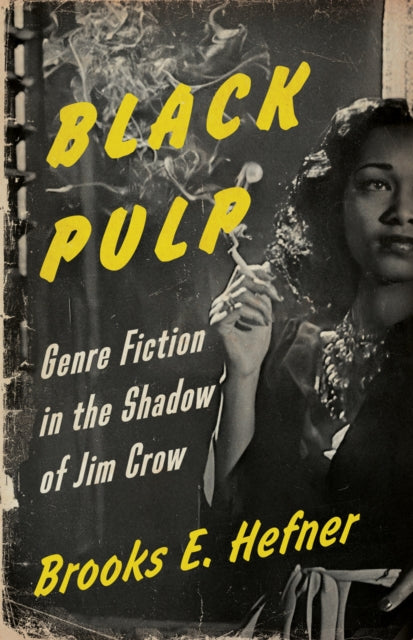
Brooks E. Hefner
Black Pulp: Genre Fiction in the Shadow of Jim Crow
Black Pulp: Genre Fiction in the Shadow of Jim Crow
💎 Earn 60 Points (£0.60) on this item.
YOU SAVE £9.91
- Condition: Brand new
- UK Delivery times: Usually arrives within 2 - 3 working days
- UK Shipping: Fee starts at £2.39. Subject to product weight & dimension
Bulk ordering. Want 15 or more copies? Get a personalised quote and bigger discounts. Learn more about bulk orders.
Couldn't load pickup availability
- More about Black Pulp: Genre Fiction in the Shadow of Jim Crow
In recent years, Jordan Peeles' Get Out, Marvel's Black Panther, and HBO's Watchmen have been praised for reusing genre conventions to challenge white supremacy, celebrate black resistance, and imagine a more racially just world. Brooks E. Hefner's Black Pulp: Antiracist Genre Revision in Mid-Century African American Newspapers demonstrates that this tradition of antiracist genre revision began in the 1920s, with serialized genre stories written by Black authors in Black newspapers with large circulations among middle- and working-class Black readers. Hefner explores how these authors deployed, critiqued, and reassembled genre formulas in the service of racial justice, offering a more vibrant understanding of African American literary history.
Format: Paperback / softback
Length: 248 pages
Publication date: 04 January 2022
Publisher: University of Minnesota Press
A profound exploration into mid-century African American newspapers reveals the fascinating story of how Black pulp fiction reimagined genre conventions to serve the cause of racial justice. In recent years, films such as Jordan Peeles Get Out, Marvels Black Panther, and HBOs Watchmen have garnered widespread acclaim for their innovative approaches to repurposing genre tropes to challenge white supremacy, celebrate Black resistance, and envision a more racially equitable world. These progressive messages have resonated widely because they are packaged within popular genres, making them accessible and engaging to a broad audience. However, it is important to note that this tradition of antiracist genre revision extends far beyond the recent studies of Black superhero comics from the 1960s. As Brooks E. Hefner demonstrates in his book Black Pulp, this reimagining of genres for antiracist purposes has its roots in the 1920s, with serialized and sometimes syndicated genre stories written by Black authors in Black newspapers with large circulations among middle- and working-class Black readers.
Hefner's meticulous research uncovers a rich archive of African American genre fiction from the 1920s through the mid-1950s, encompassing a diverse range of genres such as romance, hero-adventure, crime stories, westerns, and science fiction. Through his reading of these stories, Hefner delves into the ways in which their authors deployed, critiqued, and reassembled genre formulas to serve the cause of racial justice. These authors used the genre to criticize Jim Crow segregation, racial capitalism, and the sexual exploitation of Black women. They also sought to imagine successful interracial romance and collective sociopolitical progress, as well as to celebrate Black agency, even in the face of white supremacy.
One of the most striking aspects of these popular stories is their departure from contemporaneous fiction. Unlike the dominant narratives of the time, which often perpetuated stereotypes and marginalization, these stories offered a different perspective on Black life and culture. They portrayed Black characters as complex, multifaceted individuals with their own agency and desires, challenging the narrow and often dehumanizing portrayals that were prevalent in mainstream media.
Moreover, these stories were not just about addressing racial issues; they also explored themes of gender, sexuality, and power. They challenged traditional gender roles and explored the complexities of Black sexuality, offering a more nuanced and realistic portrayal of Black love and relationships. They also examined the power dynamics at play in society, highlighting the struggles and victories of Black individuals and communities in the face of systemic oppression.
In conclusion, the tradition of antiracist genre revision in mid-century African American newspapers is a testament to the power of storytelling to shape societal attitudes and promote social change. By repurposing genre conventions for antiracist purposes, Black pulp fiction authors challenged dominant narratives and offered a different vision of a more racially just world. Through their innovative storytelling, they not only entertained but also educated and inspired readers, contributing to the ongoing struggle for racial justice and equality.
Weight: 280g
Dimension: 139 x 215 x 16 (mm)
ISBN-13: 9781517911577
This item can be found in:
UK and International shipping information
UK and International shipping information
UK Delivery and returns information:
- Delivery within 2 - 3 days when ordering in the UK.
- Shipping fee for UK customers from £2.39. Fully tracked shipping service available.
- Returns policy: Return within 30 days of receipt for full refund.
International deliveries:
Shulph Ink now ships to Australia, Belgium, Canada, France, Germany, Ireland, Italy, India, Luxembourg Saudi Arabia, Singapore, Spain, Netherlands, New Zealand, United Arab Emirates, United States of America.
- Delivery times: within 5 - 10 days for international orders.
- Shipping fee: charges vary for overseas orders. Only tracked services are available for most international orders. Some countries have untracked shipping options.
- Customs charges: If ordering to addresses outside the United Kingdom, you may or may not incur additional customs and duties fees during local delivery.