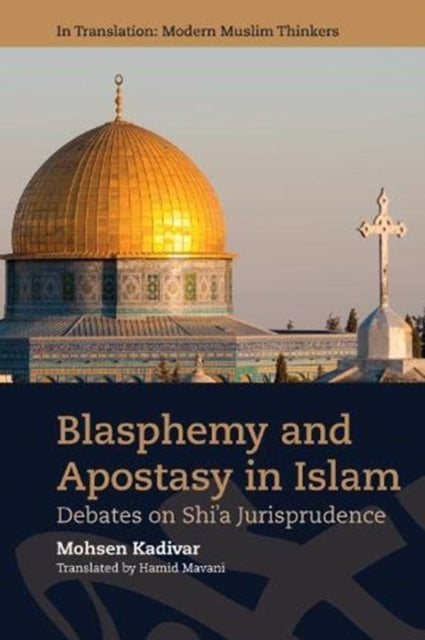
Mohsen Kadivar
Blasphemy and Apostasy in Islam: Debates on Shi'a Jurisprudence
Blasphemy and Apostasy in Islam: Debates on Shi'a Jurisprudence
💎 Earn 383 Points (£3.83) on this item.
YOU SAVE £23.30
- Condition: Brand new
- UK Delivery times: Usually arrives within 2 - 3 working days
- UK Shipping: Fee starts at £2.39. Subject to product weight & dimension
Bulk ordering. Want 15 or more copies? Get a personalised quote and bigger discounts. Learn more about bulk orders.
Couldn't load pickup availability
- More about Blasphemy and Apostasy in Islam: Debates on Shi'a Jurisprudence
Mohsen Kadivar's book explores the issue of blasphemy and apostasy from the perspective of Shi a jurisprudence, arguing for a polarisation between secularism and extremist religious orthodoxy. He debates the case of Rfiq Taqan, an Azerbaijani journalist and writer who was condemned to death by an Iranian cleric for a blasphemous news article in 2006. Kadivar takes a defensive stance against vigilante murders and questions whether death for apostasy reflects the true spirit of Islam.
Format: Hardback
Length: 352 pages
Publication date: 28 February 2021
Publisher: Edinburgh University Press
Is it lawful to shed the blood of someone who insults the Prophet Muhammad? Does the Qu ran stipulate a worldly punishment for apostates? This book tells the gripping story of Rafiq Taqan, Azerbaijani journalist and writer, who was condemned to death by an Iranian cleric for a blasphemous news article in 2006. Delving into the Qu ran and Hadith - the most sacred sources for all Muslims - Mohsen Kadivar explores the subject of blasphemy and apostasy from the perspective of Shi a jurisprudence to articulate a polarisation between secularism and extremist religious orthodoxy. In a series of online exchanges, he debates the case with Muhammad Jawad Fazel, the son of Grand Ayatollah Fazel Lankar who issued the fatwa pronouncing death penalty on Taq. While disapproving of the journalist's writings, Kadivar takes a defensive stance against vigilante murders and asks whether death for apostasy reflects the true spirit of Islam.
The Qu ran and Hadith, the most sacred sources for all Muslims, provide a comprehensive framework for understanding the issue of blasphemy and apostasy. Mohsen Kadivar, an Azerbaijani journalist and writer, has delved into these sources to explore the subject from the perspective of Shi a jurisprudence. In a series of online exchanges, he debates the case of Rafiq Taqan, an Azerbaijani journalist and writer who was condemned to death by an Iranian cleric for a blasphemous news article in 2006.
Kadivar argues that the Qu ran and Hadith do not stipulate a worldly punishment for apostates. He contends that the punishment for apostasy should be left to God and that the state should not interfere in religious matters. He further argues that the death penalty for apostasy is not in line with the true spirit of Islam, which promotes peace and tolerance.
However, Muhammad Jawad Fazel, the son of Grand Ayatollah Fazel Lankar who issued the fatwa pronouncing death penalty on Taq, takes a different stance. He argues that the Qu ran and Hadith clearly state that apostates should be killed and that the state should enforce this punishment. He further argues that the death penalty for apostasy is necessary to protect the integrity of the Islamic faith and to prevent the spread of heresy.
Kadivar's response to Fazel's arguments is nuanced. He acknowledges that the Qu ran and Hadith contain verses that appear to support the death penalty for apostasy, but he also points out that these verses are open to interpretation and that there are other verses that suggest a more lenient approach. He further argues that the death penalty for apostasy is not a practical solution to the problem of blasphemy and that it can lead to further violence and instability.
One of the key arguments that Kadivar makes is that the death penalty for apostasy is not in line with the principles of human rights. He argues that the right to life is a fundamental human right and that the state should not be allowed to take it away. He further argues that the death penalty for apostasy is a form of torture and that it violates the principles of justice and equality.
Kadivar also points out that the death penalty for apostasy can have a negative impact on the Muslim community. He argues that the death penalty for apostasy can create a sense of fear and insecurity among Muslims and that it can lead to the marginalization of certain groups within the community. He further argues that the death penalty for apostasy can undermine the efforts of Muslim scholars and activists who are working to promote peace and tolerance.
In addition to his arguments against the death penalty for apostasy, Kadivar also offers a solution to the problem of blasphemy and apostasy. He argues that the state should promote religious tolerance and that it should work to create a society that is respectful of all religions. He further argues that the state should provide education and training to Muslims and that it should work to address the underlying causes of blasphemy and apostasy.
One of the challenges that Kadivar faces in his argument is the fact that many Muslims believe that the death penalty for apostasy is a necessary part of Islam. This belief is often based on a misinterpretation of the Qu ran and Hadith. Kadivar argues that it is important to educate Muslims about the true meaning of these sources and to encourage them to think critically about the issues that they face.
Another challenge that Kadivar faces is the fact that some Muslims use the death penalty for apostasy as a tool of political oppression. Kadivar argues that this is a violation of human rights and that the state should take steps to prevent it. He further argues that the state should work to promote democracy and to ensure that all citizens have the right to participate in the political process.
In conclusion, Mohsen Kadivar's book provides a compelling and nuanced analysis of the issue of blasphemy and apostasy from the perspective of Shi a jurisprudence. He argues that the Qu ran and Hadith do not stipulate a worldly punishment for apostates and that the death penalty for apostasy is not in line with the principles of human rights. He further offers a solution to the problem of blasphemy and apostasy that involves promoting religious tolerance and creating a society that is respectful of all religions. While Kadivar's arguments may be controversial, they are worth considering and should be taken seriously by all Muslims.
Weight: 660g
Dimension: 145 x 224 x 32 (mm)
ISBN-13: 9781474457576
UK and International shipping information
UK and International shipping information
UK Delivery and returns information:
- Delivery within 2 - 3 days when ordering in the UK.
- Shipping fee for UK customers from £2.39. Fully tracked shipping service available.
- Returns policy: Return within 30 days of receipt for full refund.
International deliveries:
Shulph Ink now ships to Australia, Belgium, Canada, France, Germany, Ireland, Italy, India, Luxembourg Saudi Arabia, Singapore, Spain, Netherlands, New Zealand, United Arab Emirates, United States of America.
- Delivery times: within 5 - 10 days for international orders.
- Shipping fee: charges vary for overseas orders. Only tracked services are available for most international orders. Some countries have untracked shipping options.
- Customs charges: If ordering to addresses outside the United Kingdom, you may or may not incur additional customs and duties fees during local delivery.