Duncan Weldon
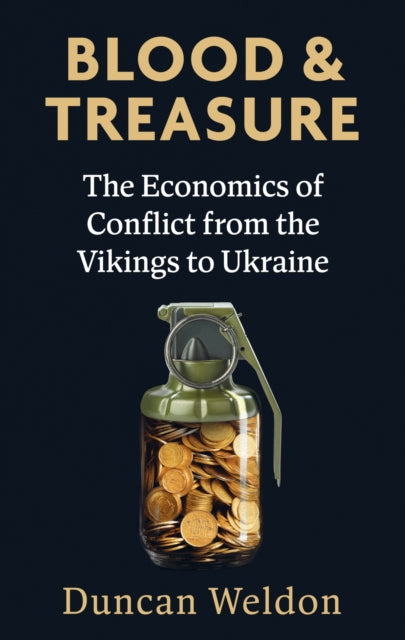
Blood and Treasure: The Economics of Conflict from the Vikings to Ukraine
Blood and Treasure: The Economics of Conflict from the Vikings to Ukraine
💎 Earn 89 Points (£0.89) on this item.
YOU SAVE £7.15
- Condition: Brand new
- UK Delivery times: Usually arrives within 2 - 3 working days
- UK Shipping: Fee starts at £2.39. Subject to product weight & dimension
Bulk ordering. Want 15 or more copies? Get a personalised quote and bigger discounts. Learn more about bulk orders.
Couldn't load pickup availability
- More about Blood and Treasure: The Economics of Conflict from the Vikings to Ukraine
Blood and Treasure explores the economics of conflict from the Viking Age to the war in Ukraine, examining how incentives and institutions have changed over time and how warfare may have driven Europe's rise to global prominence. It also asks whether Genghis Khan should be regarded as the father of globalisation, explains how New World gold and silver kept Spain poor, and assesses if economic theories helped to create a tragedy in Vietnam.
Format: Hardback
Length: 320 pages
Publication date: 05 June 2025
Publisher: Little, Brown Book Group
Blood and Treasure is a captivating book that explores the economics of conflict from the Viking Age to the war in Ukraine. Written by JAMES HOLLAND, a renowned economist, and MARTIN WOLF, the Chief Economics Editor of the Financial Times, the book offers a fascinating and surprising perspective on the relationship between war and economics.
Blood and Treasure: The Economics of Conflict from the Viking Age to the War in Ukraine
Blood and Treasure is a captivating book that explores the economics of conflict from the Viking Age to the war in Ukraine. Written by JAMES HOLLAND, a renowned economist, and MARTIN WOLF, the Chief Economics Editor of the Financial Times, the book offers a fascinating and surprising perspective on the relationship between war and economics.
A Brilliant Book
JAMES HOLLAND, a renowned economist, has praised Blood and Treasure as a "brilliant book." He notes that the book is "chock full of marvellous nuggets" and that it is both important and surprisingly cheering. MARTIN WOLF, the Chief Economics Editor of the Financial Times, has also praised the book, calling it "a delightfully quirky approach to military history."
Chock Full of Marvelous Nuggets
SPECTATOR has described Blood and Treasure as a "delightfully quirky approach to military history." The book is chock full of marvellous nuggets, which make it both important and surprisingly cheering. ED CONWAY, a historian, has praised the book for its "delightfully quirky approach to military history."
Wars Are Expensive
Wars are expensive, both in human terms and monetary ones. But while warfare might be costly, it has also, at times, been an important driver of economic change and progress. Over the long span of history, nothing has shaped human institutions - and thus the process of economic development - as much as war and violence. Wars made states and states made wars. As the costs of warfighting grew, so did state structures, taxation systems, and national markets for debt. And as warfare became ever more destructive, the incentive for governments to resort to it changed too.
Blood and Treasure Looks at the History and Economics of Warfare
Blood and Treasure looks at the history and economics of warfare from the Viking Age to the war in Ukraine, examining how incentives and institutions have changed over time. It surveys how warfare may have driven Europe's rise to global prominence, and it explains how the total wars of the twentieth century required a new type of strategy, one that took economics seriously.
Along the Way, It Asks Whether Genghis Khan Should Be Regarded as the Father of Globalization
Along the way, Blood and Treasure asks whether Genghis Khan should be regarded as the father of globalization. It explains how New World gold and silver kept Spain poor, ponders why some economists think of witch trials as a form of non-price competition, notes how pirate captains were pioneers of effective HR techniques, asks if handing out medals hurt the Luftwaffe in the Second World War, and assesses if economic theories helped the war effort.
Conclusion
Blood and Treasure is a captivating book that explores the economics of conflict from the Viking Age to the war in Ukraine. Written by JAMES HOLLAND, a renowned economist, and MARTIN WOLF, the Chief Economics Editor of the Financial Times, the book offers a fascinating and surprising perspective on the relationship between war and economics. Whether you are interested in history, economics, or military history, Blood and Treasure is a must-read.
Weight: 544g
Dimension: 162 x 243 x 29 (mm)
ISBN-13: 9780349145396
This item can be found in:
UK and International shipping information
UK and International shipping information
UK Delivery and returns information:
- Delivery within 2 - 3 days when ordering in the UK.
- Shipping fee for UK customers from £2.39. Fully tracked shipping service available.
- Returns policy: Return within 30 days of receipt for full refund.
International deliveries:
Shulph Ink now ships to Australia, Belgium, Canada, France, Germany, Ireland, Italy, India, Luxembourg Saudi Arabia, Singapore, Spain, Netherlands, New Zealand, United Arab Emirates, United States of America.
- Delivery times: within 5 - 10 days for international orders.
- Shipping fee: charges vary for overseas orders. Only tracked services are available for most international orders. Some countries have untracked shipping options.
- Customs charges: If ordering to addresses outside the United Kingdom, you may or may not incur additional customs and duties fees during local delivery.