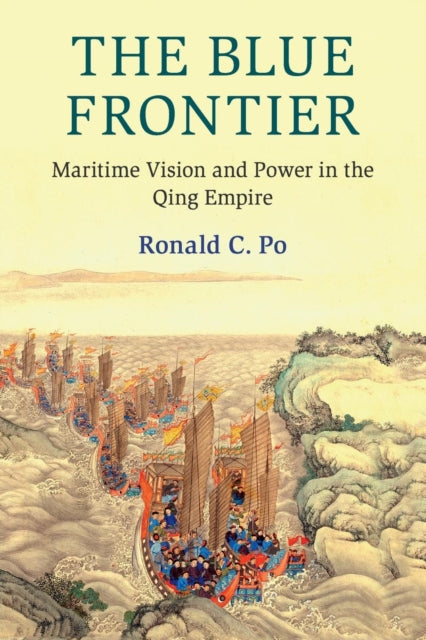
Ronald C.Po
Blue Frontier: Maritime Vision and Power in the Qing Empire
Blue Frontier: Maritime Vision and Power in the Qing Empire
💎 Earn 179 Points (£1.79) on this item.
We can order this item for you. Delivery usually takes about 4 to 6 weeks.
This item is not held in our immediate stock. We will order it for you after checkout.
Estimated delivery: About 4 to 6 weeks
YOU SAVE £2.13
- Condition: Brand new
- UK Delivery times: Usually arrives within 2 - 3 working days
- UK Shipping: Fee starts at £2.39. Subject to product weight & dimension
Bulk ordering. Want 15 or more copies? Get a personalised quote and bigger discounts. Learn more about bulk orders.
Couldn't load pickup availability
- More about Blue Frontier: Maritime Vision and Power in the Qing Empire
Ronald C. Po argues that the Qing Empire was not a landlocked state but was integrated into the maritime world through its naval development and customs institutionalization. The Blue Frontier offers a broader picture of the Qing as an Asian giant responding flexibly to challenges and extensive interaction on all frontiers.
\n Format: Paperback / softback
\n Length: 308 pages
\n Publication date: 13 June 2019
\n Publisher: Cambridge University Press
\n
In this reimagining of the eighteenth-century Qing Empire through a maritime lens, Ronald C. Po challenges the notion that China should be solely perceived as a continental power with limited engagement in the sea. With a vast coastline spanning nearly 14,500 kilometers, the Qing Empire was far from landlocked. Despite its reputation as an inward-looking empire, Po argues that the Qing was deeply interconnected with the maritime world through its naval development and the institutionalization of customs. Contrary to conventional wisdom, the Manchu court actively engaged with the ocean on political, military, and conceptual levels. The Blue Frontier presents a more comprehensive view of the Qing as an Asian powerhouse, adeptly responding to diverse challenges and engaging extensively on land and sea fronts throughout the long eighteenth century.
The Qing Empire, a vast and influential empire in eighteenth-century Asia, was not just a landlocked state. With a staggering coastline of nearly 14,500 kilometers, the Qing was deeply connected to the sea. Despite its inward-looking reputation, the empire was not isolated from the maritime world. In fact, the Manchu court actively engaged with the ocean on political, military, and conceptual levels.
One of the most significant ways in which the Qing integrated with the maritime world was through its naval development. The empire built a large and powerful navy, which was used to patrol its vast coastline, protect trade routes, and engage in territorial disputes with other nations. The Qing navy was equipped with advanced ships, weapons, and technology, and it played a crucial role in the empire's expansion and dominance in the region.
In addition to its naval power, the Qing also institutionalized customs regulations that facilitated trade and commerce with the ocean. These customs regulations were designed to promote stability and order in the maritime sphere, and they helped to establish the Qing Empire as a major player in the global trade network.
The Manchu court, in particular, was deeply involved in ocean politics. The empire's rulers recognized the strategic importance of the sea and sought to expand their influence in the region. They established ports and trading centers along the coast, and they maintained diplomatic relations with other maritime powers such as Japan and the Netherlands. The court also sent expeditions to explore the ocean and expand the empire's territorial claims.
On the military front, the Qing navy played a crucial role in defending the empire's coastline against foreign invasions. The empire's naval power was often used to deter or defeat rival powers, and it helped to maintain stability and order in the region.
In addition to its military and economic interests, the Manchu court also had a conceptual understanding of the ocean. The empire's rulers believed that the sea was a source of power and wealth, and they sought to harness its resources for their benefit. They encouraged maritime trade and exploration, and they promoted the development of marine technology and science.
The Blue Frontier, a book by Ronald C. Po, offers a comprehensive view of the Qing Empire as an Asian giant that was deeply integrated into the maritime world. Po challenges the notion that the empire was solely a landlocked power and argues that it was a dynamic and adaptable empire that responded flexibly to challenges and extensive interaction on all frontiers, both land and sea.
The book explores the empire's naval development, customs regulations, and political engagement with the ocean. It also highlights the empire's interactions with other maritime powers, such as Japan and the Netherlands, and the role that the sea played in the empire's expansion and dominance.
One of the key themes of The Blue Frontier is the empire's ability to adapt to changing circumstances and engage extensively on all frontiers. The Qing Empire faced a variety of challenges throughout its history, including internal rebellions, foreign invasions, and economic downturns. However, the empire was able to respond to these challenges flexibly and effectively, using its naval power, customs regulations, and political engagement with the ocean to maintain stability and order in the region.
The book also emphasizes the importance of the sea in shaping the empire's culture and identity. The sea was a source of inspiration for the empire's artists, writers, and scholars, and it played a central role in the empire's religious and cultural practices. The empire's rulers believed that the sea was a symbol of power and strength, and they sought to harness its resources for their benefit.
In conclusion, the Qing Empire was not just a landlocked state but a deeply interconnected and dynamic empire that was deeply integrated into the maritime world. The empire's naval development, customs regulations, and political engagement with the ocean played a crucial role in its expansion and dominance in the region. The Manchu court, in particular, was deeply involved in ocean politics and sought to harness the sea's resources for their benefit. The Blue Frontier offers a comprehensive view of the Qing Empire as an Asian giant that was adept at responding to challenges and engaging extensively on all frontiers, both land and sea.
\n Weight: 454g\n
Dimension: 152 x 321 x 20 (mm)\n
ISBN-13: 9781108440721\n \n
UK and International shipping information
UK and International shipping information
UK Delivery and returns information:
- Delivery within 2 - 3 days when ordering in the UK.
- Shipping fee for UK customers from £2.39. Fully tracked shipping service available.
- Returns policy: Return within 30 days of receipt for full refund.
International deliveries:
Shulph Ink now ships to Australia, Belgium, Canada, France, Germany, Ireland, Italy, India, Luxembourg Saudi Arabia, Singapore, Spain, Netherlands, New Zealand, United Arab Emirates, United States of America.
- Delivery times: within 5 - 10 days for international orders.
- Shipping fee: charges vary for overseas orders. Only tracked services are available for most international orders. Some countries have untracked shipping options.
- Customs charges: If ordering to addresses outside the United Kingdom, you may or may not incur additional customs and duties fees during local delivery.