Edmund T.Rolls
Brain Computations and Connectivity
Brain Computations and Connectivity
💎 Earn 703 Points (£7.03) on this item.
We can order this item for you. Delivery usually takes about 4 to 6 weeks.
This item is not held in our immediate stock. We will order it for you after checkout.
Estimated delivery: About 4 to 6 weeks
- Condition: Brand new
- UK Delivery times: Usually arrives within 2 - 3 working days
- UK Shipping: Fee starts at £2.39. Subject to product weight & dimension
Bulk ordering. Want 15 or more copies? Get a personalised quote and bigger discounts. Learn more about bulk orders.
Couldn't load pickup availability
- More about Brain Computations and Connectivity
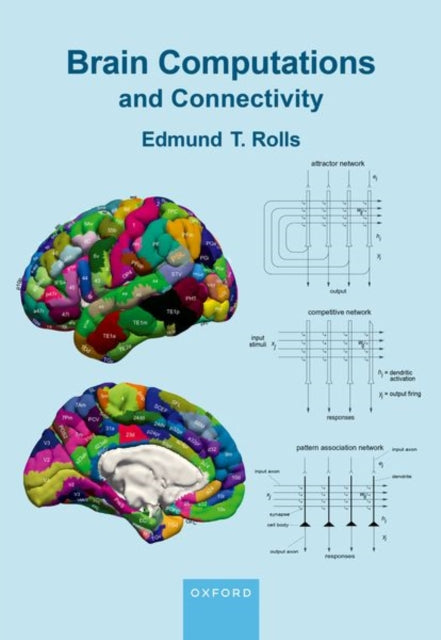
The book "Brain Computations and Connectivity" explores how the brain works by examining what is computed by different brain systems and how these computations are performed. It discusses current computational approaches and models of brain function, with potential applications in understanding ourselves better in health and disease, as well as in artificial intelligence. The book is pioneering in its approach and will be of interest to scientists from various fields.
Format: Hardback
Length: 1184 pages
Publication date: 11 July 2023
Publisher: Oxford University Press
The brain is a complex organ that performs a wide range of functions, from processing sensory information to making decisions and controlling our behavior. Understanding how the brain works is essential for understanding ourselves better in both health and disease. In this book, we will explore the computations performed by different brain systems and the models that describe these computations.
The brain is made up of many different regions, each with its own specialized functions. For example, the visual cortex processes visual information, the auditory cortex processes sound, and the motor cortex controls our movements. Each of these regions performs computations that are specific to its function.
One of the key questions in brain science is what is computed by these different brain systems. Researchers have identified a range of computations that are performed by the brain, including sensory processing, decision-making, memory, and language. Sensory processing involves the conversion of sensory information into neural signals that can be interpreted by the brain. Decision-making involves the processing of information and the generation of appropriate responses. Memory involves the storage and retrieval of information. Language involves the production and comprehension of speech.
Another important question is how these computations are performed. Researchers have identified a range of computational approaches and models that describe how the brain computes. These models include neural networks, artificial neural networks, and computational neuroscience. Neural networks are modeled after the structure of the brain and consist of interconnected neurons that transmit signals to each other. Artificial neural networks are computer programs that mimic the behavior of neural networks. Computational neuroscience is a field that combines neuroscience and computer science to study the brain's function.
Understanding the brain in this way has enormous potential for understanding ourselves better in health and disease. For example, knowledge of how the brain processes sensory information can help us develop new treatments for disorders such as blindness and deafness. Knowledge of how the brain makes decisions can help us develop new treatments for disorders such as addiction and depression.
In addition, understanding the brain has potential applications in the field of artificial intelligence. Artificial intelligence is a field that aims to develop computer programs that can mimic human intelligence and perform tasks that are traditionally performed by humans. By understanding how the brain works, researchers can develop new algorithms and models that can improve the performance of artificial intelligence systems.
This book is pioneering in taking this approach to brain function. It considers what is computed by many of our brain systems and how it is computed, and updates by much new evidence, including the connectivity of the human brain. The book will be of interest to all scientists interested in brain function and how the brain works, whether they are from neuroscience, medical sciences, computational science, or theoretical physics.
In conclusion, the brain is a complex organ that performs a wide range of functions. Understanding how the brain works is essential for understanding ourselves better in both health and disease. This book provides a comprehensive overview of the computations performed by different brain systems and the models that describe these computations. By understanding the brain in this way
way, we can develop new treatments for disorders, improve the performance of artificial intelligence systems, and gain a deeper understanding of ourselves and the world around us.
Weight: 1936g
Dimension: 178 x 255 x 53 (mm)
ISBN-13: 9780198887911
Edition number: 2 Revised edition
This item can be found in:
UK and International shipping information
UK and International shipping information
UK Delivery and returns information:
- Delivery within 2 - 3 days when ordering in the UK.
- Shipping fee for UK customers from £2.39. Fully tracked shipping service available.
- Returns policy: Return within 30 days of receipt for full refund.
International deliveries:
Shulph Ink now ships to Australia, Belgium, Canada, France, Germany, Ireland, Italy, India, Luxembourg Saudi Arabia, Singapore, Spain, Netherlands, New Zealand, United Arab Emirates, United States of America.
- Delivery times: within 5 - 10 days for international orders.
- Shipping fee: charges vary for overseas orders. Only tracked services are available for most international orders. Some countries have untracked shipping options.
- Customs charges: If ordering to addresses outside the United Kingdom, you may or may not incur additional customs and duties fees during local delivery.