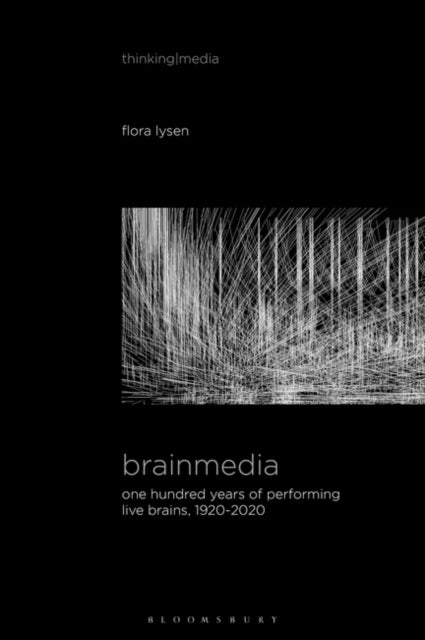
FloraLysen
Brainmedia: One Hundred Years of Performing Live Brains, 1920–2020
Brainmedia: One Hundred Years of Performing Live Brains, 1920–2020
💎 Earn 159 Points (£1.59) on this item.
We can order this item for you. Delivery usually takes about 4 to 6 weeks.
This item is not held in our immediate stock. We will order it for you after checkout.
Estimated delivery: About 4 to 6 weeks
- Condition: Brand new
- UK Delivery times: Usually arrives within 2 - 3 working days
- UK Shipping: Fee starts at £2.39. Subject to product weight & dimension
Bulk ordering. Want 15 or more copies? Get a personalised quote and bigger discounts. Learn more about bulk orders.
Couldn't load pickup availability
- More about Brainmedia: One Hundred Years of Performing Live Brains, 1920–2020
Brainmedia explores how new media technologies have enabled the visualization and study of the active human brain, showcasing examples from the past and present. It argues that practices of mediation have influenced the imagination of seeing the brain at work and highlights the role of popularization in scientific work.
Format: Paperback / softback
Length: 304 pages
Publication date: 21 March 2024
Publisher: Bloomsbury Publishing Plc
The quest to observe the brain at work has captivated the minds of scientists and science educators for centuries. While the human brain remains a complex and enigmatic organ, recent advancements in new media technologies have opened up unprecedented opportunities to glimpse its inner workings. From exhibitions of giant illuminated brain models to staged projections of brainwave recordings, and even live televised brain broadcasts, scientists and educators have sought to bring the brain to life in ways that were once unimaginable.
In Brainmedia, a groundbreaking book by Dr. Sarah Pink, we explore the past and present examples of scientists and science educators who have conceptualized and demonstrated the active human brain guided by new media technologies. Through a rich tapestry of archival material, Pink outlines a new history of "live brains," arguing that practices of mediation impacted the imagination of seeing the brain at work. By combining accounts of scientists examining brains in laboratories with examples of public demonstrations and exhibitions of brain research, Pink casts new light on popularization practices, placing them at the heart of scientific work.
One of the key themes of Brainmedia is the role of visualization in shaping our understanding of the brain. From the early days of anatomical studies, where artists meticulously depicted the brain's structures, to modern-day imaging techniques that allow us to see the brain in action, visualization has played a crucial role in shaping our understanding of the brain. In the book, Pink highlights the work of scientists and artists who have pushed the boundaries of visualization, creating stunning images and animations that help us to understand the complex processes that take place within the brain.
Another important aspect of Brainmedia is the relationship between scientific work and popularization. Pink argues that practices of mediation, such as exhibitions, demonstrations, and media coverage, have played a significant role in popularizing brain research. By bringing the brain to life in ways that are accessible and engaging to the public, scientists have been able to reach a wider audience and promote the importance of their work. This has had a positive impact on scientific funding, public awareness, and the development of new research techniques.
However, the quest to observe the brain at work has not been without its challenges. One of the biggest challenges is the ethical considerations that come with studying the brain. The brain is a sensitive organ, and any research that involves probing or manipulating it raises concerns about the potential harm that could be caused to the subject. Scientists must navigate a complex web of ethical guidelines and regulations to ensure that their research is conducted in a responsible and ethical manner.
Another challenge is the sheer complexity of the brain. The brain is a vast network of billions of neurons, each of which interacts with hundreds of other neurons. This complexity makes it difficult to study the brain in its entirety, and researchers must rely on a range of techniques, such as imaging, electrophysiology, and cognitive neuroscience, to gain a deeper understanding of the brain's functions.
Despite these challenges, the quest to observe the brain at work continues to be an important area of research. By leveraging new media technologies and combining accounts of scientific work with examples of popularization, scientists and educators are able to shed new light on the complex processes that take place within the human brain. This knowledge has the potential to improve our understanding of brain diseases, develop new treatments, and enhance our overall understanding of the human mind and consciousness.
In conclusion, the quest to observe the brain at work has been a long and fascinating journey that has been driven by the desire to understand the human mind and consciousness. While the brain remains a complex and enigmatic organ, recent advancements in new media technologies have opened up unprecedented opportunities to glimpse its inner workings. Through the work of scientists and science educators, we have been able to explore the past and present examples of "live brains," and gain a deeper understanding of the role of visualization, popularization, and ethical considerations in shaping our understanding of the brain. As we continue to advance our knowledge of the brain, we can expect to see new discoveries and innovations that will continue to push the boundaries of what we know and what we can achieve.
Dimension: 216 x 140 (mm)
ISBN-13: 9781501378720
This item can be found in:
UK and International shipping information
UK and International shipping information
UK Delivery and returns information:
- Delivery within 2 - 3 days when ordering in the UK.
- Shipping fee for UK customers from £2.39. Fully tracked shipping service available.
- Returns policy: Return within 30 days of receipt for full refund.
International deliveries:
Shulph Ink now ships to Australia, Belgium, Canada, France, Germany, Ireland, Italy, India, Luxembourg Saudi Arabia, Singapore, Spain, Netherlands, New Zealand, United Arab Emirates, United States of America.
- Delivery times: within 5 - 10 days for international orders.
- Shipping fee: charges vary for overseas orders. Only tracked services are available for most international orders. Some countries have untracked shipping options.
- Customs charges: If ordering to addresses outside the United Kingdom, you may or may not incur additional customs and duties fees during local delivery.