Shulph Ink
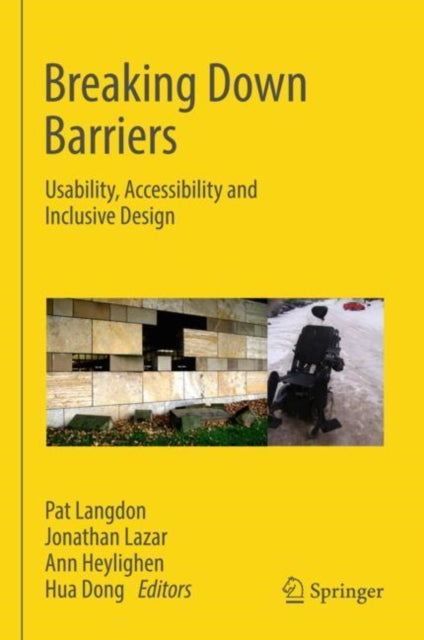
Breaking Down Barriers: Usability, Accessibility and Inclusive Design
Breaking Down Barriers: Usability, Accessibility and Inclusive Design
💎 Earn 535 Points (£5.35) on this item.
YOU SAVE £92.89
- Condition: Brand new
- UK Delivery times: Usually arrives within 2 - 3 working days
- UK Shipping: Fee starts at £2.39. Subject to product weight & dimension
Bulk ordering. Want 15 or more copies? Get a personalised quote and bigger discounts. Learn more about bulk orders.
Couldn't load pickup availability
- More about Breaking Down Barriers: Usability, Accessibility and Inclusive Design
The Cambridge Workshops on Universal Access and Assistive Technology (CWUAAT) is a global workshop that brings together professionals from diverse fields to discuss inclusive design and break down barriers between disciplines, users, designers, and developers. The workshop has five main themes based on barriers identified in the developing field of design for inclusion, and its goal is to break down barriers in technical, physical, and architectural design, as well as between different professional communities.
Format: Hardback
Length: 286 pages
Publication date: 20 February 2018
Publisher: Springer International Publishing AG
The Cambridge Workshops on Universal Access and Assistive Technology (CWUAAT) stands as a remarkable platform where individuals from diverse fields, including designers, computer scientists, engineers, architects, ergonomists, ethnographers, policymakers, and user communities, converge to explore, discuss, and collaborate on the topic of inclusive design. With its growing international presence, CWUAAT has emerged as a truly global workshop, representing a diverse array of cultures from Portugal, Germany, Trinidad and Tobago, Canada, Australia, China, Norway, USA, Belgium, UK, and many more.
The workshop is structured around five central themes that emerged from the identification of barriers in the emerging field of design for inclusion. These themes serve as guiding pillars for the discussions and collaborations that take place within the workshop:
Breaking Down Barriers between Disciplines: CWUAAT recognizes the importance of dismantling the silos between different disciplines involved in inclusive design. By fostering interdisciplinary collaboration, participants can leverage their expertise and perspectives to create holistic solutions that address the diverse needs of users.
Breaking Down Barriers between Users, Designers, and Developers: This theme focuses on bridging the gap between users, designers, and developers to ensure that inclusive design is not solely driven by technological advancements but also by a deep understanding of user needs and preferences. It emphasizes the importance of user-centered design and the involvement of stakeholders throughout the design process.
Removing Barriers to Usability, Accessibility, and Inclusive Design: CWUAAT aims to tackle the barriers that hinder the usability, accessibility, and inclusive design of products, services, and spaces. It explores strategies and techniques to make these aspects of design more accessible and inclusive to people with diverse abilities and needs.
Breaking Down Barriers between People with Impairments and Those without: Recognizing the unique challenges faced by individuals with impairments, CWUAAT seeks to break down the barriers that prevent them from fully participating in society. It explores ways to create inclusive environments and technologies that support the participation and inclusion of people with disabilities.
Breaking Down Barriers between Research and Policy-making: CWUAAT recognizes the crucial role of research in shaping inclusive policies and practices. It encourages dialogue between researchers and policymakers to ensure that research findings are translated into actionable insights and policies that promote accessibility and inclusion for all.
In the context of developing demographic changes, characterized by an increasing number of older people and individuals living with impairments, the field of inclusive design research strives to bridge the gap between the capabilities of the population and the design of products, services, and spaces. CWUAAT has always maintained a strong multidisciplinary focus, but to truly evolve into transdisciplinary fields, it is essential to identify and characterize the final barriers that hinder integrated research. Only then can the full benefits of inclusive design be realized in society.
It is important to note that barriers to inclusive design do not arise solely from impairments themselves but rather from the human-imposed limitations that often fail to consider the broader range of sensory, cognitive, and physical user capabilities. These barriers extend beyond technical and architectural considerations and permeate various aspects of society, including communication and cultural norms.
To overcome these barriers, CWUAAT fosters a collaborative and inclusive environment where participants can exchange ideas, share experiences, and work towards innovative solutions. The workshop encourages cross-disciplinary collaboration, promoting the exchange of knowledge and expertise across different fields. By breaking down silos and fostering a sense of shared responsibility, CWUAAT aims to create a transformative impact on the field of inclusive design and contribute to the creation of a more inclusive and accessible world for all.
In conclusion, the Cambridge Workshops on Universal Access and Assistive Technology (CWUAAT) serve as a pivotal platform for individuals and communities dedicated to promoting inclusive design. With its multidisciplinary focus, international presence, and commitment to breaking down barriers, CWUAAT plays a crucial role in shaping the future of accessibility and inclusion. By fostering interdisciplinary collaboration, removing barriers, and promoting inclusive practices, CWUAAT contributes to the creation of a more equitable and accessible society for all.
Weight: 576g
Dimension: 166 x 244 x 18 (mm)
ISBN-13: 9783319750279
Edition number: 1st ed. 2018
This item can be found in:
UK and International shipping information
UK and International shipping information
UK Delivery and returns information:
- Delivery within 2 - 3 days when ordering in the UK.
- Shipping fee for UK customers from £2.39. Fully tracked shipping service available.
- Returns policy: Return within 30 days of receipt for full refund.
International deliveries:
Shulph Ink now ships to Australia, Belgium, Canada, France, Germany, Ireland, Italy, India, Luxembourg Saudi Arabia, Singapore, Spain, Netherlands, New Zealand, United Arab Emirates, United States of America.
- Delivery times: within 5 - 10 days for international orders.
- Shipping fee: charges vary for overseas orders. Only tracked services are available for most international orders. Some countries have untracked shipping options.
- Customs charges: If ordering to addresses outside the United Kingdom, you may or may not incur additional customs and duties fees during local delivery.