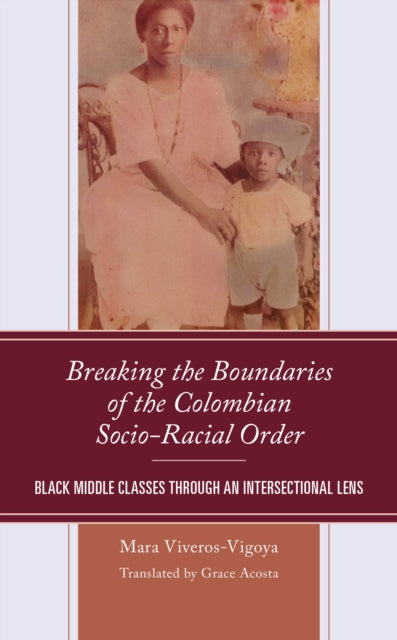
Mara Viveros-Vigoya
Breaking the Boundaries of the Colombian Socio-Racial Order: Black Middle Classes through an Intersectional Lens
Breaking the Boundaries of the Colombian Socio-Racial Order: Black Middle Classes through an Intersectional Lens
💎 Earn 424 Points (£4.24) on this item.
We can order this item for you. Delivery usually takes about 4 to 6 weeks.
This item is not held in our immediate stock. We will order it for you after checkout.
Estimated delivery: About 4 to 6 weeks
- Condition: Brand new
- UK Delivery times: Usually arrives within 2 - 3 working days
- UK Shipping: Fee starts at £3.89. Subject to product weight & dimension
Bulk ordering. Want 15 or more copies? Get a personalised quote and bigger discounts. Learn more about bulk orders.
Couldn't load pickup availability
- More about Breaking the Boundaries of the Colombian Socio-Racial Order: Black Middle Classes through an Intersectional Lens
Breaking the Boundaries of the Colombian Socio-Racial Order: Black Middle Classes through an Intersectional Lens challenges the perception of Afrodescendant 'communities as uniformly impoverished and emphasizes the interconnectedness of class with geographical and historical contexts and with axes of social inequality.
Format: Hardback
Length: 234 pages
Publication date: 15 December 2023
Publisher: Lexington Books
Breaking the Boundaries of the Colombian Socio-Racial Order: Black Middle Classes through an Intersectional Lens is a groundbreaking book by anthropologist and intersectional feminist Mara Viveros-Vigoya that explores the complex and multifaceted nature of Blackness and middle-class status in Colombia. Through an intersectional perspective, the book challenges the perception of Afrodescendant communities as uniformly impoverished and emphasizes the interconnectedness of class with geographical and historical contexts and with axes of social inequality such as gender, race, and age. Viveros-Vigoya argues that while Blackness and upward social mobility have become more compatible since the inauguration of neoliberal multiculturalism in the 1990s, it remains to be seen whether we are advancing towards a global agenda of social justice or if we are simply opening some spaces for social and political mobility that serve largely to reproduce the status quo in the name of racial equality.
The book begins by tracing the history of Blackness in Colombia, from the arrival of enslaved Africans in the 16th century to the present day. Viveros-Vigoya highlights the ways in which Blackness has been constructed and marginalized throughout history, including through the use of racialized stereotypes, discrimination, and violence. She also explores the ways in which Blackness has been resisted and challenged, including through the formation of Black communities, the development of Black cultural practices, and the pursuit of social and political rights.
One of the key theoretical shifts introduced by the book is the concept of intersectionality. Intersectionality recognizes that different forms of oppression, such as racism, sexism, and classism, are interconnected and cannot be understood in isolation. Viveros-Vigoya argues that this understanding is essential for understanding the experiences of Black people in Colombia and for developing effective strategies for addressing their challenges.
The book also explores the ways in which class has been configured in Colombia. Viveros-Vigoya argues that class is not simply a matter of income but is also shaped by factors such as education, occupation, and social status. She highlights the ways in which class has been used to justify discrimination and inequality, including through the implementation of neoliberal policies that have led to the concentration of wealth and power in the hands of a few.
The book also examines the ways in which Blackness and class intersect with gender and race. Viveros-Vigoya argues that Black women and men face unique challenges in Colombia, including gender-based violence, discrimination in the workplace, and limited access to education and healthcare. She also highlights the ways in which Blackness and class intersect with age, with older Black people facing particular challenges due to ageism and discrimination.
One of the most significant findings of the book is the way in which Blackness and class have been used to justify the exclusion of Black people from the political process. Viveros-Vigoya argues that the political system in Colombia is deeply rooted in racism and classism, and that Black people have been systematically excluded from political power and decision-making. She highlights the ways in which Black people have been mobilized to challenge this exclusion, including through the formation of Black political parties, the participation in protests and demonstrations, and the use of social media to raise awareness about their issues.
However, the book also highlights the ways in which Blackness and class have been used to promote social and political change. Viveros-Vigoya argues that Black people have been able to use their experiences of oppression to develop a strong sense of identity and solidarity, and that this has led to the development of a vibrant and diverse Black cultural scene in Colombia. She also highlights the ways in which Black people have been able to use their economic resources to support social and political causes, including through the development of Black-owned businesses and the provision of social services.
In conclusion, Breaking the Boundaries of the Colombian Socio-Racial Order: Black Middle Classes through an Intersectional Lens is a groundbreaking book that challenges the perception of Afrodescendant communities as uniformly impoverished and emphasizes the interconnectedness of class with geographical and historical contexts and with axes of social inequality such as gender, race, and age. The book introduces two important theoretical shifts, including the concept of intersectionality and the way in which class has been configured in Colombia. Through a series of case studies and interviews, the book explores the experiences of Black people in Colombia and the ways in which they have been able to use their experiences of oppression to develop a strong sense of identity and solidarity and to promote social and political change. While the book highlights the progress that has been made in recent years, it also warns that there is still much work to be done to achieve a global agenda of social justice.
Dimension: 229 x 152 (mm)
ISBN-13: 9781666919189
UK and International shipping information
UK and International shipping information
We deliver throughout the United Kingdom and to 128 countries and territories worldwide, including the United States, Australia, Canada, Germany, Spain and France.