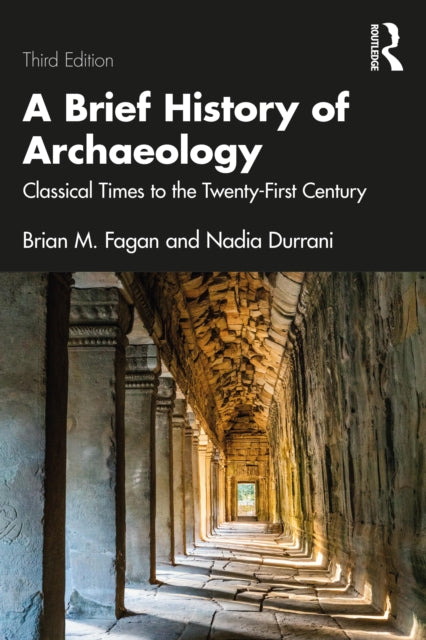
Nadia Durrani,Brian M.Fagan
Brief History of Archaeology: Classical Times to the Twenty-First Century
Brief History of Archaeology: Classical Times to the Twenty-First Century
💎 Earn 429 Points (£4.29) on this item.
We can order this item for you. Delivery usually takes about 4 to 6 weeks.
This item is not held in our immediate stock. We will order it for you after checkout.
Estimated delivery: About 4 to 6 weeks
YOU SAVE £5.10
- Condition: Brand new
- UK Delivery times: Usually arrives within 2 - 3 working days
- UK Shipping: Fee starts at £2.39. Subject to product weight & dimension
Bulk ordering. Want 15 or more copies? Get a personalised quote and bigger discounts. Learn more about bulk orders.
Couldn't load pickup availability
- More about Brief History of Archaeology: Classical Times to the Twenty-First Century
A Brief History of Archaeology provides an overview of the development of archaeology as a multidisciplinary science, highlighting important discoveries and the contributions of archaeologists. It covers early digs, the modernization of excavation methods, and debates over human antiquity and evolution. The book explores the discovery of pre-industrial civilizations, ancient sites, and the excavation of famous artifacts. It also discusses recent sensational discoveries and the debates between processual and post-processual theory in the field.
Format: Paperback / softback
Length: 258 pages
Publication date: 31 December 2021
Publisher: Taylor & Francis Ltd
Archaeology, as a multidisciplinary field, has a rich and fascinating history that spans thousands of years. From early digs to modern advancements, archaeology has uncovered invaluable insights into the evolution of human societies. In this concise account, we will explore the key milestones and discoveries that have shaped our understanding of the past.
Early Research:
The study of archaeology began with the exploration of ancient sites such as Stonehenge in Britain. These early digs revealed the existence of sophisticated structures and artifacts, challenging prevailing beliefs about the age and development of human civilization.
Burial Mound Excavations:
Another significant milestone in archaeology was the excavation of burial mounds, which provided valuable information about ancient societies' social structures, religious practices, and economic systems. The discovery of the tomb of Tutankhamun in Egypt, for example, shed light on the wealth and power of the ancient pharaohs and their intricate burial rituals.
Herculaneum and Pompeii:
The eruption of Mount Vesuvius in 79 AD led to the destruction of the cities of Herculaneum and Pompeii, preserving them in remarkable detail. These excavations revealed the daily lives of ordinary people and the intricate social networks that existed in ancient Roman society.
Nineteenth-Century Debates:
The nineteenth century saw intense debates over human antiquity and the theory of evolution. The discovery of fossilized remains, such as those of Homo neanderthalensis, challenged the idea of human evolution as a linear process and sparked new theories about the origins and diversification of our species.
Pre-Industrial Civilizations:
In the early twentieth century, archaeologists made groundbreaking discoveries in Egypt, Mesopotamia, and Central America. The excavations at Troy and Mycenae, for example, provided insights into the military and political structures of ancient Greece and Troy. The Royal Burials at Ur, Iraq, revealed the wealth and sophistication of the Sumerian civilization.
Pharaoh Tutankhamun:
One of the most famous archaeological discoveries of all time was the tomb of Pharaoh Tutankhamun in 1922. The tomb contained an abundance of artifacts and treasures, including the famous golden death mask of Tutankhamun. This discovery not only shed light on the life and reign of the pharaoh but also provided valuable insights into Egyptian art, religion, and culture.
Recent Sensational Discoveries:
In recent years, archaeology has made sensational discoveries that have continued to expand our understanding of the past. The discovery of the tomb of King Tutankhamun's wife, Queen Nefertiti, in 1992, for example, provided new insights into the role of women in ancient Egyptian society.
Debates over Processual and Post-Processual Theory:
Archaeology has always been a field that is driven by theory and interpretation. In the early twenty-first century, there have been debates over two main theoretical approaches: processual and post-processual theory. Processual theory emphasizes the scientific method and the objective analysis of archaeological evidence, while post-processual theory emphasizes the importance of cultural and social context in interpreting the past.
Conclusion:
A Brief History of Archaeology provides a comprehensive and engaging introduction to the discipline of archaeology. From early research to modern discoveries, archaeology has uncovered a wealth of information about the evolution of human societies. Through the stories of archaeologists and the dramatic discoveries they have made, we have gained a deeper appreciation for the rich and complex history of our world. As we continue to explore and interpret the past, archaeology will remain an essential tool for understanding our past and shaping our future.
Weight: 514g
Dimension: 239 x 153 x 22 (mm)
ISBN-13: 9780367709440
Edition number: 3 New edition
This item can be found in:
UK and International shipping information
UK and International shipping information
UK Delivery and returns information:
- Delivery within 2 - 3 days when ordering in the UK.
- Shipping fee for UK customers from £2.39. Fully tracked shipping service available.
- Returns policy: Return within 30 days of receipt for full refund.
International deliveries:
Shulph Ink now ships to Australia, Belgium, Canada, France, Germany, Ireland, Italy, India, Luxembourg Saudi Arabia, Singapore, Spain, Netherlands, New Zealand, United Arab Emirates, United States of America.
- Delivery times: within 5 - 10 days for international orders.
- Shipping fee: charges vary for overseas orders. Only tracked services are available for most international orders. Some countries have untracked shipping options.
- Customs charges: If ordering to addresses outside the United Kingdom, you may or may not incur additional customs and duties fees during local delivery.