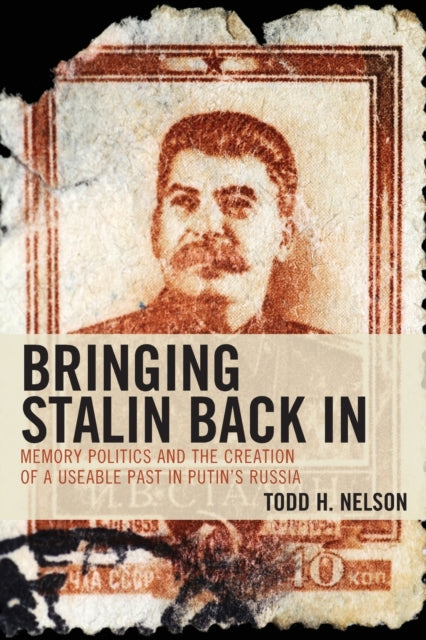
Todd H. Nelson
Bringing Stalin Back In: Memory Politics and the Creation of a Useable Past in Putin's Russia
Bringing Stalin Back In: Memory Politics and the Creation of a Useable Past in Putin's Russia
💎 Earn 191 Points (£1.91) on this item.
We can order this item for you. Delivery usually takes about 4 to 6 weeks.
This item is not held in our immediate stock. We will order it for you after checkout.
Estimated delivery: About 4 to 6 weeks
- Condition: Brand new
- UK Delivery times: Usually arrives within 2 - 3 working days
- UK Shipping: Fee starts at £2.39. Subject to product weight & dimension
Bulk ordering. Want 15 or more copies? Get a personalised quote and bigger discounts. Learn more about bulk orders.
Couldn't load pickup availability
- More about Bringing Stalin Back In: Memory Politics and the Creation of a Useable Past in Putin's Russia
This book explores how the political elite in Russia manipulate historical discourse about the Stalin period to advance their own political objectives,minimizing crimes and focusing on positive aspects of Stalin's rule. It analyzes how elites inhibit the emergence of alternative narratives and promote message-friendly groups that align with the Kremlins agenda,using state resources to co-opt multiple avenues of discourse formulation and dissemination. This strong state discourse is used to legitimize the return of authoritarianism in Russia today.
Format: Paperback / softback
Length: 182 pages
Publication date: 28 June 2021
Publisher: Lexington Books
While Joseph Stalin is commonly reviled in the West as a murderous tyrant who committed egregious human rights abuses against his own people, in Russia, he is often positively viewed as the symbol of Soviet-era stability and state power. How can there be such a disparity in perspectives? Utilizing an ethnographic approach, extensive interview data, and critical discourse analysis, this book examines the ways that the political elite in Russia are able to control and manipulate historical discourse about the Stalin period in order to advance their own political objectives. Appropriating the Stalinist discourse, they minimize or ignore outright crimes of the Soviet period, and instead focus on positive aspects of Stalin's rule, especially his role in leading the Soviet Union to victory in the Second World War. Advancing the concepts of "preventive" and "complex" co-optation, this book analyzes how elites in Russia inhibit the emergence of groups that espouse alternative narratives, while promoting message-friendly groups that are in line with the Kremlin's agenda. Bringing the resources of the state to bear, the Russian elite are able to co-opt multiple avenues of discourse formulation and dissemination. Elite-sponsored discourse positions Stalin as the symbol of a strong, centralized state that was capable of great achievements, despite great cost, enabling favorably portrayals of Stalin as part of a tradition of harsh but effective rulers in Russian history, such as Peter the Great. This strong state discourse is used to legitimize the return of authoritarianism in Russia today.
While Joseph Stalin is commonly reviled in the West as a murderous tyrant who committed egregious human rights abuses against his own people, in Russia, he is often positively viewed as the symbol of Soviet-era stability and state power. How can there be such a disparity in perspectives? Utilizing an ethnographic approach, extensive interview data, and critical discourse analysis, this book examines the ways that the political elite in Russia are able to control and manipulate historical discourse about the Stalin period in order to advance their own political objectives. Appropriating the Stalinist discourse, they minimize or ignore outright crimes of the Soviet period, and instead focus on positive aspects of Stalin's rule, especially his role in leading the Soviet Union to victory in the Second World War. Advancing the concepts of "preventive" and "complex" co-optation, this book analyzes how elites in Russia inhibit the emergence of groups that espouse alternative narratives, while promoting message-friendly groups that are in line with the Kremlin's agenda. Bringing the resources of the state to bear, the Russian elite are able to co-opt multiple avenues of discourse formulation and dissemination. Elite-sponsored discourse positions Stalin as the symbol of a strong, centralized state that was capable of great achievements, despite great cost, enabling favorably portrayals of Stalin as part of a tradition of harsh but effective rulers in Russian history, such as Peter the Great. This strong state discourse is used to legitimize the return of authoritarianism in Russia today.
Dimension: 229 x 152 (mm)
ISBN-13: 9781498591546
This item can be found in:
UK and International shipping information
UK and International shipping information
UK Delivery and returns information:
- Delivery within 2 - 3 days when ordering in the UK.
- Shipping fee for UK customers from £2.39. Fully tracked shipping service available.
- Returns policy: Return within 30 days of receipt for full refund.
International deliveries:
Shulph Ink now ships to Australia, Belgium, Canada, France, Germany, Ireland, Italy, India, Luxembourg Saudi Arabia, Singapore, Spain, Netherlands, New Zealand, United Arab Emirates, United States of America.
- Delivery times: within 5 - 10 days for international orders.
- Shipping fee: charges vary for overseas orders. Only tracked services are available for most international orders. Some countries have untracked shipping options.
- Customs charges: If ordering to addresses outside the United Kingdom, you may or may not incur additional customs and duties fees during local delivery.