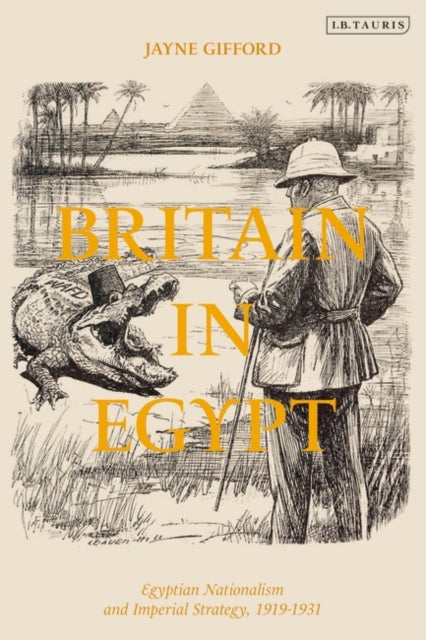
JayneGifford
Britain in Egypt: Egyptian Nationalism and Imperial Strategy, 1919-1931
Britain in Egypt: Egyptian Nationalism and Imperial Strategy, 1919-1931
💎 Earn 175 Points (£1.75) on this item.
We can order this item for you. Delivery usually takes about 4 to 6 weeks.
This item is not held in our immediate stock. We will order it for you after checkout.
Estimated delivery: About 4 to 6 weeks
- Condition: Brand new
- UK Delivery times: Usually arrives within 2 - 3 working days
- UK Shipping: Fee starts at £2.39. Subject to product weight & dimension
Bulk ordering. Want 15 or more copies? Get a personalised quote and bigger discounts. Learn more about bulk orders.
Couldn't load pickup availability
- More about Britain in Egypt: Egyptian Nationalism and Imperial Strategy, 1919-1931
During the British rule in Egypt, Egypt was a crucial part of British success in the Middle East and North Africa. However, the development of nationalism in Egypt after the First World War led to the foundation and growth of the nationalist Wafd party and the Muslim Brotherhood, which shattered the image of empire. Britain continued to control the Nile Valley through a policy of deliberate containment of nationalism until the Anglo-Egypt Treaty of 1936. This book is the first to study this process in detail and contains previously unpublished primary sources.
Format: Paperback / softback
Length: 272 pages
Publication date: 17 June 2021
Publisher: Bloomsbury Publishing PLC
The perception of Egypt under British rule tends to be colored by the events following the Suez Crisis, often seen as an inevitable disaster and the final blow to a declining empire. However, it is essential to recognize that for a significant period, Egypt played a pivotal role in British success across the Middle East and North Africa. This imperial image was shattered after the First World War, when nationalism emerged in Egypt, giving rise to the nationalist Wafd party led by Saad Zaghlul and the establishment of the Muslim Brotherhood in 1928. Despite this, Britain maintained control over the Nile Valley through a deliberate policy of containment of nationalism and a gradual relinquishment of powers, culminating in the Anglo-Egypt Treaty of 1936.
This book aims to provide a comprehensive examination of this process in the Nile Valley, delving into previously unpublished primary sources. It seeks to challenge the prevailing narrative that views Egypt's post-Suez era as solely a period of decline and instability, highlighting the complex and multifaceted nature of the country's history during this period. By exploring the interactions between British and Egyptian policymakers, the book sheds light on the strategies employed to maintain control over the Nile Valley and the challenges faced in balancing the interests of both nations.
The rise of nationalism in Egypt after the First World War was a significant turning point in the country's history. The Wafd party, led by Saad Zaghlul, emerged as a powerful force advocating for Egyptian sovereignty and self-determination. The Muslim Brotherhood, founded in 1928, also played a significant role in shaping Egyptian politics and society during this period. The Wafd party's platform emphasized the importance of national unity and the rejection of foreign influence, while the Muslim Brotherhood focused on promoting Islamic values and social justice.
Despite the emergence of these nationalist movements, Britain continued to exercise control over the Nile Valley through a policy of deliberate containment of nationalism. This policy was implemented by Field Marshal Allenby and later by George Lloyd, who served as British Governors of Egypt. The British sought to maintain stability and prevent the emergence of a strong nationalist movement that could challenge their authority. To achieve this, they implemented a series of measures, including the creation of a new constitution in 1923 that limited the power of the monarchy and established a bicameral parliament. They also promoted economic development in the Nile Valley, which helped to strengthen the local economy and reduce dependence on British imports.
However, the policy of deliberate containment of nationalism was not without its challenges. The British faced resistance from both the Wafd party and the Muslim Brotherhood, who saw their nationalist aspirations as being undermined by the British. The Wafd party accused the British of exploiting Egyptian resources and neglecting the country's development, while the Muslim Brotherhood criticized the British for their support of the monarchy and their interference in religious affairs.
Despite these challenges, the British were able to maintain control over the Nile Valley for several decades. This period was marked by a series of agreements and treaties that further entrenched British influence in the region. The Anglo-Egypt Treaty of 1936, for example, granted Britain a lease on the Suez Canal for 20 years and gave it the right to use Egyptian military forces in defense of the canal. The treaty also established the British Mandate over Egypt, which lasted until 1952 and provided for the gradual transfer of power to an Egyptian government.
However, the policy of deliberate containment of nationalism was not sustainable in the long term. The rise of Arab nationalism in the 1950s and 1960s, coupled with the growing influence of the Soviet Union in the Middle East, challenged British authority in the region. The Suez Crisis of 1956, in which Britain and France invaded Egypt to restore the canal to Egyptian control, marked the beginning of the end of British influence in the region.
In conclusion, Egypt under British rule. rule was a complex and multifaceted period in the country's history, marked by the emergence of nationalism, the growth of the Wafd party and the Muslim Brotherhood, and the policy of deliberate containment of nationalism by the British. While the Suez Crisis is often seen as the final blow to a declining empire, it is essential to recognize that Egypt played a pivotal role in British success across the Middle East and North Africa for many years. This book aims to provide a comprehensive examination of this period, challenging the prevailing narrative and shedding light on the strategies employed by both British and Egyptian policymakers to maintain control over the Nile Valley. By exploring the interactions between these two nations, the book seeks to provide a deeper understanding of the complex and multifaceted nature of Egypt's history during this period.
Weight: 416g
Dimension: 155 x 231 x 19 (mm)
ISBN-13: 9780755636686
This item can be found in:
UK and International shipping information
UK and International shipping information
UK Delivery and returns information:
- Delivery within 2 - 3 days when ordering in the UK.
- Shipping fee for UK customers from £2.39. Fully tracked shipping service available.
- Returns policy: Return within 30 days of receipt for full refund.
International deliveries:
Shulph Ink now ships to Australia, Belgium, Canada, France, Germany, Ireland, Italy, India, Luxembourg Saudi Arabia, Singapore, Spain, Netherlands, New Zealand, United Arab Emirates, United States of America.
- Delivery times: within 5 - 10 days for international orders.
- Shipping fee: charges vary for overseas orders. Only tracked services are available for most international orders. Some countries have untracked shipping options.
- Customs charges: If ordering to addresses outside the United Kingdom, you may or may not incur additional customs and duties fees during local delivery.