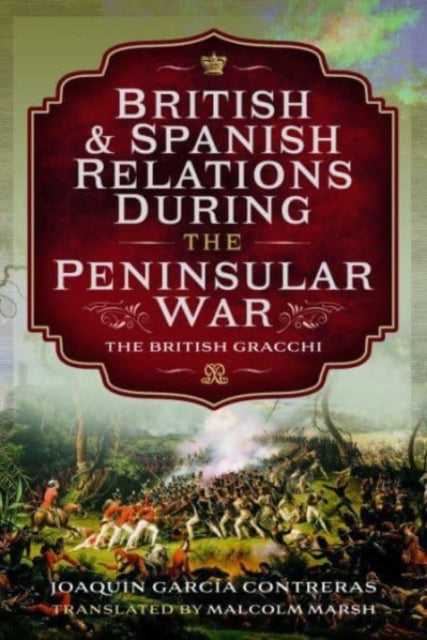
Joaquin Garc a Contreras,Malcolm Marsh
British and Spanish Relations During the Peninsular War: The British Gracchi
British and Spanish Relations During the Peninsular War: The British Gracchi
💎 Earn 77 Points (£0.77) on this item.
YOU SAVE £6.42
- Condition: Brand new
- UK Delivery times: Usually arrives within 2 - 3 working days
- UK Shipping: Fee starts at £2.39. Subject to product weight & dimension
Bulk ordering. Want 15 or more copies? Get a personalised quote and bigger discounts. Learn more about bulk orders.
Couldn't load pickup availability
- More about British and Spanish Relations During the Peninsular War: The British Gracchi
The Spanish Peninsular War (1808-1814) was a conflict between Spain, Britain, and Portugal against Napoleon. It was marked by violence and drama, and its historical interpretations have been biased. However, two centuries later, we can approach the topic with greater objectivity. The Wellesley brothers, British Gracchi, and Arthur Wellesley (Duke of Wellington) played crucial roles in maintaining the alliance between Britain and Spain until the final victory over the French. This book aims to clarify the setting in which these events unfolded by studying anglo-hispanic relations during the years of conflict.
Format: Hardback
Length: 208 pages
Publication date: 12 May 2023
Publisher: Pen & Sword Books Ltd
The Spanish Peninsular War (1808-1814) was a complex and multifaceted conflict that involved the Spanish people, their British and Portuguese allies, and Napoleon's forces. It was not just a war of occupation and national liberation, but a battle that encompassed a wide range of political, military, and cultural dimensions.
The war was marked by its intensity and drama, as two countries that had traditionally been allies, France and Spain, engaged in armed conflict without their governments declaring war. This unusual situation led to a bias in the historical accounts and memoirs drafted in France, England, and Spain, making it difficult to find reliable information for a rigorous analysis of the events.
However, two centuries have passed since the start of this conflict, allowing us to approach the topic with a greater degree of objectivity. At the beginning of the war, the climate in London was favorable to cooperation with Spain. The British government had just emerged victorious from the Napoleonic Wars and was eager to expand its influence in Europe. The Spanish people, who had been under French rule for over a century, saw an opportunity for independence and self-determination.
However, the feeling of failure soon took hold of British society due to the long and costly nature of the war. Many people felt disappointed with the scarce cooperation of Spanish troops, and the war began to drag on. Despite this, a few individuals, including the Wellesley brothers, the British Gracchi, and Arthur Wellesley (Duke of Wellington), defended the importance of the Spanish cause.
Richard Wellesley, the eldest brother and Minister of Foreign Affairs for the United Kingdom, played a crucial role in changing the war against France and was instrumental in the success of the British forces on the Iberian Peninsula. He recognized the strategic importance of Spain and worked tirelessly to maintain the fragile alliance between Britain and Spain until the final victory over the French.
His younger brother, Henry Wellesley, served as the British ambassador plenipotentiary in Madrid, coordinating official relations between Britain and Spain throughout the war. He maintained a climate of collaboration and cooperation, which helped to ensure the success of the British campaign.
Arthur Wellesley, the Duke of Wellington, was a key figure in the British victory. He commanded the British forces in Spain and was known for his strategic brilliance and leadership. His tactics, including the famous "Waterloo" battle, were instrumental in defeating Napoleon's forces and securing the independence of Spain.
The Spanish Peninsular War was a complex and multifaceted conflict that had far-reaching consequences for Europe and the world. It marked the end of the French Empire and the beginning of a new era of Spanish nationalism and independence. It also demonstrated the power of alliances and cooperation, as the British and Spanish forces were able to overcome their differences and work together to achieve a common goal.
In conclusion, the Spanish Peninsular War was a significant event in history that had a profound impact on the political, military, and cultural landscape of Europe. It was a war that tested the strength and resilience of nations and individuals, and it demonstrated the power of cooperation and collaboration in achieving a common goal. The legacy of this war continues to be felt today, and it serves as a reminder of the importance of diplomacy, strategy, and the pursuit of justice and freedom.
Weight: 528g
Dimension: 165 x 242 x 27 (mm)
ISBN-13: 9781399044837
This item can be found in:
UK and International shipping information
UK and International shipping information
UK Delivery and returns information:
- Delivery within 2 - 3 days when ordering in the UK.
- Shipping fee for UK customers from £2.39. Fully tracked shipping service available.
- Returns policy: Return within 30 days of receipt for full refund.
International deliveries:
Shulph Ink now ships to Australia, Belgium, Canada, France, Germany, Ireland, Italy, India, Luxembourg Saudi Arabia, Singapore, Spain, Netherlands, New Zealand, United Arab Emirates, United States of America.
- Delivery times: within 5 - 10 days for international orders.
- Shipping fee: charges vary for overseas orders. Only tracked services are available for most international orders. Some countries have untracked shipping options.
- Customs charges: If ordering to addresses outside the United Kingdom, you may or may not incur additional customs and duties fees during local delivery.