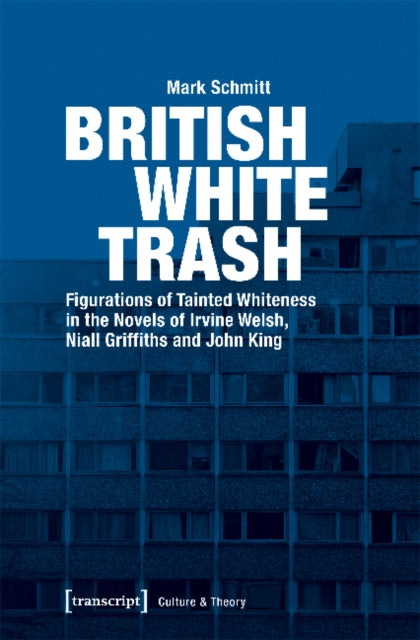
Mark Schmitt
British White Trash - Figurations of Tainted Whiteness in the Novels of Irvine Welsh, Niall Griffiths, and John King
British White Trash - Figurations of Tainted Whiteness in the Novels of Irvine Welsh, Niall Griffiths, and John King
💎 Earn 185 Points (£1.85) on this item.
We can order this item for you. Delivery usually takes about 4 to 6 weeks.
This item is not held in our immediate stock. We will order it for you after checkout.
Estimated delivery: About 4 to 6 weeks
YOU SAVE £7.83
- Condition: Brand new
- UK Delivery times: Usually arrives within 2 - 3 working days
- UK Shipping: Fee starts at £2.39. Subject to product weight & dimension
Bulk ordering. Want 15 or more copies? Get a personalised quote and bigger discounts. Learn more about bulk orders.
Couldn't load pickup availability
- More about British White Trash - Figurations of Tainted Whiteness in the Novels of Irvine Welsh, Niall Griffiths, and John King
White trash is a liminal figure that dramatizes the intersection of race and class, and contemporary British novelists like Irvine Welsh, Niall Griffiths, and John King use it to interrogate the racializing discourse of class in British society. British White Trash is the first analysis to comprehensively examine the adaptation of the white trash stereotype in major British novels, contributing to a critical understanding of racism and classism, its cultural representations, and its underlying social processes.
Format: Paperback / softback
Length: 312 pages
Publication date: 08 December 2021
Publisher: Transcript Verlag
White trash is a fascinating and complex concept that delves into the intersection of race and class, creating a liminal figure that has captured the attention of contemporary British novelists. These authors, including Irvine Welsh, Niall Griffiths, and John King, have embraced this originally American stereotype and used it to critically examine the racializing discourse of class in British society. Through their novels, these writers offer interdiscursive reflections on the enduring figurations of race and class that continue to haunt the British cultural imaginary.
British White Trash is a groundbreaking analysis that takes a comprehensive look at how the white trash stereotype has been adapted and transformed in major British novels. This study not only sheds light on the cultural representations of racism and classism but also delves into the underlying social processes that contribute to their perpetuation. By examining the ways in which these stereotypes are reproduced and transformed in literature, British White Trash provides a valuable contribution to our understanding of these complex issues.
Irvine Welsh's novel, Trainspotting, is a prime example of how the white trash stereotype has been reimagined in British literature. The novel follows the lives of a group of heroin addicts in Edinburgh, Scotland, and explores the social and economic marginalization of this community. Welsh's portrayal of the characters is nuanced and complex, showing them to be individuals with complex motivations and struggles, rather than simply stereotypes. Through his writing, Welsh challenges the dominant narratives of drug addiction and poverty and offers a critical examination of the social structures that perpetuate these issues.
Similarly, Niall Griffiths' novel, The Darkest Hours, explores the experiences of a group of immigrants living in London during the Second World War. Griffiths uses the white trash stereotype to highlight the struggles and hardships faced by these immigrants as they navigate a new and unfamiliar society. The novel also examines the ways in which these immigrants are marginalized and discriminated against by the dominant culture, and how they struggle to assert their identity and dignity in the face of adversity.
John King's novel, The Road, is a powerful exploration of the relationship between father and son in a post-apocalyptic world. King uses the white trash stereotype to depict the father as a violent and abusive man who has lost his way in life. The son, however, is a resilient and resourceful young man who is determined to find his way forward in a world that has been destroyed by war and poverty. Through his writing, King explores the themes of survival, resilience, and the search for meaning in a world that seems to have lost its way.
In conclusion, white trash is a liminal figure that dramatizes the intersection of race and class, and contemporary British novelists have used it to interrogate the racializing discourse of class in British society. British White Trash is a groundbreaking analysis that provides a comprehensive examination of how the white trash stereotype has been adapted and transformed in major British novels. By offering interdiscursive reflections on the enduring figurations of race and class, these writers contribute to a critical understanding of racism and classism, their cultural representations, and the underlying social processes that perpetuate them. Through their novels, they challenge the dominant narratives and offer alternative perspectives on these complex issues, helping to shape our understanding of the world around us.
Weight: 666g
Dimension: 226 x 147 x 15 (mm)
ISBN-13: 9783837641011
UK and International shipping information
UK and International shipping information
UK Delivery and returns information:
- Delivery within 2 - 3 days when ordering in the UK.
- Shipping fee for UK customers from £2.39. Fully tracked shipping service available.
- Returns policy: Return within 30 days of receipt for full refund.
International deliveries:
Shulph Ink now ships to Australia, Belgium, Canada, France, Germany, Ireland, Italy, India, Luxembourg Saudi Arabia, Singapore, Spain, Netherlands, New Zealand, United Arab Emirates, United States of America.
- Delivery times: within 5 - 10 days for international orders.
- Shipping fee: charges vary for overseas orders. Only tracked services are available for most international orders. Some countries have untracked shipping options.
- Customs charges: If ordering to addresses outside the United Kingdom, you may or may not incur additional customs and duties fees during local delivery.