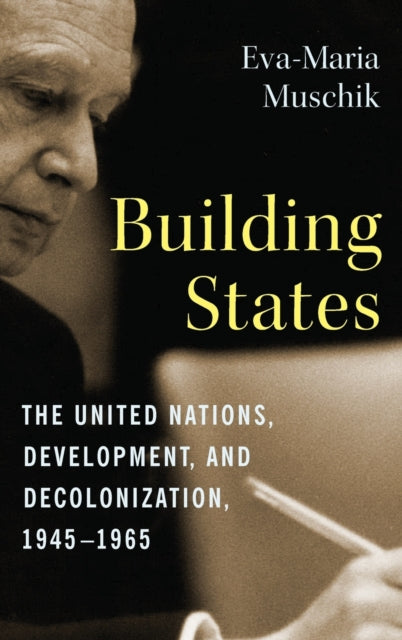
Eva-MariaMuschik
Building States: The United Nations, Development, and Decolonization, 1945-1965
Building States: The United Nations, Development, and Decolonization, 1945-1965
💎 Earn 542 Points (£5.42) on this item.
YOU SAVE £25.57
- Condition: Brand new
- UK Delivery times: Usually arrives within 2 - 3 working days
- UK Shipping: Fee starts at £2.39. Subject to product weight & dimension
Bulk ordering. Want 15 or more copies? Get a personalised quote and bigger discounts. Learn more about bulk orders.
Couldn't load pickup availability
- More about Building States: The United Nations, Development, and Decolonization, 1945-1965
Postwar multilateral cooperation was an attempt to overcome the limitations of the nation-state system, but in 1945, large parts of the world were still under imperial control. Building States investigates how the UN tried to manage the dissolution of European empires in the 1950s and 1960s and helped transform the practice of international development and the meaning of state sovereignty. Eva-Maria Muschik argues that the UN played a key role in the global proliferation and reinvention of the nation-state in the postwar era, as newly independent states came to rely on international assistance.
Format: Hardback
Length: 392 pages
Publication date: 12 April 2022
Publisher: Columbia University Press
Postwar multilateral cooperation is often seen as an attempt to transcend the constraints of the nation-state system. However, in 1945, when the United Nations was established, vast regions of the world remained under imperial control.
Building States delves into how the UN attempted to navigate the dissolution of European empires in the 1950s and 1960s, and in doing so, significantly impacted the practice of international development and the concept of state sovereignty.
Eva-Maria Muschik contends that the UN played a pivotal role in the global proliferation and reinvention of the nation-state during the postwar era. As newly independent states emerged, they increasingly relied on international assistance.
Muschik, through the examination of previously untapped primary sources, traces how UN personnel, often in close collaboration with Western officials, sought to manage decolonization peacefully through international development assistance. She highlights initiatives in Libya, Somaliland, Bolivia, the Congo, and New York, demonstrating how the UN pioneered a new understanding and practice of state building. Rather than viewing it as a political process, the UN presented state building as a technical challenge for international experts.
Muschik further observes that UN officials increasingly assumed public-policy functions, despite the organization's mandate not to interfere in the domestic affairs of its member states. These initiatives, according to Muschik, had lasting consequences for international development practice, peacekeeping, and post-conflict territorial administration.
Building States sheds new light on how international organizations emerged as significant players in the governance of developing countries. Its findings have profound implications for the histories of decolonization, the Cold War, and international development.
Dimension: 229 x 152 (mm)
ISBN-13: 9780231200240
This item can be found in:
UK and International shipping information
UK and International shipping information
UK Delivery and returns information:
- Delivery within 2 - 3 days when ordering in the UK.
- Shipping fee for UK customers from £2.39. Fully tracked shipping service available.
- Returns policy: Return within 30 days of receipt for full refund.
International deliveries:
Shulph Ink now ships to Australia, Belgium, Canada, France, Germany, Ireland, Italy, India, Luxembourg Saudi Arabia, Singapore, Spain, Netherlands, New Zealand, United Arab Emirates, United States of America.
- Delivery times: within 5 - 10 days for international orders.
- Shipping fee: charges vary for overseas orders. Only tracked services are available for most international orders. Some countries have untracked shipping options.
- Customs charges: If ordering to addresses outside the United Kingdom, you may or may not incur additional customs and duties fees during local delivery.