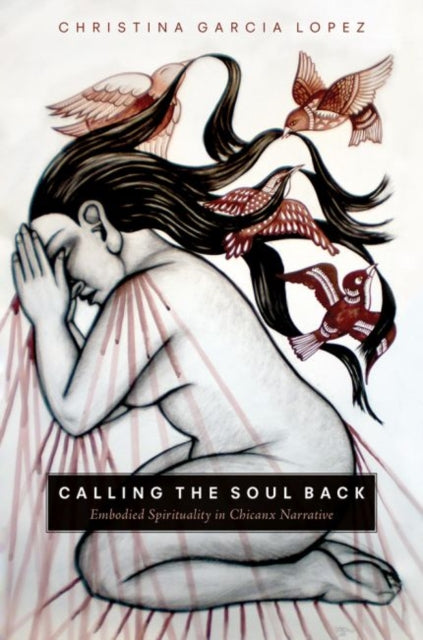
Christina Garcia Lopez
Calling the Soul Back: Embodied Spirituality in Chicanx Narrative
Calling the Soul Back: Embodied Spirituality in Chicanx Narrative
💎 Earn 104 Points (£1.04) on this item.
YOU SAVE £18.09
- Condition: Brand new
- UK Delivery times: Usually arrives within 2 - 3 working days
- UK Shipping: Fee starts at £2.39. Subject to product weight & dimension
Bulk ordering. Want 15 or more copies? Get a personalised quote and bigger discounts. Learn more about bulk orders.
Couldn't load pickup availability
- More about Calling the Soul Back: Embodied Spirituality in Chicanx Narrative
Chicanx literature has long explored spirituality, with Calling the Soul Back focusing on embodied aspects and healing work through narrative. It features underanalyzed and popular works by pivotal writers, as well as less commonly acknowledged authors, to shift readers' consciousness regarding relationships to space, time, and natural environments.
Format: Paperback / softback
Length: 232 pages
Publication date: 25 May 2021
Publisher: University of Arizona Press
Spirituality has played a significant role in the political and cultural counter-narratives of Chicanx literature, with works such as Calling the Soul Back focusing on the embodied aspects of a spirituality that integrates body, mind, and soul. Christina Garcia Lopez's book explores the relationship between embodiment and literary narrative, showing how narrative can be a healing work that ritually calls back the soul into union with the body, counteracting the wounding fragmentation that emerged from colonization and imperialism. The book features both underanalyzed and more popular works by pivotal writers such as Gloria Anzaldúa, Sandra Cisneros, and Rudolfo Anaya, as well as works by less commonly acknowledged authors.
Calling the Soul Back explores the spiritual and ancestral knowledge offered in narratives of bodies in trauma, ritual, grief, nature, and dreaming. Garcia Lopez reads across narrative nonfiction, performative monologue, short fiction, fables, illustrated children's books, and a novel, asking how these narratives draw on the embodied intersections of ways of knowing and being to shift readers' consciousness regarding relationships to space, time, and natural environments. Using an interdisciplinary approach, Calling the Soul Back draws on literary and Chicanx studies scholars as well as those in religious studies, feminist studies, sociology, environmental studies, philosophy, and Indigenous studies to reveal narrative's healing potential to bring the soul into balance with the body and mind.
One of the key themes in Calling the Soul Back is the idea of the soul as a unique immaterial essence that is connected to the body. Garcia Lopez argues that the wounding fragmentation that emerged from colonization and imperialism has caused a disconnect between the soul and the body, leading to a sense of disembodiment and alienation. Through the ritual of calling back the soul, writers and readers can reconnect with their own unique immaterial essence and find a sense of belonging and connection to the world.
The book also explores the ways in which narrative can be a healing work that addresses the trauma and pain experienced by bodies in trauma. Garcia Lopez argues that narrative can provide a space for writers and readers to process their experiences and emotions and to find a sense of meaning and purpose in their lives. She uses examples from a variety of narratives, including those by Gloria Anzaldúa, Sandra Cisneros, and Rudolfo Anaya, to illustrate how narrative can be a powerful tool for healing.
In addition to its focus on the embodied aspects of spirituality, Calling the Soul Back also explores the ways in which narrative can be a tool for social and political change. Garcia Lopez argues that narrative can be used to challenge dominant narratives and to promote a more inclusive and equitable society. She uses examples from a variety of narratives, including those by Gloria Anzaldúa, Sandra Cisneros, and Rudolfo Anaya, to illustrate how narrative can be a powerful tool for social and political change.
One of the strengths of Calling the Soul Back is its interdisciplinary approach. Garcia Lopez draws on a wide range of scholars and disciplines to explore the healing potential of narrative, and she provides a rich and detailed analysis of the various ways in which narrative can be used to promote healing and social and political change.
However, some critics have argued that Calling the Soul Back is too focused on the embodied aspects of spirituality and that it does not adequately address the spiritual aspects of spirituality. They argue that spirituality is not just about the body but also about the mind, the heart, and the spirit, and that narrative can be a powerful tool for exploring these spiritual aspects as well.
Despite these criticisms, Calling the Soul Back remains a valuable and important book for anyone interested in the intersection of spirituality and literature. Garcia Lopez's book provides a rich and detailed analysis of the various ways in which narrative can be used to promote healing and social and political change, and it offers a unique perspective on the relationship between embodiment and literary narrative.
In conclusion, spirituality has consistently been present in the political and cultural counternarratives of Chicanx literature, with works such as Calling the Soul Back focusing on the embodied aspects of a spirituality that integrates body, mind, and soul. Christina Garcia Lopez's book explores the relationship between embodiment and literary narrative, showing how narrative can be a healing work that ritually calls back the soul into union with the body, counteracting the wounding fragmentation that emerged from colonization and imperialism. The book features both underanalyzed and more popular works by pivotal writers such as Gloria Anzaldúa, Sandra Cisneros, and Rudolfo Anaya, as well as works by less commonly acknowledged authors. Calling the Soul Back remains a valuable and important book for anyone interested in the intersection of spirituality and literature.
Weight: 312g
Dimension: 154 x 229 x 18 (mm)
ISBN-13: 9780816542581
This item can be found in:
UK and International shipping information
UK and International shipping information
UK Delivery and returns information:
- Delivery within 2 - 3 days when ordering in the UK.
- Shipping fee for UK customers from £2.39. Fully tracked shipping service available.
- Returns policy: Return within 30 days of receipt for full refund.
International deliveries:
Shulph Ink now ships to Australia, Belgium, Canada, France, Germany, Ireland, Italy, India, Luxembourg Saudi Arabia, Singapore, Spain, Netherlands, New Zealand, United Arab Emirates, United States of America.
- Delivery times: within 5 - 10 days for international orders.
- Shipping fee: charges vary for overseas orders. Only tracked services are available for most international orders. Some countries have untracked shipping options.
- Customs charges: If ordering to addresses outside the United Kingdom, you may or may not incur additional customs and duties fees during local delivery.