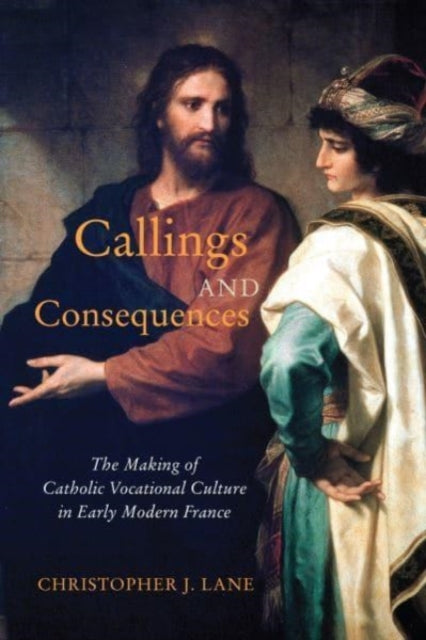
Christopher J. Lane
Callings and Consequences: The Making of Catholic Vocational Culture in Early Modern France
Callings and Consequences: The Making of Catholic Vocational Culture in Early Modern France
💎 Earn 120 Points (£1.20) on this item.
YOU SAVE £2.90
- Condition: Brand new
- UK Delivery times: Usually arrives within 2 - 3 working days
- UK Shipping: Fee starts at £2.39. Subject to product weight & dimension
Bulk ordering. Want 15 or more copies? Get a personalised quote and bigger discounts. Learn more about bulk orders.
Couldn't load pickup availability
- More about Callings and Consequences: The Making of Catholic Vocational Culture in Early Modern France
French Catholic clergy began promoting the idea that everyone, including laypeople, was called to a vocation or "state of life" in the mid-seventeenth century, with four characteristics: urgency, inclusiveness, method, and liberty. This culture of vocation became a central component of the Catholic Reformation and its legacy in France, engendering enduring beliefs and practices within global Catholic modernity.
Format: Paperback / softback
Length: 200 pages
Publication date: 15 December 2021
Publisher: McGill-Queen's University Press
The concept of vocation in an early modern setting evokes images of priesthood or religious life in a monastery or cloister, where being "called" by God meant leaving the world's concerns behind. However, a significant shift occurred in the mid-seventeenth century when French Catholic clergy began promoting the innovative idea that everyone, including ordinary laypeople, was called to a vocation or "state of life." This call had profound implications for individual happiness, salvation, and the social good.
In his book, "Callings and Consequences," Christopher Lane delves into the origins, growth, and influence of this culture of vocation that became a central component of the Catholic Reformation and its legacy in France. The reformers' vision of the choice of a state of life was characterized by four key characteristics: urgency, inclusiveness, method, and liberty. Urgency emphasized the realization that one's soul was at stake, while inclusiveness believed that everyone, including laypeople, was called by God. Method involved the use of proven discernment practices to help individuals discern their vocation. Liberty emphasized that this choice must be made freely, without coercion, especially from parents.
These vocational reforms were not mere passing phenomena but rather enduring beliefs and practices that have shaped the repertoire of global Catholic modernity, even to the present day. Lane's book provides an illuminating and sometimes surprising history of pastoral reform, helping us to understand the history of Catholic vocational culture and its role in the modernizing process, within Christianity and beyond.
The concept of vocation has deep roots in the Christian tradition, dating back to the New Testament. In the Gospel of Matthew, Jesus Christ tells his disciples, "Follow me, and I will make you fishers of men." This call is seen as a calling to a life of service and sacrifice, where individuals are called to spread the message of God's love and grace to others.
Throughout the centuries, the idea of vocation has evolved and taken on different forms. In the Middle Ages, the Catholic Church emphasized the importance of monastic life as a way for individuals to dedicate themselves fully to God. Monasteries were seen as places of spiritual growth, where monks and nuns lived a life of prayer, study, and manual labor.
However, with the rise of the Renaissance and the Enlightenment, a new perspective on vocation emerged. Theologians and philosophers began to question the traditional notion of a single, definitive vocation for an individual. They argued that people could have multiple callings or passions in life, and that it was important to find a balance between these different aspects of one's existence.
This shift in perspective led to the development of new vocational models, such as the "vocation of the layperson" and the "vocation of the professional." Laypeople were encouraged to participate in the work of the Church and society in a meaningful way, while professionals were recognized for their contributions to their respective fields.
In the mid-seventeenth century, the Catholic Reformation brought about a renewed emphasis on vocation. The reformers sought to revitalize the Church and restore its authority and influence in Europe. They believed that the key to this renewal was the cultivation of a culture of vocation among the laity.
The reformers' vision of vocation was marked by four key characteristics: urgency, inclusiveness, method, and liberty. Urgency emphasized the realization that one's soul was at stake, while inclusiveness believed that everyone, including laypeople, was called by God. Method involved the use of proven discernment practices to help individuals discern their vocation. Liberty emphasized that this choice must be made freely, without coercion, especially from parents.
These vocational reforms had a profound impact on the Catholic Church and society as a whole. They helped to create a sense of purpose and meaning in people's lives, and they contributed to the development of a more inclusive and democratic society.
However, the concept of vocation has also faced challenges and criticisms throughout its history. Some critics argue that it can lead to a sense of superiority or elitism among those who have been called to certain vocations, such as the priesthood or religious life. Others argue that it can be coercive or restrictive, forcing individuals to conform to certain norms or expectations that may not align with their personal beliefs or values.
Despite these challenges, the concept of vocation remains a central component of the Catholic Church and its teachings. The Church continues to encourage individuals to discern their vocation and to live out their calling in a meaningful way. The Church also recognizes the importance of supporting and nurturing those who have been called to vocations that may be less traditional or mainstream, such as the vocation of the layperson or the vocation of the professional.
In conclusion, the concept of vocation in an early modern setting calls to mind the priesthood or religious life in a monastery or cloister. However, a significant shift occurred in the mid-seventeenth century when French Catholic clergy began promoting the innovative idea that everyone, including ordinary laypeople, was called to a vocation or "state of life." This call had profound implications for individual happiness, salvation, and the social good.
In his book, "Callings and Consequences," Christopher Lane delves into the origins, growth, and influence of this culture of vocation that became a central component of the Catholic Reformation and its legacy in France. The reformers' vision of the choice of a state of life was characterized by four key characteristics: urgency, inclusiveness, method, and liberty. These vocational reforms were not mere passing phenomena but rather enduring beliefs and practices that have shaped the repertoire of global Catholic modernity, even to the present day.
While the concept of vocation has faced challenges and criticisms, it remains a central component of the Catholic Church and its teachings. The Church continues to encourage individuals to discern their vocation and to live out their calling in a meaningful way. By understanding the history and significance of vocational culture, we can better appreciate the role it plays in shaping our world and our lives.
Dimension: 229 x 152 (mm)
ISBN-13: 9780228008552
This item can be found in:
UK and International shipping information
UK and International shipping information
UK Delivery and returns information:
- Delivery within 2 - 3 days when ordering in the UK.
- Shipping fee for UK customers from £2.39. Fully tracked shipping service available.
- Returns policy: Return within 30 days of receipt for full refund.
International deliveries:
Shulph Ink now ships to Australia, Belgium, Canada, France, Germany, Ireland, Italy, India, Luxembourg Saudi Arabia, Singapore, Spain, Netherlands, New Zealand, United Arab Emirates, United States of America.
- Delivery times: within 5 - 10 days for international orders.
- Shipping fee: charges vary for overseas orders. Only tracked services are available for most international orders. Some countries have untracked shipping options.
- Customs charges: If ordering to addresses outside the United Kingdom, you may or may not incur additional customs and duties fees during local delivery.