Shulph Ink
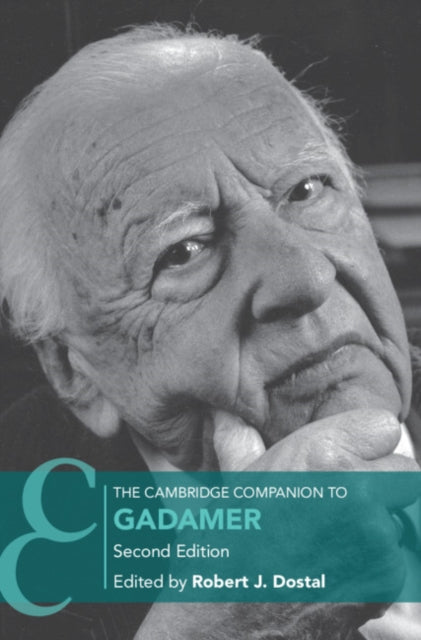
Cambridge Companion to Gadamer
Cambridge Companion to Gadamer
💎 Earn 151 Points (£1.51) on this item.
We can order this item for you. Delivery usually takes about 4 to 6 weeks.
This item is not held in our immediate stock. We will order it for you after checkout.
Estimated delivery: About 4 to 6 weeks
YOU SAVE £1.79
- Condition: Brand new
- UK Delivery times: Usually arrives within 2 - 3 working days
- UK Shipping: Fee starts at £2.39. Subject to product weight & dimension
Bulk ordering. Want 15 or more copies? Get a personalised quote and bigger discounts. Learn more about bulk orders.
Couldn't load pickup availability
- More about Cambridge Companion to Gadamer
Hans-Georg Gadamer (1900–2002) is a renowned philosopher known for his philosophical hermeneutics, which explores the interpretation of texts and the core of hermeneutical theory. This volume examines his biography, the significance of his work for ethics, aesthetics, social sciences, and theology, and his appropriation of Hegel, Heidegger, and the Greeks. It also includes new chapters and an updated bibliography.
\n Format: Paperback / softback
\n Length: 360 pages
\n Publication date: 12 August 2021
\n Publisher: Cambridge University Press
\n
Hans-Georg Gadamer (1900-2002) is widely regarded as the preeminent proponent of philosophical hermeneutics. The essays contained within this volume explore Gadamer's life, the fundamental principles of hermeneutical theory, and the profound impact of his work on ethics, aesthetics, the social sciences, and theology. Thorough consideration is given to Gadamer's appropriation of Hegel, Heidegger, and the Greeks, as well as his relationship to modernity, critical theory, and poststructuralism. This revised edition features several new chapters on various aspects of Gadamer's work, as well as updated chapters from the first edition, accompanied by the most comprehensive bibliography of works by and about Gadamer available in the English language.
Introduction:
Hans-Georg Gadamer, a renowned German philosopher, is widely recognized as the leading exponent of philosophical hermeneutics. His profound insights and innovative approach to understanding the human experience have left an indelible mark on the field of philosophy. In this volume, we delve into the life and work of Gadamer, exploring his biography, the core of his hermeneutical theory, and the significance of his work for ethics, aesthetics, the social sciences, and theology.
Biography:
Gadamer was born on April 26, 1900, in Heidelberg, Germany. He grew up in a family of academics, and his early exposure to philosophy and literature shaped his intellectual development. Gadamer attended the University of Heidelberg, where he studied philosophy under the guidance of renowned scholars such as Martin Heidegger and Friedrich Nietzsche. His doctoral thesis, titled "The Concept of Truth in Hegel's Philosophy of Religion," further solidified his expertise in the field.
Core of Hermeneutical Theory:
Gadamer's hermeneutical theory is based on the idea that understanding is a continuous and dialogical process. He posits that human beings are fundamentally interpretive creatures, capable of understanding the world through the lens of their cultural and historical backgrounds. Gadamer believed that the meaning of a text or an event is not fixed or absolute, but rather is shaped by the interpretive frameworks of the reader or listener.
Significance of Gadamer's Work:
Gadamer's work has had a profound impact on various fields of study. In ethics, his hermeneutical approach has challenged the traditional notion of moral absolutes and has emphasized the importance of contextual understanding and dialogue. He has argued that ethical decisions should be made in the context of a particular historical and cultural setting, taking into account the values and beliefs of the individuals involved.
In aesthetics, Gadamer's hermeneutical insights have contributed to the understanding of art and literature as interpretive phenomena. He has emphasized the role of the reader or viewer in shaping the meaning of a work of art, and has argued that art has the power to transcend cultural boundaries and communicate universal truths.
In the social sciences, Gadamer's hermeneutical approach has been applied to the study of history, culture, and society. He has argued that the interpretation of historical events and social phenomena is shaped by the interpretive frameworks of the individuals involved, and that understanding these frameworks is essential for social change and progress.
In theology, Gadamer's hermeneutical approach has been used to explore the relationship between faith and reason. He has argued that the two are not mutually exclusive, but rather are complementary and can be reconciled through a hermeneutical dialogue. Gadamer has also emphasized the importance of religious experience and the role of the sacred in shaping human understanding.
Appropriation of Hegel, Heidegger, and the Greeks:
Gadamer's work is deeply influenced by the philosophical traditions of Hegel, Heidegger, and the Greeks. Hegel's dialectic philosophy, in particular, has had a significant impact on Gadamer's understanding of the nature of truth and the role of the interpreter in shaping meaning. Heidegger's concept of Dasein, or being-in-the-world, has also influenced Gadamer's understanding of human experience and the importance of context.
In addition to these influences, Gadamer's work is also influenced by the broader cultural context of his time. He was a prominent figure in the Frankfurt School, a group of intellectuals who were critical of the dominant ideologies of modernity and sought to develop a more nuanced and critical understanding of society. Gadamer's hermeneutical approach has been seen as a response to the challenges posed by modernity and has contributed to the development of critical theory and poststructuralism.
Relation to Modernity, Critical Theory, and Poststructuralism:
Gadamer's work is closely intertwined with the developments of modernity, critical theory, and poststructuralism. He was a critical thinker who sought to challenge the dominant ideologies of his time and to develop a more nuanced and critical understanding of society. Gadamer's hermeneutical approach has been seen as a response to the challenges posed by modernity and has contributed to the development of critical theory and poststructuralism.
In modernity, Gadamer criticized the reductionist and instrumentalist tendencies of Western philosophy, which sought to reduce human experience to a series of empirical facts and to instrumentalize knowledge for practical purposes. He argued that these tendencies had led to a loss of the depth and complexity of human experience and had obscured the importance of the human subject.
In critical theory, Gadamer's hermeneutical approach has been used to critique the power structures and ideologies that shape society. He has argued that these power structures are often based on false assumptions and that they are perpetuated through the use of language and discourse. Gadamer's work has been particularly influential in the field of feminist philosophy, where he has challenged the patriarchal structures and ideologies that have dominated Western society.
In poststructuralism, Gadamer's hermeneutical approach has been used to critique the binary oppositions and hierarchies that shape our understanding of the world. He has argued that these oppositions are often based on false assumptions and that they are perpetuated through the use of language and discourse. Gadamer's work has been particularly influential in the field of queer theory, where he has challenged the heteronormative structures and ideologies that have dominated Western society.
Conclusion:
In conclusion, Hans-Georg Gadamer is widely recognized as the leading exponent of philosophical hermeneutics. His profound insights and innovative approach to understanding the human experience have left an indelible mark on the field of philosophy. The essays contained within this volume explore Gadamer's life, the core of his hermeneutical theory, and the significance of his work for ethics, aesthetics, the social sciences, and theology. Through careful consideration of Gadamer's appropriation of Hegel, Heidegger, and the Greeks, as well as his relationship to modernity, critical theory, and poststructuralism, we gain a deeper understanding of his contributions to philosophy and the broader cultural context of his time.
\n Weight: 654g\n
Dimension: 152 x 228 x 29 (mm)\n
ISBN-13: 9781108816298\n
Edition number: 2 Revised edition\n
This item can be found in:
UK and International shipping information
UK and International shipping information
UK Delivery and returns information:
- Delivery within 2 - 3 days when ordering in the UK.
- Shipping fee for UK customers from £2.39. Fully tracked shipping service available.
- Returns policy: Return within 30 days of receipt for full refund.
International deliveries:
Shulph Ink now ships to Australia, Belgium, Canada, France, Germany, Ireland, Italy, India, Luxembourg Saudi Arabia, Singapore, Spain, Netherlands, New Zealand, United Arab Emirates, United States of America.
- Delivery times: within 5 - 10 days for international orders.
- Shipping fee: charges vary for overseas orders. Only tracked services are available for most international orders. Some countries have untracked shipping options.
- Customs charges: If ordering to addresses outside the United Kingdom, you may or may not incur additional customs and duties fees during local delivery.