Dr Sheila Kanani
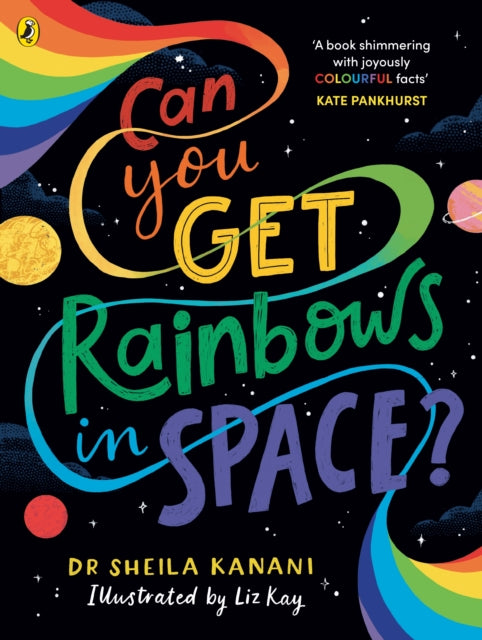
Can You Get Rainbows in Space?: A Colourful Compendium of Space and Science
Can You Get Rainbows in Space?: A Colourful Compendium of Space and Science
💎 Earn 35 Points (£0.35) on this item.
YOU SAVE £2.92
- Condition: Brand new
- UK Delivery times: Usually arrives within 2 - 3 working days
- UK Shipping: Fee starts at £2.39. Subject to product weight & dimension
Bulk ordering. Want 15 or more copies? Get a personalised quote and bigger discounts. Learn more about bulk orders.
Couldn't load pickup availability
- More about Can You Get Rainbows in Space?: A Colourful Compendium of Space and Science
This collection of scientific facts about color will answer questions about light, waves, animals, leaves, veins, and language. It will also teach how to make a rainbow in space.
Format: Paperback / softback
Length: 128 pages
Publication date: 08 February 2024
Publisher: Penguin Random House Children's UK
Why is blood red?
The color of blood is primarily due to the presence of hemoglobin, a protein responsible for transporting oxygen throughout the body. Hemoglobin is a complex molecule that contains iron, which binds to oxygen and allows it to be carried in the blood. When oxygenated, hemoglobin takes on a bright red color, which is why blood appears red when it is exposed to air.
However, the color of blood can vary slightly depending on factors such as the pH level, the presence of other substances, and the health of the individual. For example, blood that is too acidic or too alkaline can have a different color, and blood that is contaminated with certain substances can also appear different.
Carrots, on the other hand, are orange because they contain a high concentration of a pigment called beta-carotene. Beta-carotene is converted into vitamin A by the body, and vitamin A is responsible for the orange color of many fruits and vegetables.
Who invented the lightbulb?
The invention of the lightbulb is attributed to Thomas Edison, an American inventor and businessman. Edison developed the first commercially practical incandescent light bulb in 1879, which used a filament of carbonized cotton to produce light. The lightbulb revolutionized lighting technology and has since become an essential part of modern life.
Why is the world going green?
The world is going green due to a combination of factors, including environmental concerns, economic incentives, and technological advancements. One of the primary drivers of the green movement is the recognition of the impact of human activities on the environment, particularly the emission of greenhouse gases and the depletion of natural resources.
As a result, many governments, businesses, and individuals are taking steps to reduce their carbon footprint and promote sustainable practices. This includes investing in renewable energy sources such as solar and wind power, implementing energy-efficient technologies, reducing waste and pollution, and promoting sustainable agriculture and forestry practices.
Is the sky really blue?
The sky appears blue because of the way light interacts with the atmosphere. The air in the Earth's atmosphere is made up of a mixture of gases, including nitrogen, oxygen, and carbon dioxide. When sunlight enters the atmosphere, it is scattered by these gases, which causes the blue wavelengths of light to be scattered more strongly than the red and green wavelengths. This scattering effect gives the sky its blue color.
Ultraviolet light is a type of electromagnetic radiation that falls between visible light and X-rays on the electromagnetic spectrum. It has shorter wavelengths than visible light and is invisible to the human eye. However, it can be detected by certain animals, such as insects and birds, which use it for communication and navigation.
You'll discover the answers to these questions - and many more - in this incredible collection of scientific facts about color. We'll talk about light (the most important thing) and waves (not the kind you see at the beach - though you will learn why the sea looks blue!). You'll find out how some animals are able to glow in the dark and how others change their colors to hide from predators. Keep reading to discover why leaves change color in the autumn, why your veins look blue but your blood is red, and why the language we use shapes the colors we see....
And you'll learn exactly how to make a rainbow - in space.
Weight: 418g
Dimension: 255 x 195 x 12 (mm)
ISBN-13: 9780241519738
UK and International shipping information
UK and International shipping information
UK Delivery and returns information:
- Delivery within 2 - 3 days when ordering in the UK.
- Shipping fee for UK customers from £2.39. Fully tracked shipping service available.
- Returns policy: Return within 30 days of receipt for full refund.
International deliveries:
Shulph Ink now ships to Australia, Belgium, Canada, France, Germany, Ireland, Italy, India, Luxembourg Saudi Arabia, Singapore, Spain, Netherlands, New Zealand, United Arab Emirates, United States of America.
- Delivery times: within 5 - 10 days for international orders.
- Shipping fee: charges vary for overseas orders. Only tracked services are available for most international orders. Some countries have untracked shipping options.
- Customs charges: If ordering to addresses outside the United Kingdom, you may or may not incur additional customs and duties fees during local delivery.