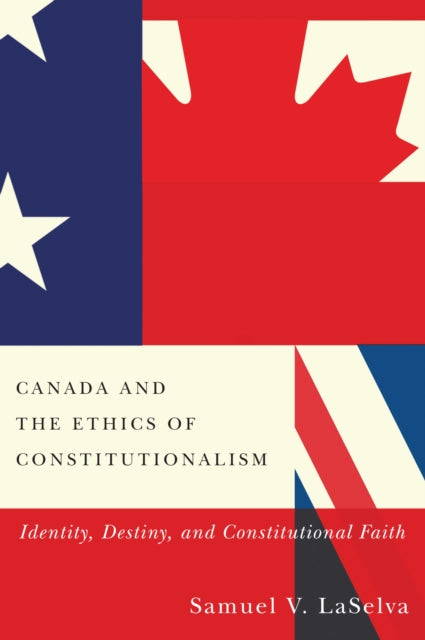
Samuel V. Laselva
Canada and the Ethics of Constitutionalism: Identity, Destiny, and Constitutional Faith
Canada and the Ethics of Constitutionalism: Identity, Destiny, and Constitutional Faith
💎 Earn 138 Points (£1.38) on this item.
YOU SAVE £3.33
- Condition: Brand new
- UK Delivery times: Usually arrives within 2 - 3 working days
- UK Shipping: Fee starts at £2.39. Subject to product weight & dimension
Bulk ordering. Want 15 or more copies? Get a personalised quote and bigger discounts. Learn more about bulk orders.
Couldn't load pickup availability
- More about Canada and the Ethics of Constitutionalism: Identity, Destiny, and Constitutional Faith
Canada is caught between two empires and two constitutional systems, but Canadian constitutionalism is distinctive and does not depend on borrowings from the British or American models. Samuel LaSelva supports his argument by exploring different aspects of Canada's contribution to the ethics of constitutionalism, such as the limits of free expression, the Charter's notwithstanding clause, judicial review, the Quebec secession debate, Aboriginal self-government, and the conception of Canada as a multicultural and multinational mosaic.
Format: Paperback / softback
Length: 334 pages
Publication date: 30 December 2018
Publisher: McGill-Queen's University Press
Canada finds itself caught between two powerful empires and two distinct constitutional systems. While the British model of a single sovereign and the American ideal of liberty resonated with certain aspects of Canadian identity, neither fully embraced the country's pluralistic nature. As a result, Canadians embarked on a journey of constitutional experimentation, seeking to forge a unique path that would reflect their diverse heritage.
In his book, Canada and the Ethics of Constitutionalism, Samuel LaSelva makes a compelling argument that understanding the old Canada of Confederation and the new one that emerged after the Charter of Rights and Freedoms requires a deep appreciation of Canadian constitutionalism's distinctiveness. LaSelva argues that Canadian constitutionalism is not merely a derivative of British or American models but rather a unique and evolving system that has been shaped by the country's history, culture, and values.
To support his argument, LaSelva delves into various aspects of Canada's contribution to the ethics of constitutionalism. He explores the boundaries of free expression, examines the notwithstanding clause in the Charter, explores the origins and functions of judicial review, examines the contentious Quebec secession debate, discusses Aboriginal self-government, and portrays Canada as a multicultural and multinational mosaic. By carefully examining how Canadian constitutional pluralism, with its emphasis on the rights of others, differs from American and British ideas, LaSelva offers insightful answers to contested questions about the country's founding and its evolution.
One of the key insights of Canada and the Ethics of Constitutionalism is that Canadian constitutionalism is characterized by a commitment to the protection of individual rights and freedoms. The Charter of Rights and Freedoms, which serves as the foundation of the Canadian legal system, emphasizes the importance of equality, freedom of speech, and the right to a fair trial. These rights are not absolute, however, and are subject to certain limitations and restrictions. LaSelva explores these limitations and restrictions in detail, highlighting the ways in which they have been used to balance competing interests and ensure the stability and cohesion of the country.
Another important aspect of Canadian constitutionalism is its emphasis on the role of the judiciary in interpreting and enforcing the Constitution. LaSelva argues that the judiciary is not just a passive institution but rather an active participant in the constitutional process. Through judicial review, the judiciary has the power to strike down laws and policies that violate the Charter or other constitutional provisions. This power has been used to protect the rights of individuals and groups, as well as to ensure that the government operates within the bounds of the Constitution.
LaSelva's book also sheds light on the contentious Quebec secession debate, which has been a defining feature of Canadian politics for decades. The debate revolves around the desire of Quebecers to secede from Canada and establish their own sovereign state. While LaSelva does not take a position on the issue of secession, he provides a comprehensive analysis of the debate, exploring the historical, political, and legal factors that have shaped it. He also examines the potential consequences of secession, both for Quebec and for Canada as a whole.
Aboriginal self-government is another important topic that LaSelva explores in his book. He argues that Aboriginal peoples have a unique constitutional status and that their rights and interests must be protected and promoted within the framework of Canadian constitutionalism. LaSelva discusses the historical and legal context of Aboriginal rights, as well as the challenges and opportunities that Aboriginal communities face in the modern world. He also highlights the importance of Aboriginal self-government as a means of promoting cultural identity, economic development, and social justice.
Finally, LaSelva's book portrays Canada as a multicultural and multinational mosaic, a country that is home to a diverse range of cultures, languages, and traditions. He argues that Canadian constitutionalism must be able to accommodate and celebrate this diversity, while also ensuring that it is integrated into the broader fabric of Canadian society. LaSelva explores the ways in which Canadian constitutionalism has been used to promote cultural diversity, as well as the challenges and opportunities that arise from this diversity.
In conclusion, Canada and the Ethics of Constitutionalism is a thought-provoking and insightful book that provides a comprehensive understanding of Canadian constitutionalism and its place in the global landscape. Through his exploration of various aspects of Canada's contribution to the ethics of constitutionalism, LaSelva challenges readers to think critically about the country's past, present, and future. Whether one agrees with his conclusions or not, this book is a valuable resource for anyone interested in understanding the complex and dynamic nature of Canadian politics and society.
Weight: 510g
Dimension: 155 x 229 x 20 (mm)
ISBN-13: 9780773555310
This item can be found in:
UK and International shipping information
UK and International shipping information
UK Delivery and returns information:
- Delivery within 2 - 3 days when ordering in the UK.
- Shipping fee for UK customers from £2.39. Fully tracked shipping service available.
- Returns policy: Return within 30 days of receipt for full refund.
International deliveries:
Shulph Ink now ships to Australia, Belgium, Canada, France, Germany, Ireland, Italy, India, Luxembourg Saudi Arabia, Singapore, Spain, Netherlands, New Zealand, United Arab Emirates, United States of America.
- Delivery times: within 5 - 10 days for international orders.
- Shipping fee: charges vary for overseas orders. Only tracked services are available for most international orders. Some countries have untracked shipping options.
- Customs charges: If ordering to addresses outside the United Kingdom, you may or may not incur additional customs and duties fees during local delivery.