Scott Rutherford
Canada's Other Red Scare: Indigenous Protest and Colonial Encounters during the Global Sixties
Canada's Other Red Scare: Indigenous Protest and Colonial Encounters during the Global Sixties
💎 Earn 457 Points (£4.57) on this item.
YOU SAVE £8.50
- Condition: Brand new
- UK Delivery times: Usually arrives within 2 - 3 working days
- UK Shipping: Fee starts at £2.39. Subject to product weight & dimension
Bulk ordering. Want 15 or more copies? Get a personalised quote and bigger discounts. Learn more about bulk orders.
Couldn't load pickup availability
- More about Canada's Other Red Scare: Indigenous Protest and Colonial Encounters during the Global Sixties
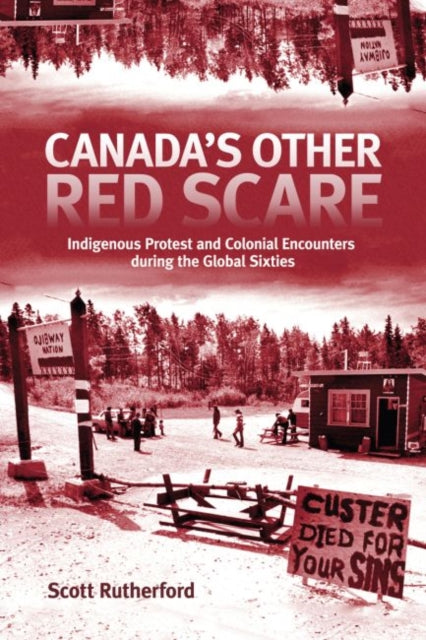
Indigenous activism in northern Ontario in the 1960s and early 1970s, including a march and an armed occupation, highlighted the local and global aspects of decolonization. Scott Rutherford's book, Canada's Other Red Scare, explores this period of protest and its responses, drawing on archival documents and personal experiences. Indigenous organizers used various tactics to advocate for various issues, drawing inspiration from global currents. The book argues that Indigenous political protest during this period should be understood as both local and transnational, confronting the experience of settler-colonialism in places and moments of protest.
Format: Hardback
Length: 208 pages
Publication date: 17 December 2020
Publisher: McGill-Queen's University Press
Indigenous activism in northern Ontario during the 1960s and early 1970s played a significant role in shaping the region's history and identity. One of the most notable events of this period was the Canada's First Civil Rights March, a four-hundred-person march that took place in Kenora, Ontario. The march was a powerful demonstration of the Indigenous peoples' desire for equality and justice and was widely recognized as a significant event in Canadian history.
Another significant event of this period was the two-month-long armed occupation of a small lakefront park in Kenora. The occupation was led by Indigenous activists who were protesting the government's decision to develop the park for tourism. The occupation was a peaceful protest, but it attracted significant media attention and led to a series of negotiations between the activists and the government.
Canada's Other Red Scare: Indigenous Political Protest and Social Struggle in Northwestern Ontario and Treaty 3 Territory from 1965 to 1974 is a book by Scott Rutherford that explores the Indigenous political protest and social struggle that took place in Northwestern Ontario and Treaty 3 territory from 1965 to 1974. Rutherford draws on a wide range of archival documents, media coverage, published interviews, memoirs, and social movement literature to reconstruct a period of turbulent protest and the responses it provoked.
One of the key themes of Canada's Other Red Scare is the importance of linking the local and the global to broaden narratives of resistance in the 1960s. Rutherford argues that the Indigenous political protest and social struggle in Northwestern Ontario and Treaty 3 territory was not isolated events closed off from the present but was part of a broader process of decolonization.
Indigenous organizers in Northwestern Ontario and Treaty 3 territory used a range of tactics to advocate for their issues. These tactics included marches, cultural production, community organizing, journalism, and armed occupation. They drew inspiration from global currents, such as black American freedom movements and Third World decolonization, to challenge the inequalities and racial logics that shaped settler-colonialism and daily life in Kenora.
One of the most significant achievements of Indigenous activism in Northwestern Ontario and Treaty 3 territory was the recognition of nationhood. Indigenous peoples had been denied their rights and land for centuries, and the activism of the 1960s and early 1970s helped to bring their issues to the forefront of Canadian politics. The recognition of nationhood led to the creation of the First Nations of Canada, which gave Indigenous peoples the right to self-government and the right to control their own land and resources.
However, the recognition of nationhood was not without its challenges. Indigenous peoples faced significant discrimination and violence from the Canadian government and other settlers. The government's policies of assimilation and forced relocation were designed to destroy Indigenous cultures and communities, and many Indigenous peoples were forced to leave their homes and communities.
Despite these challenges, Indigenous activism in Northwestern Ontario and Treaty 3 territory continued to grow and evolve. In the 1970s and 1980s, Indigenous activists began to focus on issues such as environmental protection, land rights, and economic development. They worked to create sustainable communities and to protect their traditional lands and resources.
In recent years, Indigenous activism has become more visible and influential. Indigenous peoples have been involved in a range of protests and campaigns, including the Idle No More movement, the Standing Rock protests, and the Wet'suwet'en protests. These protests have highlighted the ongoing struggles of Indigenous peoples and have led to significant changes in Canadian policy and law.
One of the challenges facing Indigenous activism in the future is the ongoing impact of colonialism and settler-colonialism. Indigenous peoples continue to face discrimination and violence, and their lands and resources are still being exploited. The government's policies of assimilation and forced relocation continue to have a negative impact on Indigenous communities, and it is important for the government to take action to address these issues.
In conclusion, Indigenous activism in northern Ontario during the 1960s and early 1970s played a significant role in shaping the region's history and identity. The Canada's First Civil Rights March and the two-month-long armed occupation of a small lakefront park were two of the most notable events of this period, and they helped to bring the Indigenous peoples' issues to the forefront of Canadian politics. Indigenous organizers used a range of tactics to advocate for their issues, and their achievements included the recognition of nationhood and the creation of sustainable communities. However, the ongoing impact of colonialism and settler-colonialism continues to pose a significant challenge to Indigenous activism, and it is important for the government to take action to address these issues.
Dimension: 229 x 152 (mm)
ISBN-13: 9780228004059
This item can be found in:
UK and International shipping information
UK and International shipping information
UK Delivery and returns information:
- Delivery within 2 - 3 days when ordering in the UK.
- Shipping fee for UK customers from £2.39. Fully tracked shipping service available.
- Returns policy: Return within 30 days of receipt for full refund.
International deliveries:
Shulph Ink now ships to Australia, Belgium, Canada, France, Germany, Ireland, Italy, India, Luxembourg Saudi Arabia, Singapore, Spain, Netherlands, New Zealand, United Arab Emirates, United States of America.
- Delivery times: within 5 - 10 days for international orders.
- Shipping fee: charges vary for overseas orders. Only tracked services are available for most international orders. Some countries have untracked shipping options.
- Customs charges: If ordering to addresses outside the United Kingdom, you may or may not incur additional customs and duties fees during local delivery.