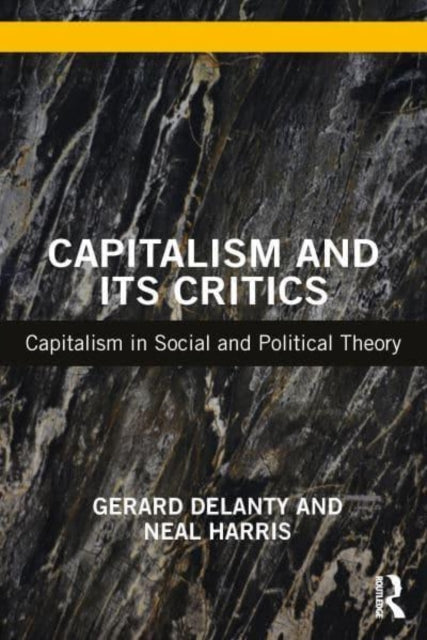
Gerard Delanty,NealHarris
Capitalism and its Critics: Capitalism in Social and Political Theory
Capitalism and its Critics: Capitalism in Social and Political Theory
💎 Earn 188 Points (£1.88) on this item.
YOU SAVE £2.24
- Condition: Brand new
- UK Delivery times: Usually arrives within 2 - 3 working days
- UK Shipping: Fee starts at £2.39. Subject to product weight & dimension
Bulk ordering. Want 15 or more copies? Get a personalised quote and bigger discounts. Learn more about bulk orders.
Couldn't load pickup availability
- More about Capitalism and its Critics: Capitalism in Social and Political Theory
Capitalism and its Critics provides an accessible account of major theories of capitalism from the industrial revolution to the present day, exploring the economic and social thought of key theorists. The book discusses the debates about capitalism and considers alternatives in the twenty-first century, highlighting the tensions between democracy and capitalism in the making of modernity. It is essential reading for anyone interested in understanding capitalism and its alternatives.
Format: Paperback / softback
Length: 210 pages
Publication date: 22 December 2022
Publisher: Taylor & Francis Ltd
Capitalism, a complex economic system that has shaped the world for centuries, has been both celebrated and criticized by many. Its advocates argue that it promotes economic growth, innovation, and individual freedom, while its critics claim that it is exploitative, leads to inequality, and harms the environment. In this essay, we will explore the origins and evolution of capitalism, its key features, and its critics.
Origins of Capitalism:
Capitalism emerged in the late 18th century as a result of the Industrial Revolution, which saw the transition from manual labor to machines and the rise of large-scale manufacturing. The Industrial Revolution was driven by technological advancements, such as the steam engine and the cotton gin, which increased productivity and efficiency. As a result, capitalists were able to produce goods and services at a lower cost, leading to increased profits and wealth.
Key Features of Capitalism:
Private Ownership: Capitalism is based on private ownership of the means of production, including land, factories, and equipment. This means that individuals or corporations can own and control these resources, and make decisions about how they are used. Profit Motivation: Capitalism is driven by the pursuit of profit, which is the incentive for individuals and corporations to invest in and produce goods and services. Profit is generated by selling goods and services at a higher price than the cost of production, with the difference being the profit. Competition: Capitalism is characterized by competition between businesses, which drives innovation and efficiency. Businesses strive to offer the best products and services at the lowest prices, in order to attract customers and gain market share.
Critics of Capitalism:
Exploitation of Labor: One of the main criticisms of capitalism is that it exploits labor by paying workers low wages and providing poor working conditions. Capitalists argue that workers are paid according to their market value and that they have the freedom to choose their employers. However, critics argue that this freedom is limited by the fact that workers are often dependent on their employers for employment, and that they are vulnerable to exploitation.
Inequality: Capitalism is often criticized for creating extreme levels of inequality, with a small percentage of the population owning a vast majority of the wealth. This inequality is often exacerbated by factors such as inheritance, education, and access to capital. Critics argue that this inequality is unfair and leads to social and economic instability.
Environmental Destruction: Capitalism is also criticized for its negative impact on the environment. The pursuit of profit often leads to the exploitation of natural resources, such as oil, gas, and minerals, which can lead to pollution and climate change. Critics argue that capitalism is unsustainable and that we need to move towards a more sustainable economic system.
Colonialism: Capitalism has been linked to colonialism, which is the exploitation of other countries and their resources for the benefit of the colonizing power. Critics argue that capitalism is responsible for the colonization of Africa, Asia, and the Americas, and that it has led to the exploitation and oppression of indigenous peoples.
Alternatives to Capitalism:
Socialism: Socialism is a political and economic system that advocates for public ownership of the means of production and the distribution of wealth. Socialists believe that capitalism is unfair and that the wealth of society should be shared more equitably. Socialism has been implemented in various forms throughout history, including in the Soviet Union and in Cuba.
Communism: Communism is a political and economic system that advocates for the abolition of private ownership of the means of production and the distribution of wealth. In a communist society, the government owns and controls all resources, and the distribution of wealth is based on need. Communism has been implemented in various forms throughout history, including in the Soviet Union and in China.
Democracy: Democracy is a political system that allows for the participation of citizens in decision-making processes. Critics argue that capitalism is undemocratic because it is driven by the pursuit of profit, which can lead to the concentration of wealth and power in the hands of a few. In a democratic society, citizens have the right
Right to vote, to participate in political campaigns, to hold elected officials accountable, and to access information.
Conclusion:
Capitalism has been both celebrated and criticized for its impact on the world. While its advocates argue that it promotes economic growth, innovation, and individual freedom, its critics claim that it is exploitative, leads to inequality, and harms the environment. In conclusion, capitalism is a complex economic system that has shaped the world for centuries. While it has brought about many positive changes, such as increased productivity and efficiency, it has also led to extreme levels of inequality, environmental destruction, and colonialism. As we move into the twenty-first century, it is important to consider alternative economic systems that are more sustainable and equitable. Socialism, communism, and democracy are all examples of alternative economic systems that have been implemented in various forms throughout history, and each has its strengths and weaknesses. It is important to engage in informed debate and discussion about these systems and to work towards creating a more just and sustainable world.
Weight: 402g
Dimension: 174 x 245 x 18 (mm)
ISBN-13: 9781138497870
This item can be found in:
UK and International shipping information
UK and International shipping information
UK Delivery and returns information:
- Delivery within 2 - 3 days when ordering in the UK.
- Shipping fee for UK customers from £2.39. Fully tracked shipping service available.
- Returns policy: Return within 30 days of receipt for full refund.
International deliveries:
Shulph Ink now ships to Australia, Belgium, Canada, France, Germany, Ireland, Italy, India, Luxembourg Saudi Arabia, Singapore, Spain, Netherlands, New Zealand, United Arab Emirates, United States of America.
- Delivery times: within 5 - 10 days for international orders.
- Shipping fee: charges vary for overseas orders. Only tracked services are available for most international orders. Some countries have untracked shipping options.
- Customs charges: If ordering to addresses outside the United Kingdom, you may or may not incur additional customs and duties fees during local delivery.