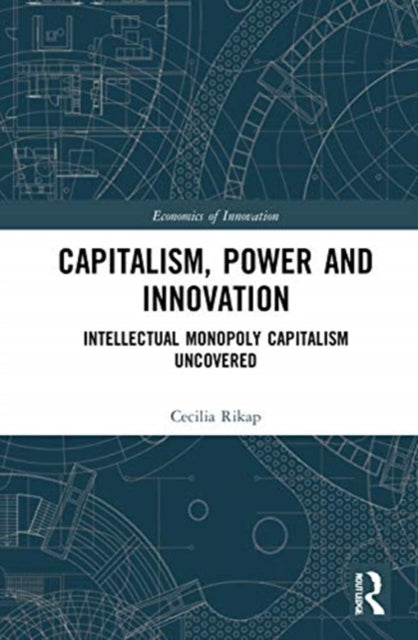
Cecilia Rikap
Capitalism, Power and Innovation: Intellectual Monopoly Capitalism Uncovered
Capitalism, Power and Innovation: Intellectual Monopoly Capitalism Uncovered
💎 Earn 689 Points (£6.89) on this item.
We can order this item for you. Delivery usually takes about 4 to 6 weeks.
This item is not held in our immediate stock. We will order it for you after checkout.
Estimated delivery: About 4 to 6 weeks
YOU SAVE £8.18
- Condition: Brand new
- UK Delivery times: Usually arrives within 2 - 3 working days
- UK Shipping: Fee starts at £2.39. Subject to product weight & dimension
Bulk ordering. Want 15 or more copies? Get a personalised quote and bigger discounts. Learn more about bulk orders.
Couldn't load pickup availability
- More about Capitalism, Power and Innovation: Intellectual Monopoly Capitalism Uncovered
The most powerful corporations in contemporary global capitalism are innovation or intellectual monopolies, which concentrate income, property, and power in the United States, China, and a handful of intellectual monopolies. This book explores how these corporations develop and transform knowledge into intangible assets, combining undermining the commons through privatization with harvesting from the same commons. It argues that desired changes require democratic mobilization of workers and citizens to tilt the scale against intellectual monopoly capitalism and that public ownership is necessary for global infrastructures that lead to natural monopolies.
\n Format: Hardback
\n Length: 296 pages
\n Publication date: 29 March 2021
\n Publisher: Taylor & Francis Ltd
\n
In the realm of contemporary global capitalism, a remarkable phenomenon has emerged: the ascendancy of powerful corporations that have become synonymous with innovation or intellectual monopolies. These corporations hold a profound influence over the world, exerting their power through the control and ownership of knowledge and data. This unique perspective delves into the intricate dynamics of private ownership and control, revealing how it has become a major source of rent and power.
At one pole, these corporations have concentrated income, property, and power in the United States, China, and a select few intellectual monopolies, particularly in the digital and pharmaceutical industries. Meanwhile, developing countries find themselves further behind, struggling to catch up and compete in this rapidly evolving landscape.
The book offers a comprehensive analysis of how intellectual monopolies emerge and transform knowledge from universities and open-source collaborations into intangible assets. It provides detailed empirical mappings that shed light on the mechanisms and strategies employed by these corporations to consolidate their hold on knowledge and reap substantial profits.
One of the key findings of the book is the strategy of undermining the commons through privatization, while simultaneously harvesting from the same commons. This approach involves leveraging the power of intellectual property rights and corporate governance structures to restrict access to knowledge and limit competition. The result is a system that privileges a few dominant corporations while leaving the majority of individuals and countries marginalized.
The book concludes with provocative reflections that aim to tilt the scale against intellectual monopoly capitalism. It argues that desired changes require the democratic mobilization of workers and citizens at large. The book recognizes that the old perspectives, such as the belief that the best way to promote innovation is to transform knowledge into private property, and the exclusive focus on consumer prices in anti-trust policies, are inadequate in the face of the challenges posed by intellectual monopolies.
Furthermore, the formation of global infrastructures that lead to natural monopolies underscores the need for public ownership rather than private control. Scholars and professionals from various social sciences and humanities fields, including economics, sociology, political science, geography, educational science, and science and technology studies, will find this book to be a valuable resource. It offers a clear and comprehensive understanding of the complex dynamics of intellectual monopoly capitalism and provides insights into the strategies and policies required to address this pressing issue.
In conclusion, this book represents one of the first attempts to capture the contours of an emerging new era where old perspectives lead us astray, and the old policy toolbox is hopelessly inadequate. It offers a fresh perspective on the power dynamics of knowledge and data, shedding light on the ways in which private ownership and control have become a major source of rent and power. By provoking reflections and advocating for democratic mobilization, the book aims to tilt the scale against intellectual monopoly capitalism and pave the way for a more equitable and sustainable global economy.
\n Weight: 620g\n
Dimension: 242 x 207 x 25 (mm)\n
ISBN-13: 9780367357634\n \n
UK and International shipping information
UK and International shipping information
UK Delivery and returns information:
- Delivery within 2 - 3 days when ordering in the UK.
- Shipping fee for UK customers from £2.39. Fully tracked shipping service available.
- Returns policy: Return within 30 days of receipt for full refund.
International deliveries:
Shulph Ink now ships to Australia, Belgium, Canada, France, Germany, Ireland, Italy, India, Luxembourg Saudi Arabia, Singapore, Spain, Netherlands, New Zealand, United Arab Emirates, United States of America.
- Delivery times: within 5 - 10 days for international orders.
- Shipping fee: charges vary for overseas orders. Only tracked services are available for most international orders. Some countries have untracked shipping options.
- Customs charges: If ordering to addresses outside the United Kingdom, you may or may not incur additional customs and duties fees during local delivery.