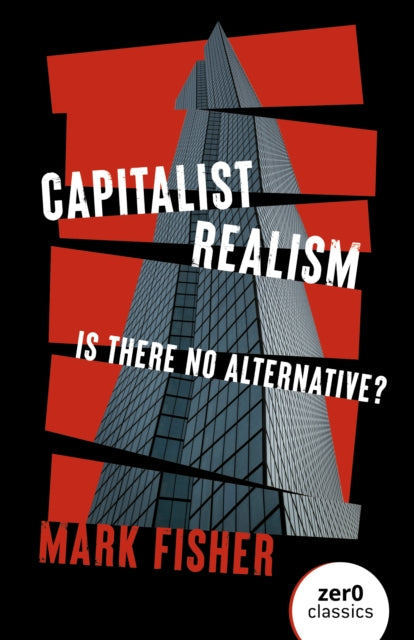
Mark Fisher
Capitalist Realism (New Edition) - Is there no alternative?
Capitalist Realism (New Edition) - Is there no alternative?
YOU SAVE £2.33
- Condition: Brand new
- UK Delivery times: Usually arrives within 2 - 3 working days
- UK Shipping: Fee starts at £3.89. Subject to product weight & dimension
Bulk ordering. Want 15 or more copies? Get a personalised quote and bigger discounts. Learn more about bulk orders.
Couldn't load pickup availability
- More about Capitalist Realism (New Edition) - Is there no alternative?
Capitalism has emerged as the dominant political-economic system since 1989, influencing work, culture, education, and mental health. However, it is challenging to imagine an alternative to capitalism that does not revert to outdated models of state control.
Format: Paperback / softback
Length: 128 pages
Publication date: 25 November 2022
Publisher: John Hunt Publishing
Capitalism has emerged as the predominant political and economic system since 1989. This capitalist realism has had profound effects on various aspects of society, including work, culture, education, and mental health. While some argue that capitalism is the best system for promoting economic growth and prosperity, others contend that it perpetuates inequality, exploitation, and social unrest. In this essay, we will explore the impact of capitalist realism on these four domains and consider whether there are viable alternatives to capitalism that can address these issues.
WORK:
Capitalist realism has had a significant impact on the nature of work in contemporary society. The shift towards a market-driven economy has led to the commodification of labor, with workers increasingly treated as commodities rather than as individuals with rights and dignity. This has resulted in low wages, job insecurity, and long working hours for many workers. Moreover, the emphasis on profit-making has led to a race to the bottom, where companies are willing to cut costs by any means necessary, including reducing employee benefits, outsourcing jobs, and exploiting workers in developing countries.
Culture:
Capitalist realism has also had a profound effect on culture. The commodification of culture has led to the dominance of popular culture over more nuanced and critical forms of expression. This has resulted in a homogenization of culture, where the same few dominant narratives and symbols are repeated ad infinitum, and alternative voices are marginalized or silenced. Moreover, the emphasis on consumerism has led to a culture of materialism, where people are valued for their consumption rather than their contributions to society.
Education:
Capitalist realism has also had a significant impact on education. The emphasis on profit-making has led to a focus on vocational training and job-ready skills rather than on critical thinking, creativity, and intellectual inquiry. This has resulted in a dumbing down of education, where students are taught to pass exams rather than to think critically and challenge the dominant narratives. Moreover, the increasing privatization of education has led to a concentration of wealth in the hands of a few, while access to education is becoming increasingly unequal.
Mental Health:
Capitalist realism has also had a profound effect on mental health. The pressure to succeed in a market-driven economy can lead to high levels of stress, anxiety, and depression. Moreover, the commodification of personal life and the constant exposure to advertising and media messages that promote consumerism can lead to body image issues, social isolation, and a sense of disconnection from others.
Is it possible to imagine an alternative to capitalism that is not some throwback to discredited models of state control?
While some argue that capitalism is the best system for promoting economic growth and prosperity, others contend that it perpetuates inequality, exploitation, and social unrest. There are indeed viable alternatives to capitalism that can address these issues. One such alternative is socialism, which advocates for a more equitable distribution of wealth and resources and the ownership of the means of production by the workers. Socialism has been successful in some countries, such as Cuba and Sweden, and has shown that it is possible to create a society that is both prosperous and socially just.
Another alternative to capitalism is democratic socialism, which combines elements of socialism and democracy. Democratic socialism seeks to create a society that is both economically democratic and socially just, with a strong emphasis on public ownership of key industries and services. This approach has been adopted by some countries, such as Denmark and Finland, and has shown that it is possible to create a society that is both prosperous and socially inclusive.
In addition to these alternatives, there are also many grassroots movements and organizations that are working towards creating a more sustainable and just society. These movements include the environmental movement, the labor movement, and the feminist movement, among others. By working together and building a broader coalition, these movements can create a more powerful alternative to capitalism that can address the many challenges facing our society today.
In conclusion, capitalist realism has had a profound effect on various aspects of society, including work, culture, education, and mental health. While some argue that capitalism is the best system for promoting economic growth and prosperity, others contend that it perpetuates inequality, exploitation, and social unrest. There are indeed viable alternatives to capitalism that can address these issues, including socialism, democratic socialism, and grassroots movements and organizations. By working together and building a broader coalition, we can create a more sustainable and just society that is based on the principles of equality, justice, and sustainability.
Weight: 132g
Dimension: 140 x 215 x 11 (mm)
ISBN-13: 9781803414300
UK and International shipping information
UK and International shipping information
We deliver throughout the United Kingdom and to 128 countries and territories worldwide, including the United States, Australia, Canada, Germany, Spain and France.