Shulph Ink
Carbon Dioxide Sequestration in Cementitious Construction Materials
Carbon Dioxide Sequestration in Cementitious Construction Materials
💎 Earn 945 Points (£9.45) on this item.
YOU SAVE £15.89
- Condition: Brand new
- UK Delivery times: Usually arrives within 2 - 3 working days
- UK Shipping: Fee starts at £2.39. Subject to product weight & dimension
Bulk ordering. Want 15 or more copies? Get a personalised quote and bigger discounts. Learn more about bulk orders.
Couldn't load pickup availability
- More about Carbon Dioxide Sequestration in Cementitious Construction Materials
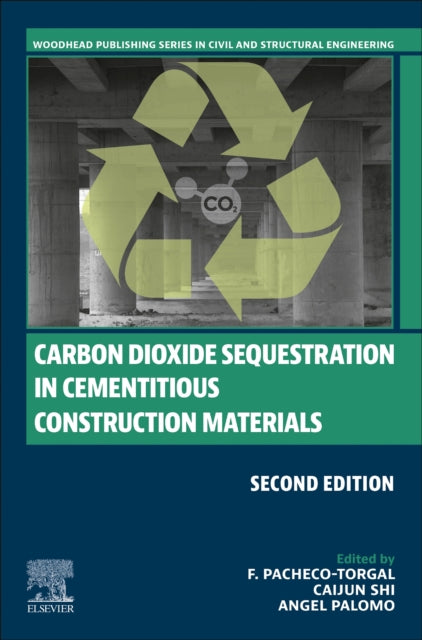
Carbon Dioxide Sequestration in Cementitious Construction Materials, Second Edition, provides an updated overview of carbon dioxide storage-based cementitious materials, offering eco-efficiency and economic advantages in the construction sector. It explores different methods and mechanisms for carbon dioxide sequestration, including steel slag, magnesium-based binders, and autoclaved cement mixtures, as well as carbon capture in industrial waste and recycled materials. The final part investigates biological approaches to carbon dioxide sequestration, including bacteria, bamboo biochar, wood bio-concretes, and bio-inspired materials.
Format: Paperback / softback
Length: 426 pages
Publication date: 01 May 2024
Publisher: Elsevier - Health Sciences Division
Carbon Dioxide Sequestration in Cementitious Construction Materials, Second Edition, provides a comprehensive and updated exploration of carbon dioxide storage-based cementitious construction materials, offering significant eco-efficiency and economic benefits within the construction sector. The book delves into various methods and mechanisms for carbon dioxide sequestration in cementitious materials, including steel slag, magnesium-based binders, and autoclaved cement mixtures. It also examines carbon capture in industrial waste and recycled materials, considering cost, energy, and aqueous carbonation kinetics. The final part introduces biological approaches to carbon dioxide sequestration in construction materials, focusing on bacteria, bamboo biochar, wood bio-concretes, and bio-inspired materials.
Carbon dioxide sequestration in cementitious construction materials involves the capture and storage of carbon dioxide within the material's structure, reducing its environmental impact and contributing to the mitigation of climate change. Cementitious materials, such as concrete, mortar, and plaster, are widely used in construction and have a significant carbon footprint. By sequestering carbon dioxide, these materials can help to reduce the amount of carbon dioxide released into the atmosphere, which is a major contributor to global warming.
There are several methods and mechanisms for carbon dioxide sequestration in cementitious materials. One of the most common methods is the use of steel slag. Steel slag is a by-product of the steelmaking process and contains a high concentration of iron and calcium. When steel slag is added to cementitious materials, it reacts with the calcium in the cement to form calcium carbonate, which is a stable form of carbon dioxide. This process can be used to create concrete that is more durable and resistant to weathering, while also reducing the amount of carbon dioxide released into the atmosphere.
Another method of carbon dioxide sequestration in cementitious materials is the use of magnesium-based binders. Magnesium-based binders are used in concrete and mortar and can react with carbon dioxide to form magnesium carbonate, which is a stable form of carbon dioxide. This process can be used to create concrete that is more durable and resistant to weathering, while also reducing the amount of carbon dioxide released into the atmosphere.
Autoclaved cement mixtures are also used for carbon dioxide sequestration in cementitious materials. Autoclaved cement mixtures are heated to high temperatures, which causes the calcium in the cement to react with the carbon dioxide to form calcium carbonate. This process can be used to create concrete that is more durable and resistant to weathering, while also reducing the amount of carbon dioxide released into the atmosphere.
Carbon capture in industrial waste and recycled materials is another method of carbon dioxide sequestration in cementitious materials. Industrial waste and recycled materials can be used as a source of carbon dioxide for sequestration. For example, waste from the steelmaking process can be used to create concrete that is more durable and resistant to weathering, while also reducing the amount of carbon dioxide released into the atmosphere.
Cost, energy, and aqueous carbonation kinetics are important factors to consider when implementing carbon dioxide sequestration in cementitious materials. Cost is a major factor, as the cost of implementing carbon dioxide sequestration can be high. Energy is also a major factor, as the process of sequestering carbon dioxide requires energy. Aqueous carbonation kinetics is also important, as the rate at which carbon dioxide is absorbed by cementitious materials can vary depending on the conditions.
Biological approaches to carbon dioxide sequestration in construction materials are also being investigated. Bacteria, bamboo biochar, wood bio-concretes, and bio-inspired materials are all being explored as potential methods for sequestering carbon dioxide in construction materials. Bacteria can be used to convert carbon dioxide into organic compounds, which can then be used as a source of energy. Bamboo biochar can be used to create concrete that is more durable and resistant to weathering, while also reducing the amount of carbon dioxide released into the atmosphere. Wood bio-concretes can be used to create concrete that is more durable and resistant to weathering, while also reducing the amount of carbon dioxide released into the atmosphere. Bio-inspired materials can be used to create concrete that is more durable and resistant to weathering, while also reducing the amount of carbon dioxide released into the atmosphere.
In conclusion, carbon dioxide sequestration in cementitious construction materials offers a promising avenue for substantial eco-efficiency and economic advantages within the construction sector. By sequestering carbon dioxide, these materials can help to reduce the amount of carbon dioxide released into the atmosphere, which is a major contributor to global warming. There are several methods and mechanisms for carbon dioxide sequestration in cementitious materials, including steel slag, magnesium-based binders, autoclaved cement mixtures, carbon capture in industrial waste and recycled materials, and biological approaches. Cost, energy, and aqueous carbonation kinetics are important factors to consider when implementing carbon dioxide sequestration in cementitious materials, and biological approaches are being investigated as potential methods for sequestering carbon dioxide in construction materials.
Dimension: 229 x 151 (mm)
ISBN-13: 9780443135774
Edition number: 2 ed
This item can be found in:
UK and International shipping information
UK and International shipping information
UK Delivery and returns information:
- Delivery within 2 - 3 days when ordering in the UK.
- Shipping fee for UK customers from £2.39. Fully tracked shipping service available.
- Returns policy: Return within 30 days of receipt for full refund.
International deliveries:
Shulph Ink now ships to Australia, Belgium, Canada, France, Germany, Ireland, Italy, India, Luxembourg Saudi Arabia, Singapore, Spain, Netherlands, New Zealand, United Arab Emirates, United States of America.
- Delivery times: within 5 - 10 days for international orders.
- Shipping fee: charges vary for overseas orders. Only tracked services are available for most international orders. Some countries have untracked shipping options.
- Customs charges: If ordering to addresses outside the United Kingdom, you may or may not incur additional customs and duties fees during local delivery.