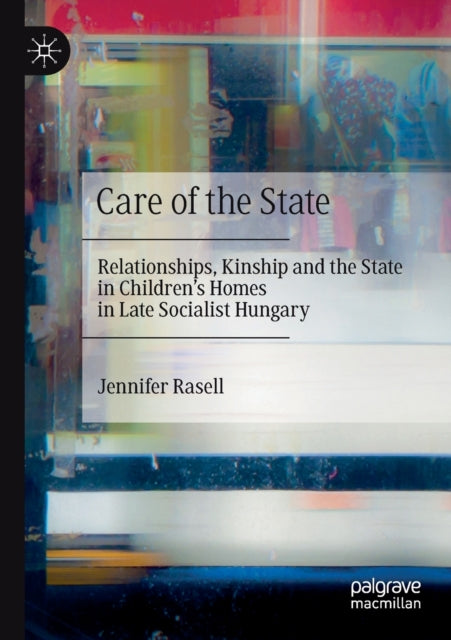
Jennifer Rasell
Care of the State: Relationships, Kinship and the State in Children's Homes in Late Socialist Hungary
Care of the State: Relationships, Kinship and the State in Children's Homes in Late Socialist Hungary
💎 Earn 185 Points (£1.85) on this item.
We can order this item for you. Delivery usually takes about 4 to 6 weeks.
This item is not held in our immediate stock. We will order it for you after checkout.
Estimated delivery: About 4 to 6 weeks
YOU SAVE £7.83
- Condition: Brand new
- UK Delivery times: Usually arrives within 2 - 3 working days
- UK Shipping: Fee starts at £2.39. Subject to product weight & dimension
Bulk ordering. Want 15 or more copies? Get a personalised quote and bigger discounts. Learn more about bulk orders.
Couldn't load pickup availability
- More about Care of the State: Relationships, Kinship and the State in Children's Homes in Late Socialist Hungary
Care of the State explores the changing relationships and kinship ties of children in state residential care in socialist Hungary, highlighting the diversity of experiences and the importance of personal attention, engagement, and emotional connections in children's well-being.
Format: Paperback / softback
Length: 169 pages
Publication date: 29 August 2021
Publisher: Springer Nature Switzerland AG
Care of the State is a groundbreaking research project that delves into the complex and evolving relationships and kinship ties of children who lived in state residential care in socialist Hungary. Through a blend of archival, oral history, interviews, and ethnographic data, the project offers a comprehensive analysis of the shifting dynamics between these children and their families, as well as the broader societal implications of state intervention.
The study explores how various state actors and practices shaped the kin ties of children in care, emphasizing the significance of nuclear families while restricting and devaluing other possible connections, such as siblings, friends, welfare workers, and wider communities. Jennifer Rasell, the project's lead researcher, demonstrates that the Hungarian welfare system placed symbolic weight on nuclear families, while simultaneously marginalizing and demeaning other forms of attachment for children in care.
By examining care practices both within and outside kin relations, Rasell reveals that children valued relationships that were fostered through personal attention, engagement, and emotional connections. The project's nuanced insights provide a valuable contribution to research on children's well-being and family policies in Central-Eastern Europe and beyond.
Through its meticulous examination of historical records, interviews with former residents, and ethnographic fieldwork, Care of the State offers a rich and detailed account of the experiences of children in state care during the socialist era. The project sheds light on the complexities of state intervention, the impact of social policies on family structures, and the enduring legacies of state-sanctioned neglect and abuse.
One of the key findings of the study is the ways in which state residential care disrupted and reshaped familial relationships. Children who were placed in care often experienced a loss of contact with their birth families, as well as a sense of dislocation and alienation from their new surroundings. This separation created a void that was difficult to fill, leading to feelings of abandonment, rejection, and a sense of belongingness.
At the same time, however, state residential care also provided opportunities for children to form new connections and relationships with caregivers, social workers, and other residents. These relationships were often characterized by a sense of trust, support, and empathy, which helped to mitigate the effects of the separation from birth families.
The study also highlights the diversity of experiences within state care in socialist Hungary. While some children experienced a relatively positive and nurturing environment, others faced neglect, abuse, and exploitation. The project explores the various factors that contributed to these disparities, including systemic inequalities, bureaucratic inefficiencies, and the personal biases and prejudices of care workers.
In conclusion, Care of the State is a groundbreaking research project that offers a profound understanding of the complex and multifaceted relationships between children, families, and the state in socialist Hungary. Through its innovative approach and comprehensive analysis, the project contributes to our understanding of kinship, state intervention, and the impact of social policies on children's well-being. Its insights are valuable not only for scholars and researchers in the field of social sciences
but also for policymakers and practitioners working to improve the lives of children and families in similar contexts.
Weight: 248g
Dimension: 210 x 148 (mm)
ISBN-13: 9783030494865
Edition number: 1st ed. 2020
This item can be found in:
UK and International shipping information
UK and International shipping information
UK Delivery and returns information:
- Delivery within 2 - 3 days when ordering in the UK.
- Shipping fee for UK customers from £2.39. Fully tracked shipping service available.
- Returns policy: Return within 30 days of receipt for full refund.
International deliveries:
Shulph Ink now ships to Australia, Belgium, Canada, France, Germany, Ireland, Italy, India, Luxembourg Saudi Arabia, Singapore, Spain, Netherlands, New Zealand, United Arab Emirates, United States of America.
- Delivery times: within 5 - 10 days for international orders.
- Shipping fee: charges vary for overseas orders. Only tracked services are available for most international orders. Some countries have untracked shipping options.
- Customs charges: If ordering to addresses outside the United Kingdom, you may or may not incur additional customs and duties fees during local delivery.