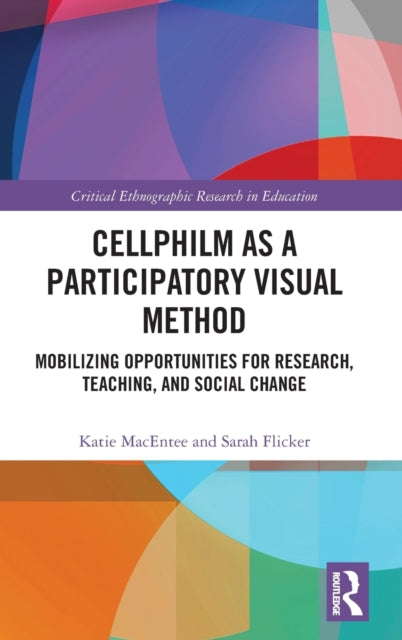
Katie MacEntee,Sarah Flicker
Cellphilm as a Participatory Visual Method: Mobilizing Opportunities for Research, Teaching, and Social Change
Cellphilm as a Participatory Visual Method: Mobilizing Opportunities for Research, Teaching, and Social Change
💎 Earn 811 Points (£8.11) on this item.
We can order this item for you. Delivery usually takes about 4 to 6 weeks.
This item is not held in our immediate stock. We will order it for you after checkout.
Estimated delivery: About 4 to 6 weeks
YOU SAVE £9.63
- Condition: Brand new
- UK Delivery times: Usually arrives within 2 - 3 working days
- UK Shipping: Fee starts at £2.39. Subject to product weight & dimension
Bulk ordering. Want 15 or more copies? Get a personalised quote and bigger discounts. Learn more about bulk orders.
Couldn't load pickup availability
- More about Cellphilm as a Participatory Visual Method: Mobilizing Opportunities for Research, Teaching, and Social Change
This book explores cellphilm as a participatory visual method that promotes learning, social change, and documentation of diverse communities using mobile devices. It provides a methodological framework, educator and researcher roles, and ethical considerations, and demonstrates its application in understanding social issues.
Format: Hardback
Length: 200 pages
Publication date: 30 June 2023
Publisher: Taylor & Francis Ltd
This comprehensive volume heralds cellphilm as a groundbreaking and transformative participatory visual method that not only fosters profound learning experiences but also ignites social change. It provides a comprehensive framework that encompasses the theoretical underpinnings, the roles of educators and researchers, and the ethical considerations involved in employing this method. The authors delve into critical issues that shape the production and dissemination of creative outputs, offering insightful perspectives. Through illustrative examples of cellphilms crafted to unravel social complexities, the book showcases how this methodology empowers diverse populations to document their communities and realities using mobile devices. By examining cellphilm as a burgeoning approach in participatory visual research, this work contributes significantly to the fields of critically engaged community-based research, pedagogy, and higher education, benefiting scholars and community activists alike.
Introduction:
Cellphilm, a term coined by the authors, represents a novel participatory visual method that harnesses the power of mobile devices to facilitate documentation and storytelling. This method combines the advantages of visual storytelling with the accessibility and portability of mobile technology, enabling individuals and communities to capture and share their experiences in a visually compelling and meaningful way.
Theoretical Framework:
The book provides a robust theoretical framework that underpins cellphilm. It explores the concept of participatory visual research, which emphasizes the active involvement of participants in the research process. Cellphilm, as a form of participatory visual research, seeks to empower individuals and communities by providing them with the tools and resources to document their lives, perspectives, and experiences.
The Role of the Educator and Researcher:
The authors emphasize the crucial role of educators and researchers in the implementation of cellphilm. They highlight the importance of fostering a collaborative and inclusive environment where participants feel comfortable expressing themselves and sharing their stories. Educators and researchers play a vital role in guiding participants through the process, ensuring that their voices are heard and their contributions are valued.
Ethical Considerations:
Ethical considerations are a central aspect of cellphilm. The authors address the potential risks and benefits associated with using mobile devices for documentation and storytelling. They emphasize the need for transparency, respect, and consent in the collection and use of data. Cellphilm provides an opportunity for participants to reclaim control over their narratives and to have a say in how their stories are portrayed.
Production and Dissemination of Creative Outputs:
The book delves into the production and dissemination of creative outputs generated through cellphilm. It explores the challenges and opportunities associated with creating and sharing cellphilms in various contexts. The authors discuss the role of technology, platforms, and networks in facilitating the distribution and promotion of cellphilms. They also highlight the importance of engaging with diverse audiences and promoting dialogue and understanding through the use of cellphilms.
Examples of Cellphilms:
Throughout the book, the authors provide examples of cellphilms created by diverse populations to understand social issues. These examples serve as powerful illustrations of how cellphilm can be used to document communities, realities, and experiences. The cellphilms showcase the creativity, resilience, and strength of individuals and communities, providing a window into the lives of others.
Pedagogical and Methodological Standpoints:
The authors demonstrate the versatility of cellphilm from both pedagogical and methodological standpoints. They discuss how cellphilm can be integrated into educational settings, such as classrooms and community centers, to promote learning and social change. Cellphilm can also be used as a research tool to gather data and insights into social issues.
Conclusion:
In conclusion, this comprehensive volume celebrates cellphilm as a groundbreaking and transformative participatory visual method that has the potential to empower individuals and communities. By providing a comprehensive framework, addressing ethical considerations, and showcasing examples of cellphilms created by diverse populations, the book fills an important gap in the fields of critically engaged community-based research, pedagogy, and higher education. Cellphilm offers a powerful tool for documenting and understanding social issues, promoting dialogue, and fostering social change.
Weight: 550g
Dimension: 229 x 152 (mm)
ISBN-13: 9780367555061
UK and International shipping information
UK and International shipping information
UK Delivery and returns information:
- Delivery within 2 - 3 days when ordering in the UK.
- Shipping fee for UK customers from £2.39. Fully tracked shipping service available.
- Returns policy: Return within 30 days of receipt for full refund.
International deliveries:
Shulph Ink now ships to Australia, Belgium, Canada, France, Germany, Ireland, Italy, India, Luxembourg Saudi Arabia, Singapore, Spain, Netherlands, New Zealand, United Arab Emirates, United States of America.
- Delivery times: within 5 - 10 days for international orders.
- Shipping fee: charges vary for overseas orders. Only tracked services are available for most international orders. Some countries have untracked shipping options.
- Customs charges: If ordering to addresses outside the United Kingdom, you may or may not incur additional customs and duties fees during local delivery.