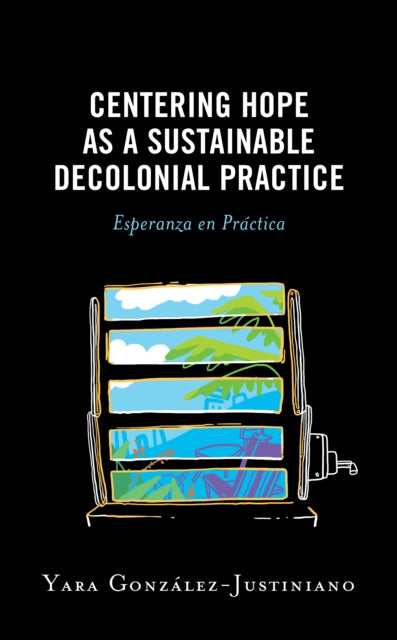
Yara Gonzalez-Justiniano
Centering Hope as a Sustainable Decolonial Practice: Esperanza en Practica
Centering Hope as a Sustainable Decolonial Practice: Esperanza en Practica
💎 Earn 169 Points (£1.69) on this item.
We can order this item for you. Delivery usually takes about 4 to 6 weeks.
This item is not held in our immediate stock. We will order it for you after checkout.
Estimated delivery: About 4 to 6 weeks
- Condition: Brand new
- UK Delivery times: Usually arrives within 2 - 3 working days
- UK Shipping: Fee starts at £2.39. Subject to product weight & dimension
Bulk ordering. Want 15 or more copies? Get a personalised quote and bigger discounts. Learn more about bulk orders.
Couldn't load pickup availability
- More about Centering Hope as a Sustainable Decolonial Practice: Esperanza en Practica
The author explores the concept of hope within Christian theology and its potential for sustainable socio-economic practices in Puerto Rico. They analyze political systems that suppress hope and build a model that puts hope at the center of socio-economic practices.
Format: Paperback / softback
Length: 164 pages
Publication date: 26 February 2024
Publisher: Bloomsbury Publishing Plc
Hope is a fundamental aspect of the human experience, and it plays a significant role in Christian theology as an ontological category. This work explores the definition of hope within Christian theology as an ontological category of the human experience, through ethnographic research and ecclesial study of diverse congregations in Puerto Rico. The author aims to reveal the hope that can be sustainable in time and space through a theology of hope that is rooted in the operations of political systems that suppress hope in the island. The work builds a model that puts hope at the center of socio-economic practices and moves toward a recipe for a hope that is sustainable in practice.
The author begins by examining the context of hope in Puerto Rico, which is characterized by a history of colonialism, poverty, and political instability. She argues that hope is a necessary component of human flourishing and that it can be found in the practices of the Christian church. However, she also notes that the Christian church has often been complicit in the suppression of hope in Puerto Rico, through its emphasis on individual salvation and its failure to address the structural causes of poverty and inequality.
To address this issue, the author proposes a theology of hope that is rooted in the operations of political systems that suppress hope in the island. She argues that hope is not just a personal belief or emotion, but a social and political reality that is shaped by the structures of power and inequality. She draws on the fields of ecclesiology, memory studies, postcolonial and decolonial theory, liberation theology, and the study of social movements to build her model.
One of the key aspects of the author's model is the idea of hope as a practice. She argues that hope is not just a passive state of mind, but a active and engaged process that involves the transformation of oneself and the world around one. She suggests that hope can be cultivated through practices such as prayer, meditation, and community engagement. These practices help individuals to connect with their inner selves and with others, and to develop a sense of purpose and meaning in their lives.
Another important aspect of the author's model is the idea of hope as a future. She argues that hope is not just a present-day reality, but a future-oriented vision that can guide individuals and communities toward a better future. She suggests that hope can be grounded in the values of justice, equality, and compassion, and that it can be used to challenge the structures of power and inequality that exist in the world.
The author's model also includes a critique of the political systems that suppress hope in Puerto Rico. She argues that these systems are based on a system of domination and exploitation that has been perpetuated for centuries. She suggests that these systems can be transformed through a process of liberation that involves the empowerment of individuals and communities.
To support her model, the author provides a series of case studies of diverse congregations in Puerto Rico. These case studies illustrate the ways in which hope is practiced in different contexts and the ways in which it can be used to challenge the structures of power and inequality. For example, one congregation in San Juan uses prayer and meditation to help individuals to cope with the stress of poverty and inequality, while another congregation in Ponce uses community engagement to address the issue of homelessness.
The author also argues that hope is not just a Christian concept, but a universal one. She suggests that hope can be found in the practices of other religious traditions, as well as in the practices of social movements. She argues that hope is a powerful tool for social change and that it can be used to create a more just and equitable world.
However, the author also acknowledges that there are challenges to the practice of hope. She notes that hope can be fragile and vulnerable, and that it can be easily destroyed by external forces such as violence, poverty, and political instability. She suggests that it is important to build resilience and to create a sense of community that can support individuals and communities in times of crisis.
In conclusion, this work explores the definition of hope within Christian theology as an ontological category of the human experience. Through ethnographic research and ecclesial study of diverse congregations in Puerto Rico, the author aims to reveal the hope that can be sustainable in time and space through a theology of hope that is rooted in the operations of political systems that suppress hope in the island. The author's model includes a series of case studies of diverse congregations in Puerto Rico, as well as a critique of the political systems that suppress hope. The author argues that hope is a powerful tool for social change and that it can be used to create a more just and equitable world. However, she also acknowledges that there are challenges to the practice of hope and that it is important to build resilience and to create a sense of community that can support individuals and communities in times of crisis.
Weight: 259g
Dimension: 228 x 150 x 12 (mm)
ISBN-13: 9781793650917
This item can be found in:
UK and International shipping information
UK and International shipping information
UK Delivery and returns information:
- Delivery within 2 - 3 days when ordering in the UK.
- Shipping fee for UK customers from £2.39. Fully tracked shipping service available.
- Returns policy: Return within 30 days of receipt for full refund.
International deliveries:
Shulph Ink now ships to Australia, Belgium, Canada, France, Germany, Ireland, Italy, India, Luxembourg Saudi Arabia, Singapore, Spain, Netherlands, New Zealand, United Arab Emirates, United States of America.
- Delivery times: within 5 - 10 days for international orders.
- Shipping fee: charges vary for overseas orders. Only tracked services are available for most international orders. Some countries have untracked shipping options.
- Customs charges: If ordering to addresses outside the United Kingdom, you may or may not incur additional customs and duties fees during local delivery.