Shulph Ink
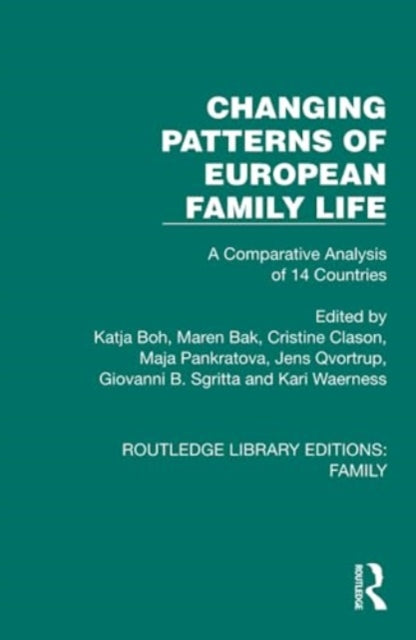
Changing Patterns of European Family Life: A Comparative Analysis of 14 Countries
Changing Patterns of European Family Life: A Comparative Analysis of 14 Countries
💎 Earn 775 Points (£7.75) on this item.
We can order this item for you. Delivery usually takes about 4 to 6 weeks.
This item is not held in our immediate stock. We will order it for you after checkout.
Estimated delivery: About 4 to 6 weeks
- Condition: Brand new
- UK Delivery times: Usually arrives within 2 - 3 working days
- UK Shipping: Fee starts at £3.89. Subject to product weight & dimension
Bulk ordering. Want 15 or more copies? Get a personalised quote and bigger discounts. Learn more about bulk orders.
Couldn't load pickup availability
- More about Changing Patterns of European Family Life: A Comparative Analysis of 14 Countries
A cross-national study published in 1989 investigates the role and pattern of family life in fourteen countries in contemporary Europe. The study argues that the family remained a significant social unit with considerable influence on other social institutions, despite changes in production and working life. The contributors focus on the pressures and contradictions produced by the division of functions between family and work and conclude that the family in modern European societies still had a contribution to make that no other institution could provide.
Format: Hardback
Length: 324 pages
Publication date: 09 August 2023
Publisher: Taylor & Francis Ltd
This extensive cross-national study, originally published in 1989, delves into the intricate dynamics of family life across fourteen diverse countries in contemporary Europe. Offering a treasure trove of insights into European families, it serves as a vital resource for anyone seeking to comprehend the profound shifts occurring within the family sphere at that time. The contributors contend that, rather than succumbing to decline, the family retained its status as a highly significant social unit, exerting a substantial impact on other social institutions such as the state and the labor market. At the heart of this study lies the exploration of the intricate interplay between changes in production and working life on one hand, and changes in family life and reproduction on the other. The contributors zero in on the pressures and contradictions arising from the division of functions between family and work, as well as the challenges posed by the sometimes conflicting and even divergent demands of these two institutions. Through their analysis, they demonstrate that the evolution of the nuclear family model in Europe has resulted in a rich tapestry of family patterns, highlighting the continued relevance and significance of the family in modern European societies.
Introduction:
The family has long been a central institution in human societies, shaping individuals and communities alike. Over the years, it has undergone significant changes, reflecting the evolving social, economic, and cultural landscapes of different regions and countries. In contemporary Europe, the family continues to be a subject of intense study and analysis, as researchers seek to understand the role and patterns of family life in the context of rapidly changing societal dynamics.
The Study:
The study, originally published in 1989, is a comprehensive cross-national examination of the role and patterns of family life in fourteen European countries. Conducted by a team of experts from various disciplines, the study provides a wealth of information on European families, serving as a key source for anyone interested in understanding the changes in the family at that time.
Contributors:
The study is comprised of contributions from a diverse range of scholars and researchers, each bringing their unique perspectives and expertise to the table. The contributors argue that, far from withering away, the family remained a very important social unit that continued to have considerable influence on other social institutions such as the state and the labor market. They emphasize the need to understand the interrelation between changes in production and working life on one hand, and changes in family life and reproduction on the other.
Central Theme:
The central theme of the study is the interrelation between changes in production and working life on one hand, and changes in family life and reproduction on the other. The contributors focus on the pressures and contradictions produced by the division of functions between family and work, and on the problems that have arisen. They show that the evolution of the nuclear family model in Europe had led to a great diversity of family patterns, and conclude that the family in modern European societies still had a contribution to make that no other institution could provide.
Conclusion:
In conclusion, this extensive cross-national study provides a valuable insight into the role and patterns of family life in fourteen European countries. The contributors argue that, far from withering away, the family remained a significant social unit that continued to have a profound impact on other social institutions. The study highlights the pressures and contradictions produced by the division of functions between family and work, and the challenges posed by the sometimes conflicting demands of these two institutions. Through their analysis, the contributors demonstrate that the evolution of the nuclear family model in Europe has resulted in a rich tapestry of family patterns, highlighting the continued relevance and significance of the family in modern European societies.
Dimension: 216 x 138 (mm)
ISBN-13: 9781032536309
UK and International shipping information
UK and International shipping information
We deliver throughout the United Kingdom and to 128 countries and territories worldwide, including the United States, Australia, Canada, Germany, Spain and France.