Dr OlafAlmqvist
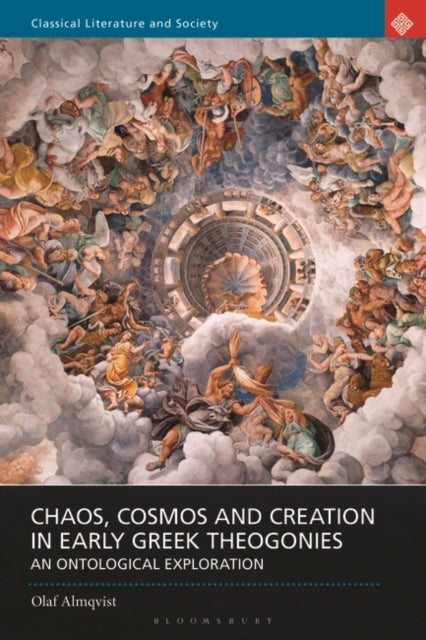
Chaos, Cosmos and Creation in Early Greek Theogonies: An Ontological Exploration
Chaos, Cosmos and Creation in Early Greek Theogonies: An Ontological Exploration
💎 Earn 504 Points (£5.04) on this item.
We can order this item for you. Delivery usually takes about 4 to 6 weeks.
This item is not held in our immediate stock. We will order it for you after checkout.
Estimated delivery: About 4 to 6 weeks
- Condition: Brand new
- UK Delivery times: Usually arrives within 2 - 3 working days
- UK Shipping: Fee starts at £2.39. Subject to product weight & dimension
Bulk ordering. Want 15 or more copies? Get a personalised quote and bigger discounts. Learn more about bulk orders.
Couldn't load pickup availability
- More about Chaos, Cosmos and Creation in Early Greek Theogonies: An Ontological Exploration
This book explores three competing cosmologies of the early Greek world, arguing that they offer different answers to the debate on what it is to be human. It combines approaches from classical studies, anthropology, and philosophy to outline three key sets of ontological assumptions - analogism, pantheism, and naturalism - found in early Greek literature and explores how these assumptions result in contrasting attitudes to rituals such as prayer and sacrifice.
Format: Hardback
Length: 256 pages
Publication date: 10 February 2022
Publisher: Bloomsbury Publishing PLC
Cosmological narratives, such as the creation story in the Book of Genesis or the modern Big Bang theory, are commonly perceived as explanations of the universe's origin. However, cosmologies encompass a much broader scope. In fact, most ancient and modern cosmologies delve into not only the creation of the world but also the intricate relationship between humans and their environment, as well as the delicate boundary that distinguishes humans from gods and animals. By drawing upon approaches from classical studies, anthropology, and philosophy, this book examines three competing cosmologies of the early Greek world: Hesiod's Theogony, the Orphic Derveni Theogony, and Protagoras's creation myth in Plato's renowned dialogue. While all three cosmologies share common elements and characters, Olaf Almqvist contends that they provide distinct perspectives on the essence of humanity. This book engages closely with the ontological turn in anthropology, particularly with the work of Philippe Descola, to outline three fundamental ontological assumptions found in early Greek literature: analogism, pantheism, and naturalism. It then explores how these competing ontological assumptions shape contrasting attitudes toward rituals such as prayer and sacrifice.
Introduction:
Cosmological narratives, whether ancient or modern, have played a significant role in shaping our understanding of the universe and our place within it. These narratives provide a framework for understanding the origins, structure, and evolution of the cosmos, as well as the relationships between different entities within it. In the case of the early Greek world, three competing cosmologies emerged: Hesiod's Theogony, the Orphic Derveni Theogony, and Protagoras's creation myth in Plato's dialogue. These cosmologies offer different perspectives on the nature of the universe, the role of humans, and the relationship between gods and humans.
Hesiod's Theogony:
Hesiod's Theogony is one of the oldest surviving Greek epic poems, dating back to the 8th century BCE. It tells the story of the gods and goddesses, their battles, and the creation of the world. According to Hesiod, the world was created by the god Zeus, who emerged from the chaos of the primordial void. The gods and goddesses were then created to rule over the world and to serve as intermediaries between humans and Zeus.
The Orphic Derveni Theogony:
The Orphic Derveni Theogony is a lesser-known Greek epic poem that dates back to the 2nd century BCE. It tells the story of the god Dionysus, who was born from the union of Zeus and the mortal woman Persephone. The poem emphasizes the importance of the divine and the human, as well as the cycle of birth, death, and rebirth.
Protagoras's Creation Myth:
Protagoras's creation myth is found in Plato's dialogue "The Republic." In this myth, Protagoras argues that the gods are not responsible for the creation of the world but that it is instead the result of chance and natural processes. He believes that humans are the architects of their own destiny and that the gods are merely observers and enforcers of the laws of nature.
Contrasting Perspectives:
Despite these three cosmologies sharing some common elements and characters, they offer very different answers to the question of what it is to be human. Hesiod's Theogony emphasizes the divine and the hierarchical relationship between gods and humans, while the Orphic Derveni Theogony emphasizes the importance of the human and the cycle of birth, death, and rebirth. Protagoras's creation myth, on the other hand, emphasizes the human's role in shaping their own destiny and the limitations of the gods.
Ontological Assumptions:
To better understand the contrasting perspectives of these cosmologies, it is necessary to examine the ontological assumptions that underlie them. Analogism, pantheism, and naturalism are three key sets of ontological assumptions found in early Greek literature.
Analogism:
Analogism is the belief that the world is modeled after a divine prototype. In Hesiod's Theogony, for example, the world is created by the god Zeus, who is modeled after the god Chronos. This belief in analogism suggests that the world is not an independent entity but is instead part of a larger divine order.
Pantheism:
Pantheism is the belief that the world is identical to the divine. In the Orphic Derveni Theogony, for example, the god Dionysus is described as the source of all things, and the world is seen as a reflection of his divine nature. This belief in pantheism suggests that the world is not separate from the divine but is instead an extension of it.
Naturalism:
Naturalism is the belief that the world is the result of natural processes and chance. In Protagoras's creation myth, for example, the world is created by natural processes and chance, and the gods are merely observers and enforcers of the laws of nature. This belief in naturalism suggests that the world is not governed by divine intervention but is instead governed by the laws of physics and biology.
Conclusion:
In conclusion, cosmological narratives, such as the creation story in the Book of Genesis or the modern Big Bang theory, are commonly perceived as explanations of the universe's origin. However, cosmologies encompass a much broader scope. By examining the competing cosmologies of the early Greek world, we can gain a deeper understanding of the nature of the universe, the role of humans, and the relationship between gods and humans. The ontological assumptions of analogism, pantheism, and naturalism provide a framework for understanding these competing cosmologies and their contrasting perspectives on humanity.
Weight: 530g
Dimension: 164 x 242 x 22 (mm)
ISBN-13: 9781350221840
This item can be found in:
UK and International shipping information
UK and International shipping information
UK Delivery and returns information:
- Delivery within 2 - 3 days when ordering in the UK.
- Shipping fee for UK customers from £2.39. Fully tracked shipping service available.
- Returns policy: Return within 30 days of receipt for full refund.
International deliveries:
Shulph Ink now ships to Australia, Belgium, Canada, France, Germany, Ireland, Italy, India, Luxembourg Saudi Arabia, Singapore, Spain, Netherlands, New Zealand, United Arab Emirates, United States of America.
- Delivery times: within 5 - 10 days for international orders.
- Shipping fee: charges vary for overseas orders. Only tracked services are available for most international orders. Some countries have untracked shipping options.
- Customs charges: If ordering to addresses outside the United Kingdom, you may or may not incur additional customs and duties fees during local delivery.