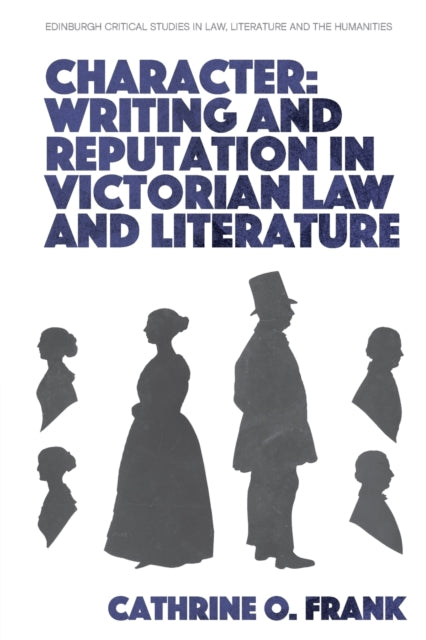
Cathrine O. Frank
Character, Writing, and Reputation in Victorian Law and Literature
Character, Writing, and Reputation in Victorian Law and Literature
YOU SAVE £6.99
- Condition: Brand new
- UK Delivery times: Usually arrives within 2 - 3 working days
- UK Shipping: Fee starts at £3.89. Subject to product weight & dimension
Bulk ordering. Want 15 or more copies? Get a personalised quote and bigger discounts. Learn more about bulk orders.
Couldn't load pickup availability
- More about Character, Writing, and Reputation in Victorian Law and Literature
Cathrine O. Frank explores how literary characterisation and legal developments interacted to create a jurisprudential theory of character that extends beyond the legal profession, shaping communities and mediating relations.
Format: Paperback / softback
Length: 256 pages
Publication date: 31 August 2023
Publisher: Edinburgh University Press
Hawthorne and Eliot's decision to grant fallen women an anachronistic right to silence, which could only worsen their punishment, was a controversial one. While gossip was a useful source of information for lawyers, it was often excluded as hearsay in court. Trollope's work as an editor also influenced his preoccupation with libel throughout his novels. Drawing on a range of primary sources, including novels, Victorian periodical literature, legislative debate, case law, and legal treatise, Cathrine O. Frank explores how conventions of literary characterisation mingled with character-centred legal developments to produce a jurisprudential theory of character that extends beyond the legal profession. She examines how key categories and representational strategies for imagining individual personhood also defined communities and mediated relations within them, in life and in fiction.
One of the key factors that influenced Hawthorne and Eliot's decision to grant fallen women an anachronistic right to silence was the social and cultural context of the time. In the 19th century, women were often seen as inferior to men and were not given the same rights and privileges. This included the right to speak in court, which was seen as a privilege reserved for men. Hawthorne and Eliot believed that granting fallen women the right to silence would help to protect them from further harm and would allow them to maintain their dignity.
However, there were also practical reasons for granting fallen women the right to silence. In the 19th century, courts were often biased against women and were more likely to convict them based on their testimony than on the evidence presented. By granting fallen women the right to silence, Hawthorne and Eliot hoped to reduce the number of false convictions and to ensure that women were treated fairly in the legal system.
However, the anachronistic right to silence could also have had negative consequences for fallen women. By granting them the right to silence, Hawthorne and Eliot were essentially denying them the opportunity to defend themselves in court. This could have led to harsher punishments for women who were guilty of crimes, as they would not be able to provide evidence to support their innocence.
In contrast to Hawthorne and Eliot, Bronte and Gaskell found gossip to be a useful source of information for lawyers. Gaskell, in particular, was known for her detailed and accurate portrayal of social life in Victorian England, and she often used gossip to provide insight into the characters and events of her novels. While gossip was often excluded as hearsay in court, it was still a valuable tool for lawyers to gather information about their clients and their cases.
One of the reasons why gossip was so useful for lawyers was that it was often based on firsthand accounts. Gossip was often spread by people who had direct knowledge of the events or the people involved, and it could provide valuable information that was not available through other sources. For example, gossip could reveal information about a person's character, their relationships, or their past behavior.
However, there were also risks associated with using gossip as a source of information. Gossip could be inaccurate, and it could be used to manipulate or discredit someone. Lawyers had to be careful to verify the information that they received from gossip before using it in court.
Trollope's work as an editor also influenced his preoccupation with libel throughout his novels. Trollope was a prolific writer who published over 100 novels during his lifetime. He was known for his detailed and accurate portrayal of social life in Victorian England, and he often used libel to explore the social and political issues of the day.
One of the reasons why Trollope was so interested in libel was that it was a powerful tool for social control. Libel could be used to damage someone's reputation, and it could be used to silence dissent. Trollope was particularly concerned with the use of libel in the press, and he often used his novels to criticize the press for its lack of ethical standards.
Trollope's work as an editor also influenced his preoccupation with libel in his novels. Trollope was a master of characterisation, and he used his characters to explore the social and political issues of the day. He often used libel to reveal the true nature of his characters and to expose their flaws and weaknesses.
However, Trollope's preoccupation with libel also had negative consequences for his novels. Some of his novels were criticized for their excessive use of libel, and some of his characters were portrayed in a negative light as a result of their use of libel. Trollope's preoccupation with libel also led to a decline in the popularity of his novels in the late 19th century.
In conclusion, Hawthorne and Eliot's decision to grant fallen women an anachronistic right to silence was a controversial one that had both practical and negative consequences. While gossip was a useful source of information for lawyers, it was often excluded as hearsay in court. Trollope's work as an editor also influenced his preoccupation with libel throughout his novels, and his preoccupation with libel had both positive and negative consequences for his novels. By drawing on a range of primary sources, Cathrine O. Frank explores how conventions of literary characterisation mingled with character-centred legal developments to produce a jurisprudential theory of character that extends beyond the legal profession.
Dimension: 234 x 156 (mm)
ISBN-13: 9781474485715
UK and International shipping information
UK and International shipping information
We deliver throughout the United Kingdom and to 128 countries and territories worldwide, including the United States, Australia, Canada, Germany, Spain and France.