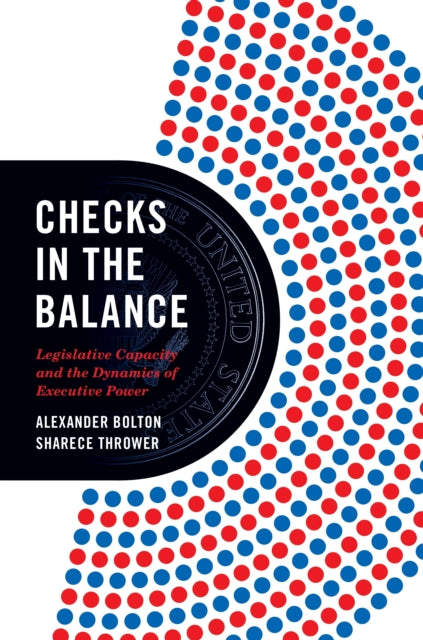
Alexander Bolton,Sharece Thrower
Checks in the Balance: Legislative Capacity and the Dynamics of Executive Power
Checks in the Balance: Legislative Capacity and the Dynamics of Executive Power
💎 Earn 129 Points (£1.29) on this item.
YOU SAVE £6.11
- Condition: Brand new
- UK Delivery times: Usually arrives within 2 - 3 working days
- UK Shipping: Fee starts at £2.39. Subject to product weight & dimension
Bulk ordering. Want 15 or more copies? Get a personalised quote and bigger discounts. Learn more about bulk orders.
Couldn't load pickup availability
- More about Checks in the Balance: Legislative Capacity and the Dynamics of Executive Power
The book "Checks in the Balance" argues that the balance of power between the legislative and executive branches is determined by access to resources and policymaking powers. It suggests that low-capacity legislatures face difficulties checking the executive, while high-capacity legislatures can effectively stifle executives. The book draws on historical evidence and examines thousands of gubernatorial executive orders to demonstrate this.
Format: Paperback / softback
Length: 256 pages
Publication date: 14 December 2021
Publisher: Princeton University Press
The power dynamics between the legislative and executive branches are intricately shaped by the distribution of resources and policymaking authority. The American political landscape is often haunted by the specter of unbridled executive power, raising concerns about the ability of checks and balances to restrain ambitious executives. In their book, Checks in the Balance, Alexander Bolton and Sharece Thrower present a novel theory of separation of powers that emphasizes the crucial role of legislative capacity in constraining executive power.
According to Bolton and Thrower, legislative capacity refers to the combination of a legislature's resources and policymaking powers. They argue that when legislative capacity is high, the legislative branch can effectively check the executive through mechanisms such as oversight, discretion, and the ability to propose and pass legislation. On the other hand, low-capacity legislatures face challenges in holding the executive accountable, as they lack the resources and policymaking authority to challenge the executive's actions.
Bolton and Thrower illustrate their argument with a wealth of historical evidence and empirical analysis. They examine the historical records of congressional capacity, oversight, discretion, and presidential unilateralism to demonstrate how varying levels of legislative capacity affect the balance of power between the branches. They also analyze thousands of gubernatorial executive orders to show how the capacity of state legislatures impacts governors' power.
One of the key findings of Checks in the Balance is that the accumulation of power in the hands of an encroaching executive is prevented by a strong and capable legislative branch. When legislative capacity is low, executives can unilaterally bypass legislative adversaries to impose their will, leading to a concentration of power and a decline in democratic accountability. However, when legislative capacity is high, the legislative branch can effectively stifle executives, preventing the erosion of democratic norms and values.
The book also sheds vital new light on the factors that contribute to the decline of legislative capacity. Bolton and Thrower argue that the decline of legislative capacity is often driven by factors such as political polarization, the rise of interest groups, and the erosion of public trust in government. They suggest that policymakers and citizens can work to strengthen legislative capacity by promoting greater bipartisanship, increasing public engagement in the legislative process, and reforming campaign finance laws to reduce the influence of money in politics.
In conclusion, Checks in the Balance offers a compelling theory of separation of powers that emphasizes the crucial role of legislative capacity in constraining executive power. By highlighting the challenges faced by low-capacity legislatures and the dangers of an encroaching executive, the book provides valuable insights into the dynamics of American politics and offers practical solutions for promoting greater democratic accountability and balance of power.
Weight: 414g
Dimension: 155 x 235 x 20 (mm)
ISBN-13: 9780691224596
This item can be found in:
UK and International shipping information
UK and International shipping information
UK Delivery and returns information:
- Delivery within 2 - 3 days when ordering in the UK.
- Shipping fee for UK customers from £2.39. Fully tracked shipping service available.
- Returns policy: Return within 30 days of receipt for full refund.
International deliveries:
Shulph Ink now ships to Australia, Belgium, Canada, France, Germany, Ireland, Italy, India, Luxembourg Saudi Arabia, Singapore, Spain, Netherlands, New Zealand, United Arab Emirates, United States of America.
- Delivery times: within 5 - 10 days for international orders.
- Shipping fee: charges vary for overseas orders. Only tracked services are available for most international orders. Some countries have untracked shipping options.
- Customs charges: If ordering to addresses outside the United Kingdom, you may or may not incur additional customs and duties fees during local delivery.