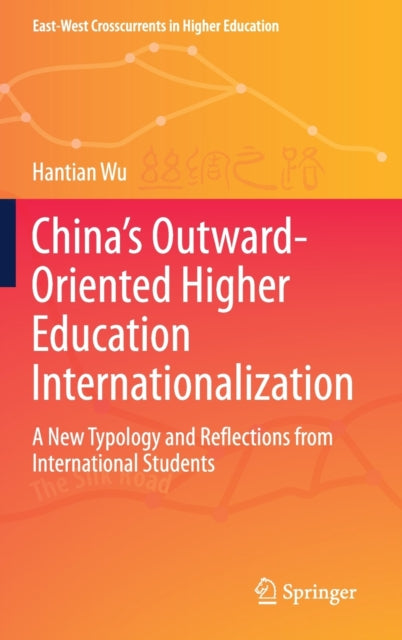
Hantian Wu
China's Outward-Oriented Higher Education Internationalization: A New Typology and Reflections from International Students
China's Outward-Oriented Higher Education Internationalization: A New Typology and Reflections from International Students
💎 Earn 495 Points (£4.95) on this item.
We can order this item for you. Delivery usually takes about 4 to 6 weeks.
This item is not held in our immediate stock. We will order it for you after checkout.
Estimated delivery: About 4 to 6 weeks
YOU SAVE £20.88
- Condition: Brand new
- UK Delivery times: Usually arrives within 2 - 3 working days
- UK Shipping: Fee starts at £2.39. Subject to product weight & dimension
Bulk ordering. Want 15 or more copies? Get a personalised quote and bigger discounts. Learn more about bulk orders.
Couldn't load pickup availability
- More about China's Outward-Oriented Higher Education Internationalization: A New Typology and Reflections from International Students
This book explores China's transition from inward-oriented to outward-oriented higher education internationalization, examining the gap between soft power goals and reality through the perspectives of international graduate students. It provides insights for researchers, students, administrators, and policymakers.
Format: Hardback
Length: 142 pages
Publication date: 11 June 2021
Publisher: Springer Verlag, Singapore
This book presents a novel typology of "inward- and outward-oriented" higher education internationalization, delving into China's transition from a predominantly "inward-oriented" approach to a more balanced strategy. It explores the gap between China's soft power aspirations, aimed at enhancing its image and influence through higher education internationalization, and the realities faced in achieving these goals. Through in-depth examinations of the three major dimensions of China's "outward-oriented" higher education internationalization, namely the Confucius Institute program, international development aid in higher education, and the recruitment of international students at higher education levels, the book sheds light on the experiences and perspectives of international graduate students enrolled in English instruction programs in education-related majors at three Chinese universities. By offering theoretical insights and practical examples, this comprehensive text caters to the needs of higher education researchers, graduate students, administrators of higher education institutions, and policymakers in the government sector.
Introduction:
The global landscape of higher education is undergoing a profound transformation, driven by the forces of globalization, technological advancements, and changing societal needs. In this context, China, as a rapidly developing country, has been actively engaging in internationalization efforts to enhance its higher education system and position itself as a global player. This book aims to contribute to the understanding of China's higher education internationalization by exploring the dynamics of "inward- and outward-oriented" higher education internationalization.
Theoretical Framework:
The typology presented in this book distinguishes between "inward- and outward-oriented" higher education internationalization. "Inward-oriented" internationalization focuses on enhancing the quality of education, attracting domestic students, and promoting national development. On the other hand, "outward-oriented" internationalization aims to expand the reach of Chinese higher education institutions, attract international students, and promote cultural exchange and cooperation.
China's Transition:
China has undergone a significant shift in its higher education internationalization strategy over the past few decades. Initially, China's higher education internationalization was primarily "inward-oriented," with a focus on domestic students and national development. However, with the increasing demand for global talent and the recognition of the importance of internationalization in higher education, China has gradually adopted a more balanced approach.
The Gap between Soft Power Goals and Reality:
Despite China's efforts to enhance its international reputation and influence through higher education internationalization, there exists a gap between the country's soft power goals and the reality on the ground. This gap is primarily due to several factors, including the lack of infrastructure and resources, language barriers, and cultural differences.
Outward-Oriented Higher Education Internationalization:
To address the gap between soft power goals and reality, China has implemented various initiatives aimed at promoting "outward-oriented" higher education internationalization. One of the most prominent initiatives is the Confucius Institute program, which was launched in 2000 to promote Chinese language and culture worldwide. The Confucius Institute program has established hundreds of centers in more than 140 countries, attracting thousands of international students and promoting cultural exchange and cooperation.
International development aid in higher education is another dimension of China's "outward-oriented" higher education internationalization. China has been providing financial assistance and technical expertise to developing countries to improve their higher education systems. This aid has helped to build capacity and infrastructure in developing countries, enabling them to offer quality higher education programs and attract international students.
Higher education level international student recruitment is also a significant aspect of China's "outward-oriented" higher education internationalization. China has been actively recruiting international students to its universities, offering competitive scholarships and attractive academic programs. This recruitment has helped to diversify the student population and promote cultural exchange and cooperation.
Conclusion:
In conclusion, this book presents a novel typology of "inward- and outward-oriented" higher education internationalization, and investigates China's current situation of shifting from a mainly "inward-oriented" higher education internationalization to a more balanced approach. It describes the gap between China's soft power goals of using higher education internationalization for image and influence enhancement and the reality, and examines the three major dimensions of China's "outward-oriented" higher education internationalization based on reflections provided by international graduate students in English instruction programs in education-related majors in three Chinese universities. Providing both theoretical insights and real-world examples, this book is suitable for higher education researchers, graduate students in the relevant fields, administrators of higher education institutions, and policymakers in the government sector.
Weight: 454g
Dimension: 235 x 155 (mm)
ISBN-13: 9789811625572
Edition number: 1st ed. 2021
This item can be found in:
UK and International shipping information
UK and International shipping information
UK Delivery and returns information:
- Delivery within 2 - 3 days when ordering in the UK.
- Shipping fee for UK customers from £2.39. Fully tracked shipping service available.
- Returns policy: Return within 30 days of receipt for full refund.
International deliveries:
Shulph Ink now ships to Australia, Belgium, Canada, France, Germany, Ireland, Italy, India, Luxembourg Saudi Arabia, Singapore, Spain, Netherlands, New Zealand, United Arab Emirates, United States of America.
- Delivery times: within 5 - 10 days for international orders.
- Shipping fee: charges vary for overseas orders. Only tracked services are available for most international orders. Some countries have untracked shipping options.
- Customs charges: If ordering to addresses outside the United Kingdom, you may or may not incur additional customs and duties fees during local delivery.