Shulph Ink
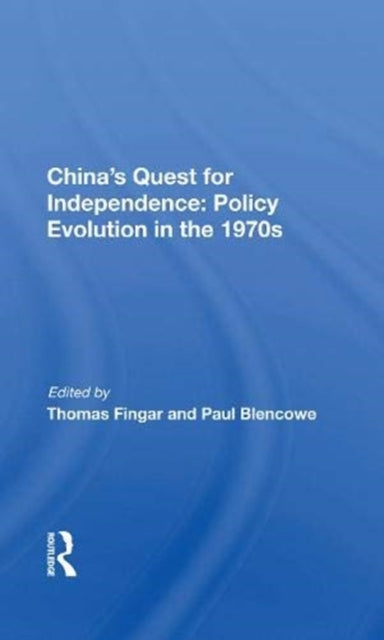
China's Quest For Independence: Policy Evolution In The 1970s
China's Quest For Independence: Policy Evolution In The 1970s
💎 Earn 207 Points (£2.07) on this item.
We can order this item for you. Delivery usually takes about 4 to 6 weeks.
This item is not held in our immediate stock. We will order it for you after checkout.
Estimated delivery: About 4 to 6 weeks
YOU SAVE £2.47
- Condition: Brand new
- UK Delivery times: Usually arrives within 2 - 3 working days
- UK Shipping: Fee starts at £2.39. Subject to product weight & dimension
Bulk ordering. Want 15 or more copies? Get a personalised quote and bigger discounts. Learn more about bulk orders.
Couldn't load pickup availability
- More about China's Quest For Independence: Policy Evolution In The 1970s
This examination of policy developments in the People's Republic of China since the Cultural Revolution addresses two central questions: how durable were foreign and domestic policies during the 1970s, and what is the relationship between both of these policy areas and internal political maneuvering?
Format: Paperback / softback
Length: 270 pages
Publication date: 29 July 2022
Publisher: Taylor & Francis Ltd
This comprehensive examination of policy developments in the People's Republic of China since the Cultural Revolution delves into two fundamental questions: first, to what extent were foreign and domestic policies resilient during the 1970s, and second, how do these policy domains intersect with internal political maneuvering? By exploring these critical aspects, the study sheds
offers valuable insights into the complex dynamics that shaped China's political landscape during this transformative period.
The 1970s marked a pivotal era in China's history, characterized by significant policy shifts and transformations. The Cultural Revolution, which began in 1966, brought about a radical shift in the country's political and social landscape, challenging the established order and paving the way. for a new era of reform and opening up.
One of the key challenges facing China during the 1970s was the need to balance its foreign and domestic policies. On the one hand, China sought to establish diplomatic relations with the West and engage in economic cooperation. trade with other countries to promote its economic development and improve its international standing. On the other hand, China was also committed to maintaining its socialist ideology and implementing policies that would promote social stability and economic growth within its borders.
To achieve this balance, China pursued a series of policies during the 1970s. These policies included opening up to the world, implementing economic reforms, and promoting social stability. Opening up to the world involved reducing trade barriers, attracting foreign investment, and establishing diplomatic relations with other countries. Economic reforms aimed to modernize China's economy and increase its competitiveness in the global market. Promoting social stability involved implementing policies that would address social inequality, reduce poverty, and improve social welfare.
Despite these efforts, China faced several challenges during the 1970s. One of the most significant challenges was the economic crisis that began in 1976. The crisis was caused by a combination of factors, including overproduction, inflation, and a lack of investment. The crisis led to a decline in China's economic growth and a rise in unemployment.
To address the economic crisis, China implemented a series of policies, including the "Boluan Fanzheng" program, which aimed to reduce overproduction and increase investment. The program was successful in reducing overproduction and increasing investment, but it also led to a rise in unemployment and a decline in social welfare.
Another challenge facing China during the 1970s was the political instability that was caused by the Cultural Revolution. The Cultural Revolution was a period of intense political turmoil and social unrest that lasted from 1966 to 1976. The revolution was led by Mao Zedong, who sought to transform China's society and economy into a socialist state. The revolution was characterized by violent clashes between different political factions and a decline in social welfare.
To address the political instability, China implemented a series of policies, including the "Great Leap Forward" program, which aimed to modernize China's agriculture and increase productivity. The program was successful in increasing productivity, but it also led to a decline in food production and a rise in starvation and death.
Despite these challenges, China was able to make significant progress during the 1970s. One of the most significant achievements was the establishment of diplomatic relations with the United States in 1979. The establishment of diplomatic relations was a significant milestone in China's history, as it marked the beginning of a new era of cooperation and engagement with the West.
Another significant achievement was the implementation of economic reforms. Economic reforms aimed to modernize China's economy and increase its competitiveness in the global market. The reforms included opening up to the world, implementing market-oriented policies, and promoting private enterprise.
Promoting social stability was also a significant achievement during the 1970s. China implemented policies that aimed to address social inequality, reduce poverty, and improve social welfare. These policies included the establishment of social security systems, the expansion of education, and the promotion of women's rights.
In conclusion, this examination of policy developments in the People's Republic of China since the Cultural Revolution offers valuable insights into the complex dynamics that shaped China's political landscape during this transformative period. The 1970s marked a pivotal era in China's history, characterized by significant policy shifts and transformations. China sought to balance its foreign and domestic policies, opening up to the world, implementing economic reforms, and promoting social stability. Despite facing several challenges, China was able to make significant progress, including establishing diplomatic relations with the United States, implementing economic reforms, and promoting social stability. The 1970s were a period of intense political turmoil and social unrest, but they also marked the beginning of a new era of cooperation and engagement with the West.
Weight: 500g
ISBN-13: 9780367171445
UK and International shipping information
UK and International shipping information
UK Delivery and returns information:
- Delivery within 2 - 3 days when ordering in the UK.
- Shipping fee for UK customers from £2.39. Fully tracked shipping service available.
- Returns policy: Return within 30 days of receipt for full refund.
International deliveries:
Shulph Ink now ships to Australia, Belgium, Canada, France, Germany, Ireland, Italy, India, Luxembourg Saudi Arabia, Singapore, Spain, Netherlands, New Zealand, United Arab Emirates, United States of America.
- Delivery times: within 5 - 10 days for international orders.
- Shipping fee: charges vary for overseas orders. Only tracked services are available for most international orders. Some countries have untracked shipping options.
- Customs charges: If ordering to addresses outside the United Kingdom, you may or may not incur additional customs and duties fees during local delivery.