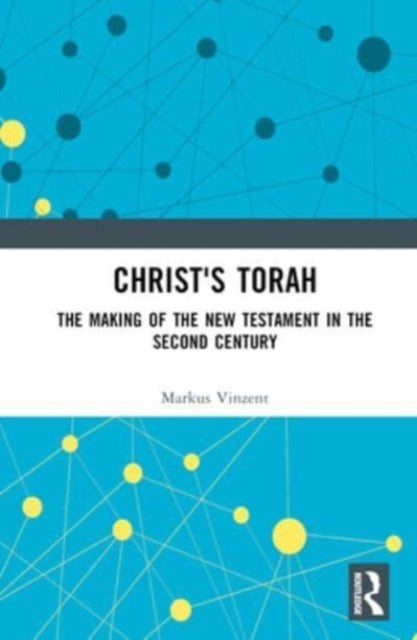
Markus Vinzent
Christ's Torah: The Making of the New Testament in the Second Century
Christ's Torah: The Making of the New Testament in the Second Century
💎 Earn 811 Points (£8.11) on this item.
We can order this item for you. Delivery usually takes about 4 to 6 weeks.
This item is not held in our immediate stock. We will order it for you after checkout.
Estimated delivery: About 4 to 6 weeks
YOU SAVE £9.63
- Condition: Brand new
- UK Delivery times: Usually arrives within 2 - 3 working days
- UK Shipping: Fee starts at £2.39. Subject to product weight & dimension
Bulk ordering. Want 15 or more copies? Get a personalised quote and bigger discounts. Learn more about bulk orders.
Couldn't load pickup availability
- More about Christ's Torah: The Making of the New Testament in the Second Century
This volume explores the creation of the New Testament, discussing how the writings were compiled and by whom. It argues that key second-century scholars played an important role in the emergence of the canonical collection and presents possible historical origins for the texts' composition.
Format: Hardback
Length: 402 pages
Publication date: 13 December 2023
Publisher: Taylor & Francis Ltd
The creation of the New Testament, a collection of writings that became widely recognized in the late second century CE, is a subject of extensive study. While it is generally accepted that the New Testament did not emerge as a cohesive collection prior to this time, the question of how it came to be remains a subject of debate. This volume explores the intricate process of the New Testament's formation, examining the various factors that contributed to its development.
The New Testament comprises a diverse range of texts, including the Gospels, the so-called Praxapostolos (Acts and the canonical letters), the Epistles of Paul, and Revelation. The historical origins of these writings are a subject of much speculation and debate. While it is generally believed that they were written by different authors and communities over a period of several centuries, the exact process by which they were compiled and edited into the New Testament remains unclear.
One prevailing theory suggests that the New Testament was a slow, organic process in which texts written by different authors grew together over time. This theory posits that the early Christian communities were characterized by a sense of shared identity and a common set of beliefs, and that these communities gradually developed a collection of writings that reflected their shared heritage. This process of compilation and editing was likely influenced by various factors, including the need to preserve and transmit the teachings of Jesus and his followers, as well as the desire to address specific theological and ethical issues within the early Christian community.
Another theory suggests that the New Testament was compiled on the basis. This theory posits that an individual or a group of editors made editorial decisions about which writings to include and how to arrange them. These editors may have revised certain writings for this purpose and partly harmonized them with each other to create a cohesive collection of texts. This theory is supported by the fact.
The emergence of the New Testament as a recognisable collection in more detail can be traced back to the work of Irenaeus of Lyon towards the end of the second century CE. Irenaeus, a prominent Christian scholar of his time, argued that the Gospels, the Epistles of Paul, and Revelation were the three most important writings in the New Testament and that they were written by different authors but were nevertheless inspired by the Holy Spirit. This argument laid the foundation for the development of the early Christian canon, which became widely accepted in the fourth century CE.
Despite the various theories and debates surrounding the New Testament's creation, it is clear that key second century scholars played an important role in the emergence of the canonical collection. Among these scholars were Justin Martyr, who wrote extensively about the teachings of Jesus and his followers, and Tertullian, who was a prominent apologist for the Christian faith. Tertullian's work, in particular, influenced the development of the early Christian canon by advocating for the inclusion of certain writings and the exclusion of others.
In conclusion, the creation of the New Testament is a complex and multifaceted process that remains a subject of ongoing study and debate. While it is generally accepted that the New Testament did not emerge as a cohesive collection prior to the late second century CE, the question of how it came to be remains a subject of intense investigation. This volume explores the various theories and debates surrounding the New Testament's formation, examining the possible historical origins of the texts composition and the role of key second century scholars in the emergence of the canonical collection. By studying the New Testament, we can gain a deeper understanding of the early Christian community and its beliefs, and how these beliefs evolved and developed over time.
Weight: 910g
Dimension: 234 x 156 (mm)
ISBN-13: 9781032457024
UK and International shipping information
UK and International shipping information
UK Delivery and returns information:
- Delivery within 2 - 3 days when ordering in the UK.
- Shipping fee for UK customers from £2.39. Fully tracked shipping service available.
- Returns policy: Return within 30 days of receipt for full refund.
International deliveries:
Shulph Ink now ships to Australia, Belgium, Canada, France, Germany, Ireland, Italy, India, Luxembourg Saudi Arabia, Singapore, Spain, Netherlands, New Zealand, United Arab Emirates, United States of America.
- Delivery times: within 5 - 10 days for international orders.
- Shipping fee: charges vary for overseas orders. Only tracked services are available for most international orders. Some countries have untracked shipping options.
- Customs charges: If ordering to addresses outside the United Kingdom, you may or may not incur additional customs and duties fees during local delivery.