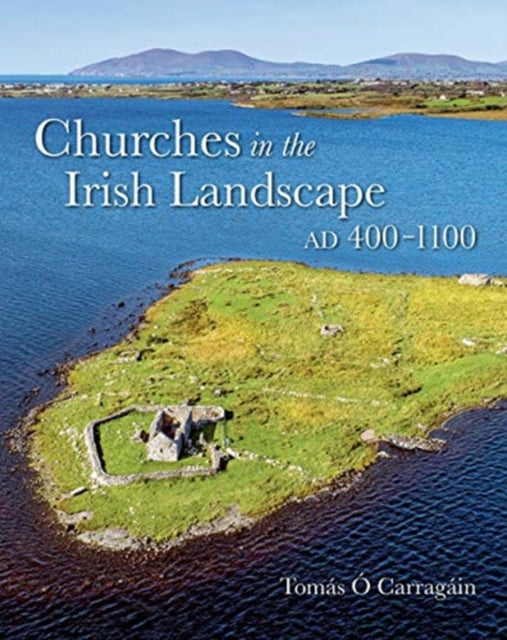
Tomas O Carragain
Churches in the Irish Landscape Ad 400-1100
Churches in the Irish Landscape Ad 400-1100
YOU SAVE £3.96
- Condition: Brand new
- UK Delivery times: Usually arrives within 2 - 3 working days
- UK Shipping: Fee starts at £3.89. Subject to product weight & dimension
Bulk ordering. Want 15 or more copies? Get a personalised quote and bigger discounts. Learn more about bulk orders.
Couldn't load pickup availability
- More about Churches in the Irish Landscape Ad 400-1100
During the fifth to ninth centuries, thousands of churches were built in Ireland, resulting in significant changes in settlement patterns, agriculture, social organization, rituals, and beliefs. Landscape archaeology is a valuable tool for studying these churches, as it allows us to map their placement in relation to pagan ritual and royal sites, burial grounds, and settlements. This research provides a new perspective on this formative period, with implications for the study of social power and religious change in other parts of Europe.
\n Format: Hardback
\n Length: 434 pages
\n Publication date: 17 September 2021
\n Publisher: Cork University Press
\n
Between the fifth century and the ninth, Ireland experienced a remarkable surge in the establishment of churches, surpassing most other regions of Europe in terms of density. This period witnessed profound transformations in settlement patterns, agriculture, social organization, rituals, and beliefs, and churches played a significant role in these developments. The central premise of this book is that landscape archaeology offers a powerful lens through which to explore these changes. By examining the spatial placement of churches in relation to pagan ritual and royal sites, burial grounds, and settlements, as well as their historical trajectory over time, we can gain insights into the shifting strategies of kings, clerics, and ordinary people. The result is a fascinating new perspective on this formative period, with broader implications for the study of social power and religious change in other parts of Europe.
The earliest churches, founded during a time of religious diversity between 400 and 550, were often located within royal landscapes, indicating that some sections of the elite were open to accommodating the new religion. However, these early churches often faced competition from new monasteries that were established away from the core royal land, granting them vast estates on which their wealth was built. This shift in power dynamics led to the emergence of a more inclusive religious landscape, where rituals and beliefs of local origin coexisted alongside Christianity.
In the subsequent centuries, the establishment of churches became less exclusive to the ruling elite. Middle-ranking individuals played a significant role in transforming the landscape and shaping religious cultures that incorporated both local traditions and Christianity. The construction of numerous lesser churches outside the estates of kings and nobles facilitated the spread of Christianity among the common people, leading to the development of a more diverse and inclusive religious community.
The Viking Age (800-1100) marked a significant turning point in the history of Irish churches. While some lesser churches were abandoned, community churches began to exert a greater gravitational pull, foreshadowing the later medieval parish system. This shift in religious practices reflected the growing influence of the common people and their desire for a more localized and accessible form of worship.
In conclusion, the establishment of thousands of churches in Ireland between the fifth century and the ninth century represents a pivotal period in the country's history. Through the lens of landscape archaeology, we can gain a deeper understanding of the complex interplay between religious change, social power, and the physical landscape. The study of these churches provides valuable insights into the development of religious cultures, the shifting strategies of rulers, and the broader implications of religious transformation in Europe.
\n Weight: 2474g\n
Dimension: 248 x 310 x 34 (mm)\n
ISBN-13: 9781782054306\n \n
UK and International shipping information
UK and International shipping information
We deliver throughout the United Kingdom and to 128 countries and territories worldwide, including the United States, Australia, Canada, Germany, Spain and France.