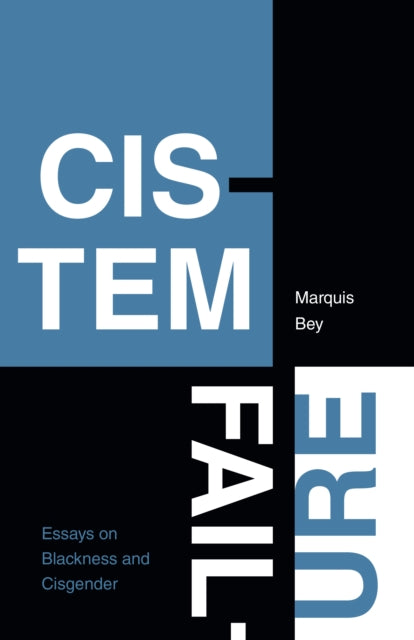
Marquis Bey
Cistem Failure: Essays on Blackness and Cisgender
Cistem Failure: Essays on Blackness and Cisgender
💎 Earn 103 Points (£1.03) on this item.
YOU SAVE £4.35
- Condition: Brand new
- UK Delivery times: Usually arrives within 2 - 3 working days
- UK Shipping: Fee starts at £2.39. Subject to product weight & dimension
Bulk ordering. Want 15 or more copies? Get a personalised quote and bigger discounts. Learn more about bulk orders.
Couldn't load pickup availability
- More about Cistem Failure: Essays on Blackness and Cisgender
Cistem Failure by Marquis Bey explores the antagonistic relationship between blackness and cisgender, arguing that cisgender is too flat a category to hold the myriad ways that people depart from gender alignment. Bey suggests an antiracist gender abolition project that rejects cisgender as a regulatory apparatus.
Format: Paperback / softback
Length: 184 pages
Publication date: 15 July 2022
Publisher: Duke University Press
Cistem Failure: Exploring the Antagonistic Relationship between Blackness and Cisgender
Marquis Bey explores the antagonistic relationship between blackness and cisgender in his work. He questions the notion of being cisgender, which suggests that there is a natural way to be a sex. Bey argues that cisgender is too flat as a category to hold the myriad ways that people who may or may not have undergone gender-affirmative interventions depart from gender alignment. He also contends that blackness strikes at the heart of cisgender's invariable coding as white, implying a non-cis space. By showing how blackness opens up a way to subvert the hegemonic power of the gender binary, Bey makes a case for an antiracist gender abolition project that rejects cisgender as a regulatory apparatus.
Bey begins by examining the Powerpuff Girls, a cartoon that features three female superheroes with different gender identities. He notes that the show's creators used the term "cisgender" to describe the character's gender alignment, but that the term was not widely understood at the time. He then moves on to the greeting "How ya mamanem?" which is used in the Caribbean and Latin America to address women. Bey argues that the term is too flat as a category to hold the myriad ways that people who may or may not have undergone gender-affirmative interventions depart from gender alignment.
Bey then turns to their own gender identity. They describe themselves as a black, queer, and non-binary person who has undergone gender-affirmative interventions. They argue that cisgender is too flat as a category to hold the myriad ways that people who may or may not have undergone gender-affirmative interventions depart from gender alignment. They also contend that blackness strikes at the heart of cisgender's invariable coding as white, implying a non-cis space.
Bey makes a case for an antiracist gender abolition project that rejects cisgender as a regulatory apparatus. They argue that cisgender is a tool of the patriarchy that reinforces the gender binary and that it is necessary to dismantle it in order to achieve gender equality. They suggest that this can be done by creating a space for people to express their gender identities in a way that is not constrained by the gender binary.
Bey's work has received critical acclaim, and he has been invited to speak at various conferences and events. He has also published several books, including "Blackness and Cisgender: A Critical Analysis" and "Queer Theory and the Politics of Gender." Bey's work has helped to shape the way that we think about gender and has contributed to the growing movement for gender equality.
In conclusion, Marquis Bey's work explores the antagonistic relationship between blackness and cisgender. He argues that cisgender is too flat as a category to hold the myriad ways that people who may or may not have undergone gender-affirmative interventions depart from gender alignment. He also contends that blackness strikes at the heart of cisgender's invariable coding as white, implying a non-cis space. By making a case for an antiracist gender abolition project that rejects cisgender as a regulatory apparatus, Bey has helped to shape the way that we think about gender and has contributed to the growing movement for gender equality.
Weight: 227g
Dimension: 203 x 127 (mm)
ISBN-13: 9781478018445
UK and International shipping information
UK and International shipping information
UK Delivery and returns information:
- Delivery within 2 - 3 days when ordering in the UK.
- Shipping fee for UK customers from £2.39. Fully tracked shipping service available.
- Returns policy: Return within 30 days of receipt for full refund.
International deliveries:
Shulph Ink now ships to Australia, Belgium, Canada, France, Germany, Ireland, Italy, India, Luxembourg Saudi Arabia, Singapore, Spain, Netherlands, New Zealand, United Arab Emirates, United States of America.
- Delivery times: within 5 - 10 days for international orders.
- Shipping fee: charges vary for overseas orders. Only tracked services are available for most international orders. Some countries have untracked shipping options.
- Customs charges: If ordering to addresses outside the United Kingdom, you may or may not incur additional customs and duties fees during local delivery.