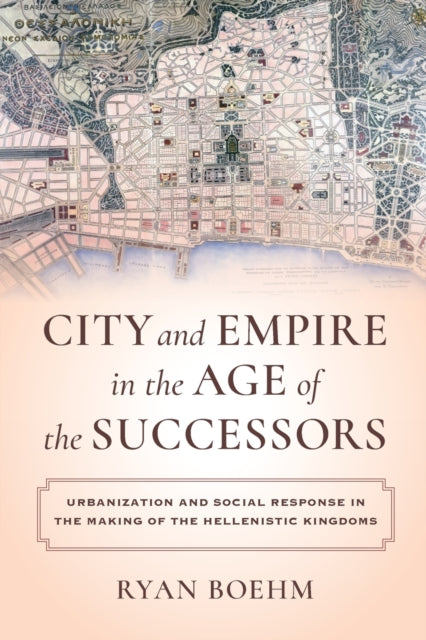
Ryan Boehm
City and Empire in the Age of the Successors: Urbanization and Social Response in the Making of the Hellenistic Kingdoms
City and Empire in the Age of the Successors: Urbanization and Social Response in the Making of the Hellenistic Kingdoms
💎 Earn 124 Points (£1.24) on this item.
YOU SAVE £5.11
- Condition: Brand new
- UK Delivery times: Usually arrives within 2 - 3 working days
- UK Shipping: Fee starts at £2.39. Subject to product weight & dimension
Bulk ordering. Want 15 or more copies? Get a personalised quote and bigger discounts. Learn more about bulk orders.
Couldn't load pickup availability
- More about City and Empire in the Age of the Successors: Urbanization and Social Response in the Making of the Hellenistic Kingdoms
After Alexander the Great's death, the Greek city-state world was embroiled in political struggles and violence. Successors developed new cities by merging smaller settlements, leading to the transformation of the fragmented world into an urbanized network of cities. City and Empire in the Age of the Successors reinterprets the role of urbanization in the creation of the Hellenistic kingdoms and argues for the agency of local actors.
Format: Paperback / softback
Length: 316 pages
Publication date: 02 November 2021
Publisher: University of California Press
In the tumultuous years that followed the demise of Alexander the Great, the world of the Greek city-state plunged headlong into a realm of political contention and relentless violence as his successors vied for supremacy. As these aspiring rulers grappled with the practical challenges of governing the diverse territories under their control, they embarked on a remarkable endeavor: the creation of new cities through the amalgamation of smaller settlements. This practice, known as synoikism, gave rise to numerous pivotal cities that would shape the course of history. It initiated significant shifts in settlement patterns and consolidated numerous previously independent polities, resulting in the gradual transformation of the fragmented world of the small Greek polis into an urbanized network of cities.
To unravel the intricate tapestry of urbanization during this era, City and Empire in the Age of the Successors employs a comprehensive array of archaeological, epigraphic, and textual evidence. Through meticulous analysis, the book reinterprets the role of urbanization in the formation of the Hellenistic kingdoms and advocates for the agency of local actors in the creation of these new imperial cities.
The book begins by exploring the political landscape of the Hellenistic world, which was characterized by a power vacuum and the rise of numerous petty kingdoms. As these kingdoms sought to assert their authority and expand their territories, they turned their attention to the cities, which were vital centers of commerce, culture, and governance. The successors of Alexander the Great recognized the strategic importance of cities and embarked on a program of urbanization that would shape the course of history.
One of the key strategies employed by the successors was the creation of new cities through the amalgamation of smaller settlements. This practice was not limited to a single region but was widespread throughout the Hellenistic world. Cities such as Alexandria, Antioch, and Athens emerged as powerful centers of commerce, culture, and governance, attracting people from all over the Mediterranean. These cities were not only hubs of economic activity but also centers of learning, where scholars and intellectuals gathered to exchange ideas and advance their knowledge.
The creation of new cities also had significant social and political implications. It facilitated the spread of Greek culture and language, as people from different regions were brought together in these urban centers. It also helped to consolidate power and authority, as the rulers of these cities could exert control over a larger population and exert influence over neighboring territories.
However, the creation of new cities was not without its challenges. It required significant investment in infrastructure, such as roads, ports, and public buildings, which could be costly and difficult to maintain. It also led to competition between cities, as they sought to attract merchants, tourists, and other visitors and establish themselves as the preeminent center of commerce and culture.
Despite these challenges, the creation of new cities continued to be a driving force behind the development of the Hellenistic kingdoms. It helped to consolidate power and authority, facilitated the spread of Greek culture and language, and provided a platform for the exchange of ideas and knowledge. The cities that emerged during this period would go on to influence the course of history for centuries to come, leaving a lasting legacy that continues to be studied and admired today.
In conclusion, the creation of new cities through the amalgamation of smaller settlements was a crucial aspect of the political and social landscape of the Hellenistic world. It played a vital role in the formation of the Hellenistic kingdoms and facilitated the spread of Greek culture and language. Despite the challenges that it presented, the practice of synoikism continued to be a driving force behind the development of the Hellenistic world, leaving a lasting legacy that continues to be studied and admired today.
Weight: 466g
Dimension: 154 x 226 x 23 (mm)
ISBN-13: 9780520385719
This item can be found in:
UK and International shipping information
UK and International shipping information
UK Delivery and returns information:
- Delivery within 2 - 3 days when ordering in the UK.
- Shipping fee for UK customers from £2.39. Fully tracked shipping service available.
- Returns policy: Return within 30 days of receipt for full refund.
International deliveries:
Shulph Ink now ships to Australia, Belgium, Canada, France, Germany, Ireland, Italy, India, Luxembourg Saudi Arabia, Singapore, Spain, Netherlands, New Zealand, United Arab Emirates, United States of America.
- Delivery times: within 5 - 10 days for international orders.
- Shipping fee: charges vary for overseas orders. Only tracked services are available for most international orders. Some countries have untracked shipping options.
- Customs charges: If ordering to addresses outside the United Kingdom, you may or may not incur additional customs and duties fees during local delivery.