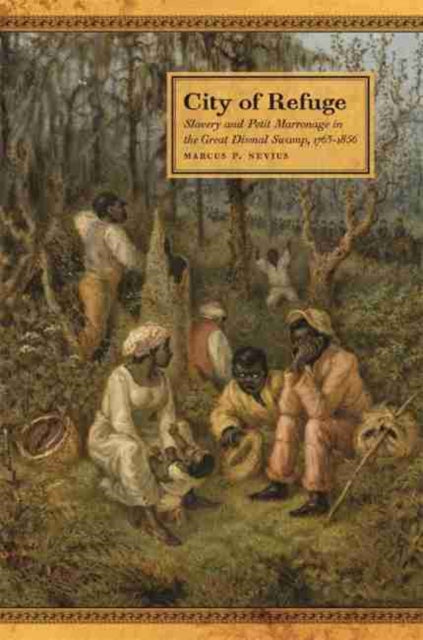
Marcus P. Nevius
City of Refuge: Slavery and Petit Marronage in the Great Dismal Swamp, 1763-1856
City of Refuge: Slavery and Petit Marronage in the Great Dismal Swamp, 1763-1856
💎 Earn 319 Points (£3.19) on this item.
- Condition: Brand new
- UK Delivery times: Usually arrives within 2 - 3 working days
- UK Shipping: Fee starts at £2.39. Subject to product weight & dimension
Bulk ordering. Want 15 or more copies? Get a personalised quote and bigger discounts. Learn more about bulk orders.
Couldn't load pickup availability
- More about City of Refuge: Slavery and Petit Marronage in the Great Dismal Swamp, 1763-1856
City of Refuge is a book that explores the story of petit marronage, an informal slave economy, and the construction of internal improvements in the Great Dismal Swamp of Virginia and North Carolina. It uses a wide range of primary sources to examine how American maroons, enslaved canal laborers, white company agents, and commission merchants shaped, and were shaped by, race and slavery in the region.
Format: Hardback
Length: 168 pages
Publication date: 30 December 2019
Publisher: University of Georgia Press
City of Refuge is a captivating tale that delves into the intricate world of petit marronage, an informal slave economy, and the construction of internal improvements in the vast Great Dismal Swamp of Virginia and North Carolina. This vast wetland, considered inhospitable by most white Virginians and North Carolinians, became a sanctuary for black slaves who sought refuge and freedom. Despite the desolate perception, these slaves ventured into the remote corners of the swamp and engaged in a form of escape and fugitivity known as petit marronage. This practice, prevalent throughout the Atlantic world, offered an alternative to the dangers of flight via the Underground Railroad. Maroon communities, often neighboring slave-labor camps, thrived on the swamp's periphery. These camps, operated by the Dismal Swamp Land Company and other companies that relied on slave labor for resource extraction, provided a haven for black slaves seeking to escape the oppressive conditions of slavery.
In his comprehensive examination of life, commerce, and social activity in the Great Dismal Swamp, Marcus P. Nevius draws upon a rich array of primary sources. These include runaway advertisements, planters' and merchants' records, inventories, letterbooks, and correspondence; abolitionist pamphlets and broadsides; county free black registries; and the records and inventories of private companies. By meticulously analyzing these sources, Nevius sheds light on how American maroons, enslaved canal laborers, white company agents, and commission merchants intertwined and were influenced by race and slavery in this significant region of the late Atlantic world.
Petit marronage, as practiced by black slaves in the Great Dismal Swamp, was a complex and multifaceted phenomenon. It involved a range of activities, including small-scale farming, fishing, and hunting, as well as the production of goods and services for local communities. These maroon communities, often led by skilled individuals known as "maroon leaders," developed their own systems of governance, social organization, and cultural practices. They formed networks with other maroon communities and neighboring free black communities, exchanging goods and provisions to sustain their existence.
One of the key aspects of petit marronage was its relationship with slave-labor camps. While some maroon communities neighbored these camps, others were located in remote areas, far from the prying eyes of white authorities. These maroon communities, with the tacit acceptance of white company agents, engaged in various exchanges of goods and provisions with maroon networks. These exchanges not only padded company accounts but also helped to sustain maroon colonies and communities.
The construction of internal improvements in the Great Dismal Swamp, such as canals and roads, played a significant role in the development of petit marronage and the expansion of slavery in the region. These improvements facilitated the transportation of goods and enslaved people, enabling the growth of plantation agriculture and the exploitation of the swamp's natural resources. However, they also brought about new challenges and dangers for maroon communities, as they were increasingly subjected to the surveillance and control of white authorities.
Nevius' examination of City of Refuge highlights the resilience and ingenuity of black slaves in the face of adversity. It sheds light on the complex web of relationships that existed between maroon communities, slave-labor camps, and white authorities. Through his meticulous research and analysis, Nevius provides a valuable contribution to our understanding of the history of race and slavery in the early American republic.
In conclusion, City of Refuge is a captivating story that delves into the world of petit marronage, an informal slave economy, and the construction of internal improvements in the Great Dismal Swamp. Through the use of a wide variety of primary sources, Marcus P. Nevius provides a comprehensive examination of life, commerce, and social activity in this significant region of the late Atlantic world. His work sheds light on the complex relationships between American maroons, enslaved canal laborers, white company agents, and commission merchants, and highlights the resilience and ingenuity of black slaves in the face of adversity. City of Refuge is a valuable addition to the historiographies of slave resistance and abolitionism in the early American republic.
Weight: 412g
Dimension: 159 x 236 x 18 (mm)
ISBN-13: 9780820356426
UK and International shipping information
UK and International shipping information
UK Delivery and returns information:
- Delivery within 2 - 3 days when ordering in the UK.
- Shipping fee for UK customers from £2.39. Fully tracked shipping service available.
- Returns policy: Return within 30 days of receipt for full refund.
International deliveries:
Shulph Ink now ships to Australia, Belgium, Canada, France, Germany, Ireland, Italy, India, Luxembourg Saudi Arabia, Singapore, Spain, Netherlands, New Zealand, United Arab Emirates, United States of America.
- Delivery times: within 5 - 10 days for international orders.
- Shipping fee: charges vary for overseas orders. Only tracked services are available for most international orders. Some countries have untracked shipping options.
- Customs charges: If ordering to addresses outside the United Kingdom, you may or may not incur additional customs and duties fees during local delivery.