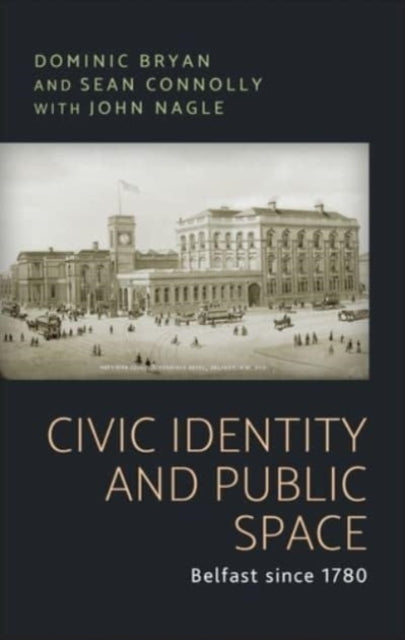
Dominic Bryan,Sean J. Connolly
Civic Identity and Public Space: Belfast Since 1780
Civic Identity and Public Space: Belfast Since 1780
💎 Earn 80 Points (£0.80) on this item.
YOU SAVE £13.93
- Condition: Brand new
- UK Delivery times: Usually arrives within 2 - 3 working days
- UK Shipping: Fee starts at £2.39. Subject to product weight & dimension
Bulk ordering. Want 15 or more copies? Get a personalised quote and bigger discounts. Learn more about bulk orders.
Couldn't load pickup availability
- More about Civic Identity and Public Space: Belfast Since 1780
Civic identity and public space,focussing on Belfast,and bringing together the work of a historian and two social scientists,offers a new perspective on the sometimes lethal conflicts over parades,flags and other issues that continue to disrupt political life in Northern Ireland.
Format: Paperback / softback
Length: 248 pages
Publication date: 15 March 2022
Publisher: Manchester University Press
Civic identity and public space, focusing on Belfast, brings together the work of a historian and two social scientists to offer a fresh perspective on the often deadly conflicts over parades, flags, and other issues that continue to disrupt political life in Northern Ireland. It explores the emergence during the nineteenth century of the concept of public space and the development of new strategies for its regulation, the establishment of a near monopoly of public space enjoyed by Protestants and unionists in the aftermath of the 1920 establishment of a Northern Ireland state, and the breakdown of that monopoly in more recent decades.
Policymakers and politicians are currently grappling with the challenge of devising a strategy for managing public space in a divided city, while also striving to foster a new sense of civic identity that can transcend long-standing sectarian and political divisions. This essay examines the historical and social factors that have contributed to the current state of affairs and proposes potential solutions for promoting greater unity and understanding in Belfast.
The concept of public space has evolved significantly over time, with different societies and cultures defining it in their own unique ways. In Belfast, the public space has been shaped by a complex history of sectarianism, political violence, and social division. During the nineteenth century, the city was divided into Protestant and Catholic neighborhoods, with each community having its own distinct social and cultural practices.
However, the emergence of the Northern Ireland state in 1920 brought about a significant change in the political landscape of the region. The state was established to promote peace and stability in a divided society, and it sought to create a shared public space that would be accessible to all citizens. This was achieved through the creation of a network of public parks, libraries, and other recreational facilities that were open to people of all backgrounds.
Despite these efforts, the emergence of a Northern Ireland state also created new conditions that led to the establishment of a near monopoly of public space enjoyed by Protestants and unionists. This monopoly was facilitated by the political and social divisions that had existed in the region for centuries, and it was reinforced by the policies of the state and the institutions it created. For example, the state-funded education system was designed to promote the Protestant and unionist identity, and it was often taught in schools that were segregated by religion.
Furthermore, the state-owned media and the government's policies towards religious and cultural organizations also contributed to the establishment of a near monopoly of public space enjoyed by Protestants and unionists. For example, the state-owned radio and television stations were often biased towards the Protestant and unionist communities, and the government's policies towards religious and cultural organizations were often discriminatory towards Catholics and other minority groups.
Over time, the monopoly of public space enjoyed by Protestants and unionists began to break down. This was facilitated by a number of factors, including the rise.
The emergence of a new generation of activists and campaigners who were committed to promoting greater equality and social justice in Northern Ireland. These activists and campaigners worked to challenge the dominant narrative of sectarianism and political violence and to promote a new sense of civic identity that would transcend long-standing sectarian and political divisions.
The growth of the civil rights movement in Northern Ireland, which challenged the state's policies towards Catholics and other minority groups and demanded greater equality and social justice.
The increasing globalization of the economy and the rise of new forms of communication and technology, which facilitated the spread of ideas and information and promoted greater social and political engagement among people of all backgrounds.
Despite these efforts, the management of public space in Belfast remains a complex and challenging issue. Policymakers and politicians struggle to devise a strategy that will promote a new sense of civic identity that will transcend long-standing sectarian and political divisions, while also ensuring that public space is safe, accessible, and inclusive for all citizens.
One potential solution to this challenge is the promotion of greater inter-community dialogue and cooperation. This can be achieved through a number of means, including the establishment of community-based organizations and initiatives that bring people from different backgrounds together to discuss and address issues of common interest.
Furthermore, policymakers and politicians can also work to promote greater equality and social justice in Northern Ireland by addressing the underlying causes of sectarianism and political violence. This can be achieved through a number of means, including the implementation of policies that promote social inclusion and economic development, the promotion of human rights.
In conclusion, civic identity and public space, focusing on Belfast, offers a fresh perspective on the often deadly conflicts over parades, flags, and other issues that continue to disrupt political life in Northern Ireland. It explores the emergence during the nineteenth century of the concept of public space and the development of new strategies for its regulation, the establishment of a near monopoly of public space enjoyed by Protestants and unionists in the aftermath of the 1920 establishment of a Northern Ireland state, and the breakdown of that monopoly in more recent decades. Policymakers and politicians are currently grappling with the challenge of devising a strategy for managing public space in a divided city, while also striving to foster a new sense of civic identity that can transcend long-standing sectarian and political divisions. This essay examines the historical and social factors that have contributed to the current state of affairs and proposes potential solutions for promoting greater unity and understanding in Belfast. The concept of public space has evolved significantly over time, with different societies.
Dimension: 234 x 156 (mm)
ISBN-13: 9781526163660
This item can be found in:
UK and International shipping information
UK and International shipping information
UK Delivery and returns information:
- Delivery within 2 - 3 days when ordering in the UK.
- Shipping fee for UK customers from £2.39. Fully tracked shipping service available.
- Returns policy: Return within 30 days of receipt for full refund.
International deliveries:
Shulph Ink now ships to Australia, Belgium, Canada, France, Germany, Ireland, Italy, India, Luxembourg Saudi Arabia, Singapore, Spain, Netherlands, New Zealand, United Arab Emirates, United States of America.
- Delivery times: within 5 - 10 days for international orders.
- Shipping fee: charges vary for overseas orders. Only tracked services are available for most international orders. Some countries have untracked shipping options.
- Customs charges: If ordering to addresses outside the United Kingdom, you may or may not incur additional customs and duties fees during local delivery.